
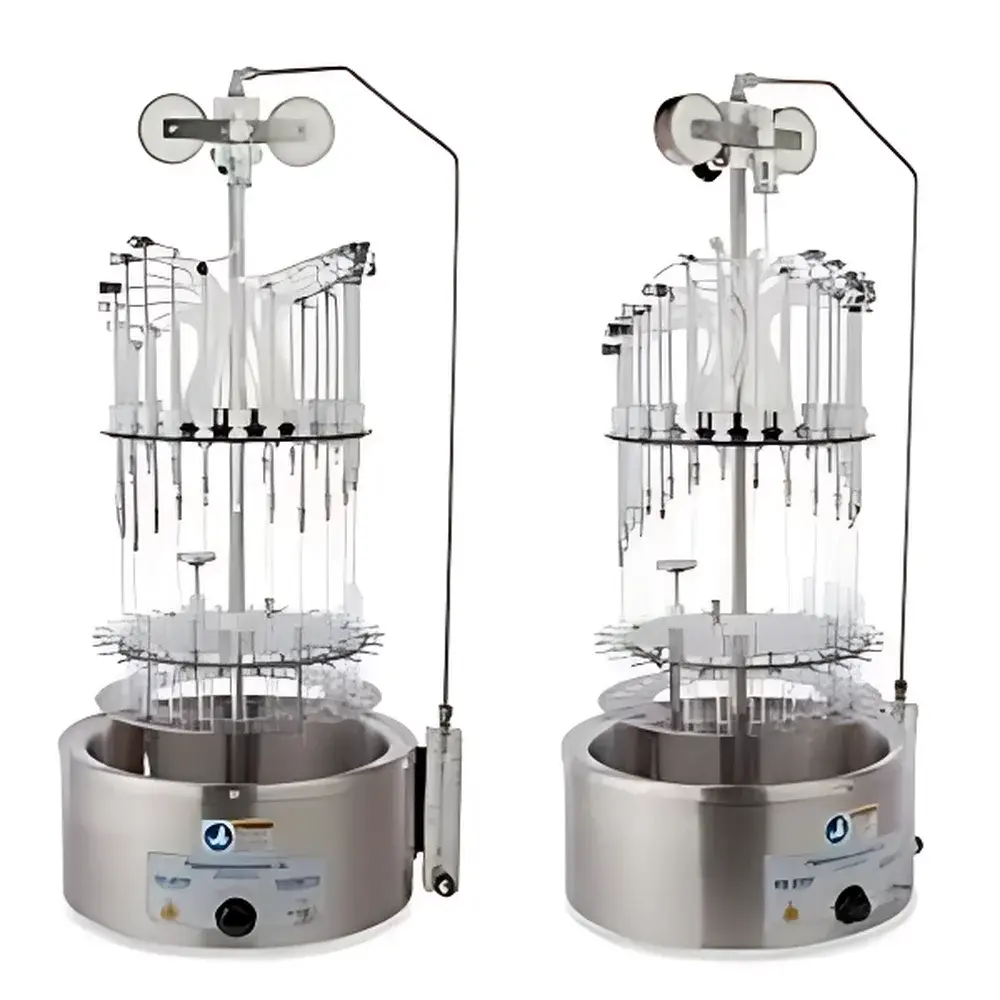
Organomation N-EVAP-24 Water Bath Nitrogen Evaporator
| Brand | Organomation |
|---|---|
| Origin | USA |
| Model | N-EVAP-24 |
| Catalog No. | KL-11250 |
| Heating Method | Water Bath |
| Temperature Range | 30°C–90°C |
| Temperature Stability | ±2°C |
| Sample Tube Diameter | 10–29 mm |
| Gas Flow Rate | 0–10 LPM (330 mL/min per position) |
| Sample Capacity | 24 positions |
| Heating Power | 800 W |
Overview
The Organomation N-EVAP-24 is a precision-engineered water bath nitrogen evaporator designed for reproducible, gentle concentration of multiple liquid samples under controlled thermal and gas-flow conditions. Based on the principle of inert gas-assisted solvent evaporation—where dry, filtered nitrogen (or compressed air) is delivered via adjustable stainless-steel needles directly above sample surfaces—the system enables rapid yet non-turbulent removal of volatile solvents without risk of splashing, bumping, or analyte degradation. Unlike rotary evaporation—which may induce thermal stress or foaming in heat-sensitive matrices—the N-EVAP-24 employs uniform water bath heating (30–90°C) to maintain consistent sample temperature while minimizing localized overheating. Its modular architecture integrates a thermostatically regulated water reservoir, rotating circular sample holder, and independently controllable gas distribution manifold—making it suitable for high-throughput preparation workflows in regulated analytical laboratories.
Key Features
- 24-position circular sample rack with full 360° rotation, enabling ergonomic front-access operation and unobstructed visual monitoring of all samples
- Stainless-steel gas delivery needles (4-inch, 19-gauge), individually replaceable and chemically resistant to common organic solvents and mild acids
- Independent needle-level flow control: each position features a precision needle valve and calibrated flow meter (0–330 mL/min per channel), ensuring method reproducibility across multi-sample runs
- Water bath heating system with digital PID temperature controller; ±2°C stability over full 30–90°C operating range
- Robust construction using laboratory-grade materials—including optional acid-resistant epoxy coating for enhanced corrosion resistance in aggressive environments
- Compact footprint (68 × 48 × 86 cm) optimized for fume hood integration without compromising accessibility or serviceability
- Gas input compatibility: accepts nitrogen or compressed air at 30–150 psig supply pressure; regulated output range: 0–30 psig
Sample Compatibility & Compliance
The N-EVAP-24 accommodates a broad range of container formats, including round-bottom test tubes (10–29 mm OD), conical centrifuge tubes, and small-volume vials (1–50 mL capacity). Its design conforms to widely adopted laboratory safety and operational standards, including ASTM D5845 (for pesticide residue analysis), ISO 17025 requirements for equipment calibration traceability, and USP guidelines for chromatographic sample preparation. When operated with validated SOPs and integrated into a documented quality system, the instrument supports GLP and GMP compliance—particularly when coupled with audit-trail-capable data logging software (see Software & Data Management section). All wetted components are inert to acetonitrile, methanol, chloroform, ethyl acetate, and other common extraction solvents used in environmental, pharmaceutical, and food testing applications.
Software & Data Management
While the N-EVAP-24 operates as a stand-alone benchtop instrument with analog/digital controls, it is fully compatible with external data acquisition systems via RS-232 or optional USB interface modules (sold separately). Integration with LIMS platforms or electronic lab notebooks (ELNs) enables automated timestamping of run parameters—including start/stop times, setpoint temperatures, and gas flow logs—supporting 21 CFR Part 11 compliance when paired with appropriate validation packages and user access controls. Organomation provides comprehensive documentation—including IQ/OQ protocols, material certifications, and maintenance logs—to facilitate internal qualification and regulatory audits.
Applications
This evaporator is routinely deployed across regulated and research-intensive domains requiring precise, parallel sample concentration prior to instrumental analysis. Key use cases include: pesticide residue analysis in fruits, vegetables, tobacco, and cereals (per EPA Method 525.3 and EN 15662); residual solvent quantification in pharmaceutical intermediates (ICH Q3C); determination of polychlorinated dibenzo-p-dioxins (PCDDs) and furans (PCDFs) in environmental matrices; preparation of biological fluids—including plasma, serum, urine, and whole blood—for LC-MS/MS-based biomarker studies; and pre-concentration steps in food safety testing (e.g., mycotoxin analysis in milk and beverages per AOAC 2005.02). Its reliability and repeatability make it a preferred choice among contract testing labs, national reference laboratories, and academic core facilities engaged in method development and validation.
FAQ
What types of gases can be used with the N-EVAP-24?
Nitrogen is recommended for optimal inertness and oxidation prevention; however, compressed air may be substituted where analyte stability permits.
Is the water bath temperature calibrated and traceable to NIST standards?
Yes—each unit ships with a certificate of calibration, and optional annual recalibration services are available through authorized Organomation service centers.
Can the N-EVAP-24 accommodate custom tube racks or alternative vessel geometries?
Standard configurations support 10–29 mm diameter tubes; custom inserts for microcentrifuge tubes or deep-well plates are available upon request.
Does the system include overtemperature or dry-run protection?
The unit features an independent high-limit thermostat that cuts power to the heater if the bath exceeds 95°C, preventing damage during low-water conditions.
How often should the stainless-steel needles be replaced?
Under typical usage with clean solvents, needles require replacement every 6–12 months; frequency increases with abrasive or highly corrosive samples, especially when the optional acid-resistant coating is not selected.



