
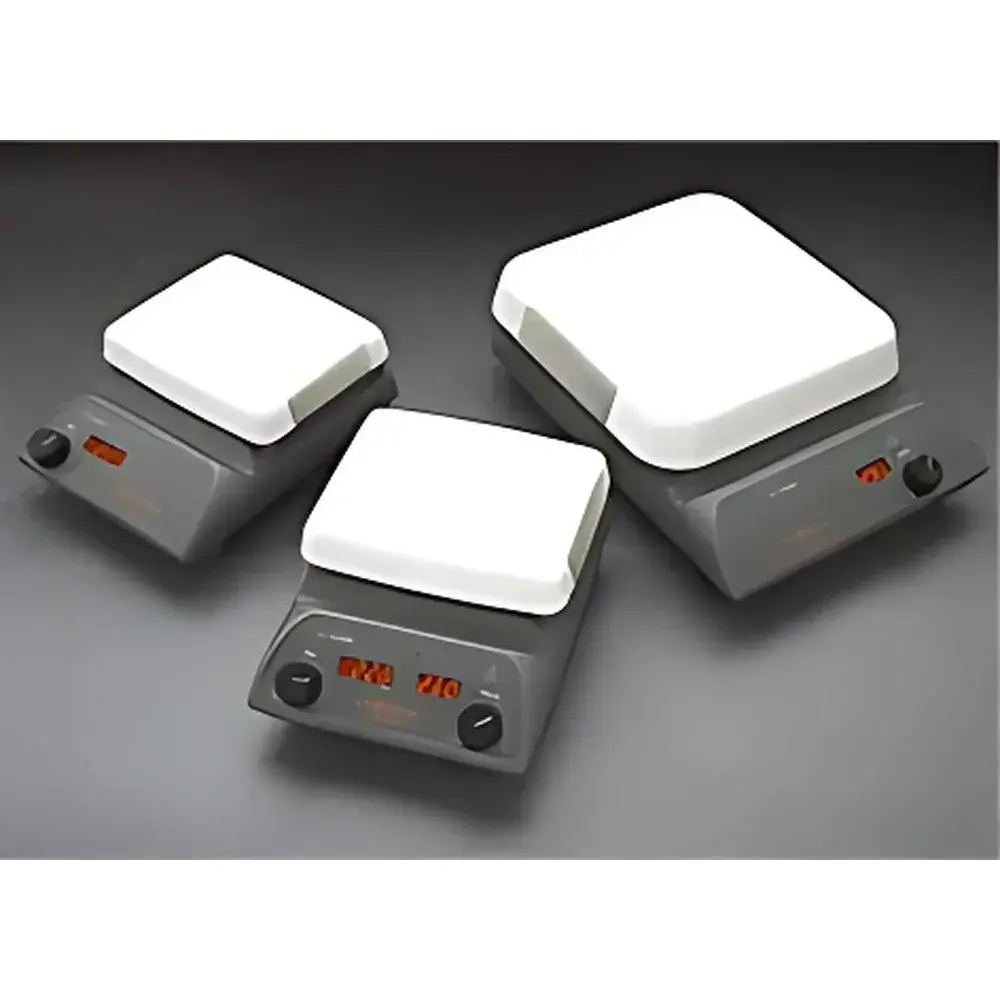
Corning PC-620D Digital Hotplate Stirrer with Pyroceram® Ceramic Top
| Brand | Corning |
|---|---|
| Origin | USA |
| Model | PC-620D |
| Heating Range | 5–550°C (200°C with optional external temperature probe, Cat. No. 6795PR) |
| Top Plate Dimensions | 5" × 7" (226 cm²) or 10" × 10" (645 cm²) |
| Safety Certifications | UL / cUL Listed |
| Height | 4.875" (12.2 cm) |
| Top Surface Material | Pyroceram® glass-ceramic |
| Stirring Function | Motorized magnetic stirring |
| Control System | Microprocessor-based digital control with dual LED displays (temperature & speed) |
| Overheat Protection | Dual-stage — surface overheat indicator (>60°C) and independent thermal cutoff sensor |
| Optional Accessories | External immersion temperature controller (Cat. No. 6795PR), support stand (Cat. No. 440129) |
Overview
The Corning PC-620D Digital Hotplate Stirrer is an integrated benchtop heating and mixing instrument engineered for precision, repeatability, and operational safety in regulated laboratory environments. It combines a high-performance magnetic stirrer with a digitally controlled hotplate featuring a Corning Pyroceram® glass-ceramic top plate — a material renowned for exceptional thermal shock resistance, uniform heat distribution, and chemical inertness. Unlike conventional aluminum or stainless-steel hotplates, the white Pyroceram® surface provides high-contrast visibility for colorimetric reactions and visual endpoint detection, while resisting scratching, corrosion, and degradation from aggressive reagents including strong acids, bases, and organic solvents. The unit operates on a closed-loop microprocessor control architecture that maintains setpoint stability within ±1°C across its full 5–550°C heating range — with extended low-range capability (down to 5°C) enabled by real-time digital feedback. When paired with the optional external temperature probe (Cat. No. 6795PR), the system transitions from surface temperature control to true solution-phase temperature regulation — critical for applications requiring strict thermal compliance per ASTM E29, ISO/IEC 17025, or USP .
Key Features
- Dual digital LED displays showing real-time temperature (°C) and stirring speed (rpm), both adjustable in 1°C and 10 rpm increments respectively
- Pyroceram® glass-ceramic top plate offering superior thermal uniformity (±2°C across surface at 400°C), non-magnetic operation, and Class A chemical resistance per ASTM C652
- Integrated overheat protection: visual LED indicator activates at >60°C surface temperature; independent bimetallic thermal cutoff interrupts power above safe threshold
- Compact low-profile design (12.2 cm height) optimized for fume hood integration or under-cabinet storage; compatible with Corning support stand (Cat. No. 440129) for vertical accessory mounting
- Microprocessor-based PID control ensures minimal overshoot (<3°C) and long-term drift <0.5°C/hour under continuous operation
- UL/cUL listed to ANSI/UL 61010-1 and CAN/CSA C22.2 No. 61010-1 standards for electrical safety in laboratory instrumentation
Sample Compatibility & Compliance
The PC-620D accommodates a broad range of vessel geometries and materials, including borosilicate glass, PTFE-coated beakers, quartz crucibles, and stainless-steel reactors — all without risk of top-plate delamination or thermal warping. Its non-inductive ceramic surface eliminates interference with pH electrodes, conductivity probes, or redox sensors mounted simultaneously via the optional support stand. For GLP/GMP-regulated workflows, the unit supports audit-ready operation when used with the 6795PR external controller, which logs temperature setpoints, actual readings, and deviation alerts — meeting data integrity requirements outlined in FDA 21 CFR Part 11 when paired with compliant LIMS or ELN systems. The device complies with IEC 61326-1 for electromagnetic compatibility in shared lab environments.
Software & Data Management
While the PC-620D operates as a standalone instrument with no native USB or Ethernet interface, its analog-compatible output signals (0–5 V DC proportional to temperature and speed) enable seamless integration with third-party data acquisition systems (e.g., LabVIEW, MATLAB, or PLC-based SCADA). When deployed with the 6795PR controller, analog voltage outputs can be routed to chart recorders or validated DCS platforms for continuous thermal trending. All configuration parameters — including max temperature limit, ramp rate, and hold time — are retained in non-volatile memory during power loss, eliminating recalibration needs after routine shutdowns.
Applications
- Controlled-rate dissolution testing per USP and Ph. Eur. 2.9.3
- Homogenization of viscous polymer solutions prior to rheological characterization
- Preparative synthesis requiring inert-atmosphere heating/stirring (compatible with glovebox integration)
- Standardization of calibration baths for thermometer validation (ASTM E77)
- Accelerated stability studies under isothermal conditions per ICH Q1A(R2)
- Sample conditioning for XRD, FTIR, or DSC analysis where thermal history must be precisely documented
FAQ
Does the PC-620D support external temperature feedback for closed-loop solution control?
Yes — when used with the optional Corning External Temperature Controller (Cat. No. 6795PR), the system regulates based on direct immersion probe input, enabling accurate control of bulk liquid temperature rather than surface temperature.
Is the Pyroceram® top plate resistant to hydrofluoric acid exposure?
No — while highly resistant to most laboratory chemicals, Pyroceram® is susceptible to etching by concentrated hydrofluoric acid and anhydrous fluorides; use quartz or PTFE-lined vessels for such applications.
Can the unit be operated inside a nitrogen-purged glovebox?
Yes — the absence of venting requirements, non-outgassing construction, and low power draw (max 1200 W) make it suitable for inert atmosphere enclosures; confirm electrical feedthrough compatibility with your glovebox manufacturer.
What is the maximum recommended stirring speed for a 4-L beaker at 500°C?
For optimal vortex stability and thermal uniformity, Corning recommends ≤300 rpm with standard PTFE-coated stir bars when operating above 400°C; higher speeds may induce localized cooling or splashing due to reduced fluid viscosity.
Does the PC-620D meet requirements for ISO/IEC 17025 accredited laboratories?
Yes — its traceable calibration capability (via NIST-traceable RTD probe), documented uncertainty budget (<±0.8°C at 200°C), and built-in thermal safety interlocks satisfy Clause 6.4.10 (Equipment Verification) and Clause 6.5.2 (Measurement Uncertainty) of ISO/IEC 17025:2017.



