
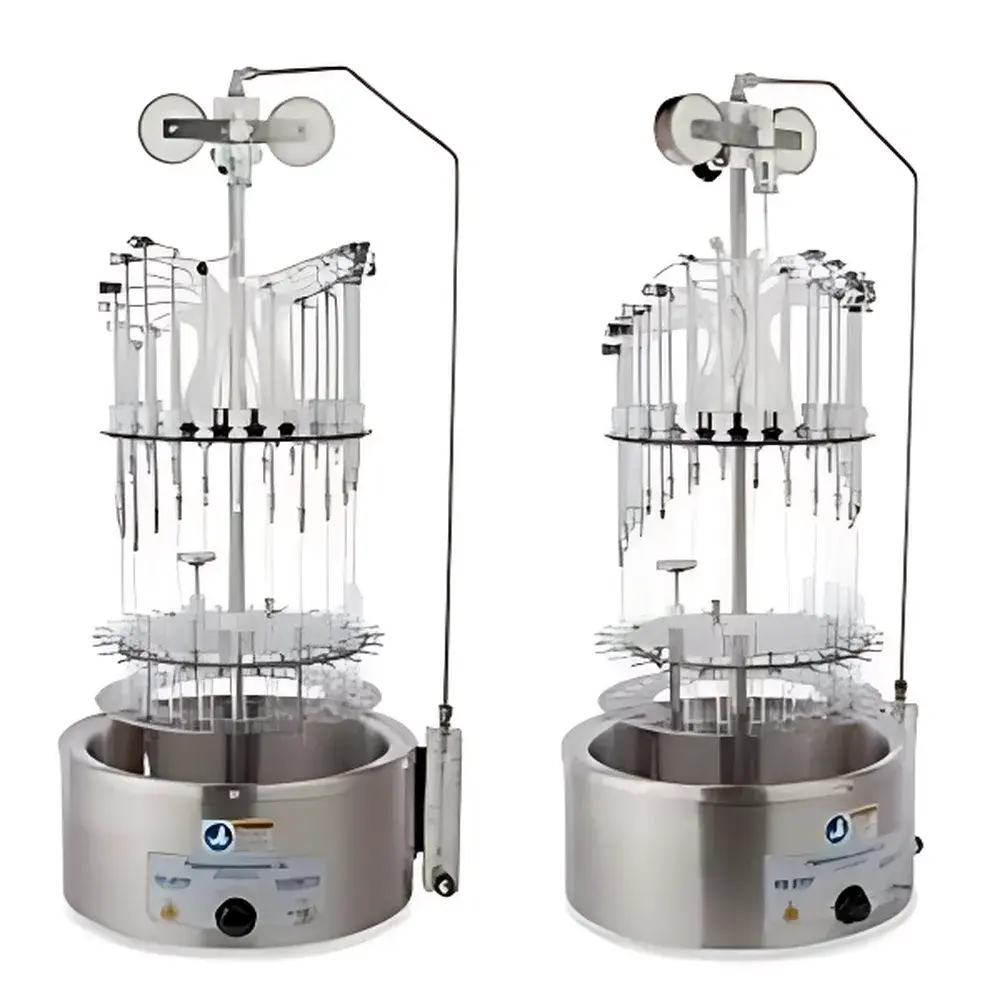
Organomation N-EVAP-24 24-Position Nitrogen Evaporator
| Brand | Organomation |
|---|---|
| Origin | USA |
| Model | N-EVAP-24 |
| Catalog No. | KL-11250-JG |
| Heating Method | Water Bath |
| Temperature Range | 30°C to 90°C |
| Temperature Stability | ±2°C |
| Tube Diameter Compatibility | 10–29 mm |
| Gas Flow Rate | 0–10 LPM (330 mL/min per position) |
| Sample Capacity | 24 positions |
| Heating Power | 800 W |
Overview
The Organomation N-EVAP-24 is a precision-engineered, 24-position nitrogen evaporator designed for reproducible, low-temperature solvent removal in analytical laboratories. It operates on the principle of gentle inert-gas displacement—using controlled nitrogen (or compressed air) flow directed tangentially across the surface of heated liquid samples—to accelerate evaporation without thermal degradation or sample oxidation. Unlike rotary evaporation, which subjects volatile analytes to vacuum-induced boiling and potential bumping, the N-EVAP-24 employs a stabilized water bath heating system combined with individually adjustable gas delivery nozzles, enabling uniform, non-turbulent solvent stripping ideal for trace-level analysis in LC, GC, and LC-MS sample preparation workflows.
Key Features
- 24 independently accessible sample positions arranged in a rotating, front-access configuration—optimized for ergonomic operation and unobstructed visual monitoring during evaporation.
- Stainless steel construction with optional acid-resistant coating; all wetted components are chemically inert to common organic solvents (e.g., acetonitrile, methanol, chloroform, ethyl acetate) and aqueous matrices.
- Precision water bath heating system (30–90°C range) with ±2°C temperature uniformity across the entire bath volume—validated per ASTM E2777-21 for thermal stability in laboratory evaporators.
- Individual needle valve-controlled gas flow regulation per position, calibrated to deliver 0–330 mL/min (330 mL/min per port, up to 10 LPM total), ensuring consistent gas velocity and minimal cross-contamination risk.
- Modular design includes base unit, vertical support column, rotating sample holder, and gas dispersion manifold—all pre-aligned and field-serviceable without tools.
- No internal electronics in the bath zone; electrical isolation between heating element and control circuitry complies with IEC 61010-1 safety standards for laboratory equipment.
Sample Compatibility & Compliance
The N-EVAP-24 accommodates tubes, vials, centrifuge tubes, and conical flasks with outer diameters from 10 mm to 29 mm—including standard 13 × 100 mm, 16 × 100 mm, and 18 × 150 mm formats. Its open architecture supports direct integration with automated liquid handlers and robotic arms when mounted on lab benches with ≥60 cm clearance. The instrument meets ISO/IEC 17025 requirements for equipment qualification in accredited testing labs and is routinely deployed in GLP-compliant residue analysis (e.g., EPA Method 525.3, AOAC 2007.01) and pharmaceutical stability studies (ICH Q5C). All materials comply with USP Class VI biocompatibility standards for indirect food contact and clinical sample handling.
Software & Data Management
While the N-EVAP-24 operates as a stand-alone analog instrument (no embedded microprocessor or digital display), its mechanical design supports full traceability in regulated environments. Optional third-party data loggers (e.g., Omega OM-DAQPRO-5300) can interface via PT100 probe outputs to record bath temperature at 1-second intervals. Gas flow is manually verified using the integrated rotameter scale and documented in lab notebooks per FDA 21 CFR Part 11 Annex 11 guidance for non-electronic systems. Calibration certificates (temperature and flow) are provided with each unit and recommended annually per manufacturer’s maintenance protocol.
Applications
- Residue & Pesticide Analysis: Concentration of extracts from tobacco, fruits, vegetables, cereals, and plant tissues prior to GC-ECD or LC-MS/MS quantification (aligned with EN 15662:2018).
- Pharmaceutical QC/QA: Solvent exchange and final concentration of API solutions, impurity standards, and dissolution media in accordance with USP & Ph. Eur. general chapters and .
- Environmental Testing: Pre-concentration of VOCs, SVOCs, and PAHs from drinking water, groundwater, and wastewater per EPA Methods 8260D, 8270E, and 1613B.
- Clinical & Forensic Toxicology: Preparation of plasma, serum, urine, and whole blood extracts for targeted metabolite screening under CLIA and CAP accreditation frameworks.
- Food Safety Monitoring: Cleanup and concentration steps in dioxin, furan, PCB, and mycotoxin analyses (EU Regulation 1881/2006, 2017/644).
FAQ
Is the N-EVAP-24 compatible with corrosive solvents such as hydrochloric acid or trifluoroacetic acid?
Yes—when specified with the optional acid-resistant epoxy-polyester coating, the stainless steel frame and gas manifolds resist degradation from low-concentration acidic vapors encountered during derivatization workflows.
Can I use compressed air instead of nitrogen?
Yes—the system accepts clean, oil-free, particle-filtered compressed air (dew point ≤ −40°C) as an alternative carrier gas; however, nitrogen is strongly recommended for oxygen-sensitive analytes (e.g., catecholamines, unsaturated lipids).
What is the recommended maintenance interval?
Annual calibration of bath temperature uniformity and gas flow verification is advised. Daily cleaning of needle tips with methanol and periodic descaling of the water bath (using 10% citric acid solution) ensures long-term performance.
Does the unit include a water level sensor or auto-shutoff?
No—this is a deliberate design choice to eliminate electronic failure points in humid environments; users must monitor bath volume manually per SOPs aligned with ISO/IEC 17025 Clause 6.4.2.
Is the N-EVAP-24 suitable for GMP-regulated environments?
Yes—its mechanical simplicity, material traceability (full RoHS/REACH documentation available), and compatibility with IQ/OQ/PQ validation protocols make it widely adopted in pharmaceutical manufacturing and contract research labs operating under EU GMP Annex 11 and FDA guidance.



