
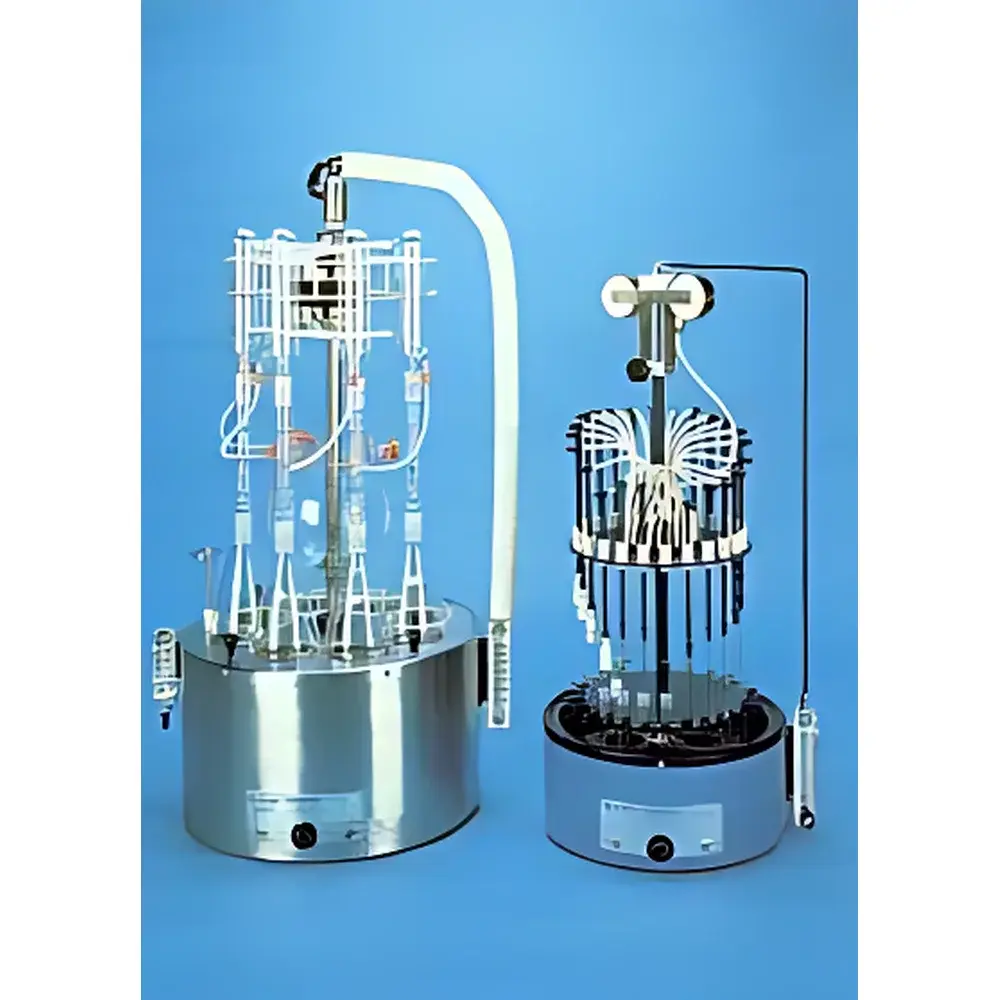
Organomation N-EVAP, S-EVAP & MULTIVAP Series Nitrogen Evaporators
| Brand | Organomation |
|---|---|
| Origin | USA |
| Product Line | N-EVAP / S-EVAP / MULTIVAP |
| Sample Capacity | 6–100 positions |
| Gas Medium | Nitrogen or compressed air |
| Heating Method | Precision water bath (S-EVAP: boiling solvent evaporation) |
| Solvent Recovery Rate | Up to 98% (S-EVAP model) |
| Gas Flow Control | Individual needle valve + flow meter (330 mL/min per sample) |
| Compatibility | Test tubes, centrifuge tubes, conical flasks |
| Construction | Laboratory-grade corrosion-resistant materials |
| Compliance | Designed for GLP-compliant sample preparation workflows in regulated environments |
Overview
Organomation N-EVAP, S-EVAP, and MULTIVAP Series nitrogen evaporators are precision-engineered instruments for controlled, parallel sample concentration in analytical laboratories. These systems operate on the principle of gentle inert gas displacement—introducing a stream of nitrogen (or compressed air) across the surface of heated liquid samples to accelerate solvent evaporation while minimizing analyte degradation, oxidation, or cross-contamination. Unlike vacuum-based concentrators, nitrogen blow-down systems maintain atmospheric pressure, enabling stable temperature control via calibrated water baths and eliminating foaming or bumping in volatile or viscous matrices. The N-EVAP series emphasizes flexibility for small- to medium-scale workflows; the S-EVAP series is specifically configured for high-volume solvent recovery (50–800 mL → 0–5 mL) with integrated reflux and condensation management; and the MULTIVAP platform delivers high-throughput batch processing in rectangular format—optimized for pharmaceutical QC, clinical toxicology, environmental testing, and omics sample prep where reproducibility and traceability are critical.
Key Features
- Modular configuration supporting 6 to 100 simultaneous sample positions—scalable from benchtop research to production-level labs
- Rotatable sample rack design enables unobstructed front-access to all vessels, reducing handling time and improving ergonomics during tube insertion/removal
- Individual needle-valve gas regulators with calibrated flow meters (330 mL/min per channel, ±5% accuracy) ensure precise, repeatable gas delivery—critical for method validation and inter-laboratory comparability
- Temperature-controlled water bath heating (N-EVAP/S-EVAP) provides uniform thermal energy transfer without hotspots; S-EVAP models support controlled boiling for rapid bulk solvent removal
- Chemically resistant construction: stainless steel frames, PTFE-coated gas manifolds, and optionally acid-resistant epoxy-painted surfaces for extended service life in aggressive solvent environments (e.g., TFA, HCl in LC-MS prep)
- Gas dispersion system engineered to minimize turbulence and splashing—preserving low-abundance analytes and preventing sample loss during final concentration stages
Sample Compatibility & Compliance
These evaporators accommodate standard laboratory glassware and plastic consumables including 10–100 mL test tubes, 15–50 mL conical centrifuge tubes, and round-bottom flasks. Vessel height adjustability (up to 200 mm) ensures optimal gas nozzle positioning relative to meniscus level across diverse container geometries. All models are designed in alignment with Good Laboratory Practice (GLP) and Good Manufacturing Practice (GMP) frameworks: full traceability of gas flow settings, no firmware-based automation that would require 21 CFR Part 11 validation, and mechanical simplicity supporting routine IQ/OQ/PQ protocols. While not certified as medical devices, MULTIVAP systems are routinely deployed in CLIA-certified clinical labs for urine drug screening and therapeutic drug monitoring sample prep per CAP-accredited SOPs.
Software & Data Management
The Organomation nitrogen evaporator series operates as a standalone hardware platform with no embedded software or digital interface—deliberately omitting microprocessor controls to maximize reliability, reduce calibration drift risk, and simplify regulatory documentation. All operational parameters (water bath temperature, gas flow rate per channel, run duration) are recorded manually or integrated into LIMS via external loggers. This analog-first architecture eliminates cybersecurity vulnerabilities and avoids complex electronic record validation burdens under FDA 21 CFR Part 11. For labs requiring audit trails, third-party temperature data loggers (e.g., Omega OM-DAQPRO-5300) can be paired with the water bath; gas flow consistency is verified using calibrated rotameters traceable to NIST standards.
Applications
- Preparative cleanup prior to GC, GC-MS, LC, and LC-MS/MS analysis—including pesticide residue testing (AOAC 2007.01), PAH quantification (EPA 8270), and steroid profiling in serum
- High-throughput residual solvent testing in API manufacturing per ICH Q3C guidelines
- Concentration of metabolite extracts from cell culture media or tissue homogenates in metabolomics studies
- Environmental water analysis (EPA 525.3, 8081B) requiring recovery of ng/L-level organochlorines and trihalomethanes
- Forensic toxicology workflows involving blood, urine, and hair digestates—where analyte stability and minimal carryover are non-negotiable
FAQ
What is the maximum recommended operating temperature for the water bath?
The standard water bath is rated for continuous operation up to 99 °C; however, for optimal analyte integrity in sensitive applications (e.g., thermolabile drugs), most protocols specify 30–60 °C.
Can I use compressed air instead of nitrogen?
Yes—air is acceptable for non-oxidizable analytes; however, nitrogen is strongly recommended for unsaturated lipids, catecholamines, or compounds prone to autoxidation.
Is the MULTIVAP system compatible with 96-well plate formats?
No—the MULTIVAP accommodates individual tubes only; it does not support microtiter plates. For plate-based evaporation, alternative platforms such as robotic nitrogen concentrators with plate-handling modules are advised.
How often should the gas distribution manifold be cleaned?
Inspect and clean quarterly using isopropanol and lint-free wipes; more frequently if used with high-salt or protein-rich matrices to prevent nozzle clogging.
Does Organomation provide installation qualification (IQ) documentation?
Yes—factory-issued IQ templates and component traceability sheets are supplied with each unit, supporting user-defined OQ execution per ISO/IEC 17025 or ASTM E2500.



