
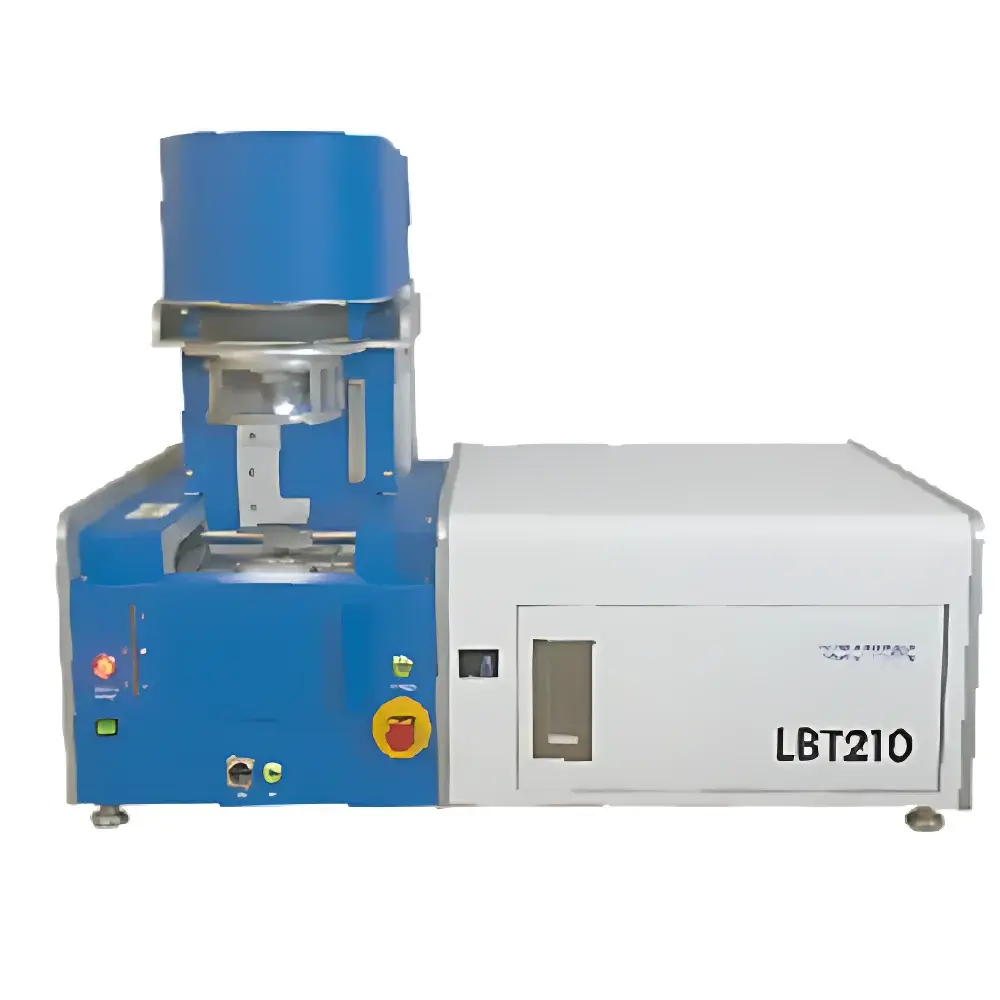
Microtronic LBT-210 Automated Solderability Testing System
| Brand | Microtronic |
|---|---|
| Origin | USA |
| Model | LBT-210 |
| Test Methods | Solder Bath, Solder Ball, Solder Paste Reflow Simulation |
| Positioning Accuracy | < 5 µm |
| Force Resolution | Sub-milligram |
| Preheat Control | Dynamic Range with Auto-Amplification |
| Bath Surface Detection | Contactless Laser Sensor |
| Data Storage | SQL Database with Audit Trail |
| Compliance | CE, EN 61000-6-2/6-4, IEC 61326-1 |
| Software Languages | English, German, French (customizable) |
| Safety | Integrated E-Stop, Dual-Channel Safety Circuit |
Overview
The Microtronic LBT-210 Automated Solderability Testing System is an ISO/IEC 17025-aligned instrumentation platform engineered for quantitative assessment of solder wetting behavior in electronic interconnects. It operates on the fundamental principle of dynamic wetting force measurement—capturing real-time force vs. time profiles as a test specimen is immersed into molten solder (bath method), contacted by calibrated solder spheres (ball method), or subjected to reflow-compatible thermal profiles with solder paste (paste reflow simulation). Unlike static visual inspection or qualitative dip-and-look approaches, the LBT-210 delivers traceable, repeatable force-derived metrics—including wetting onset time, maximum wetting force, wetting angle approximation, and dewetting kinetics—enabling objective pass/fail criteria per IPC-J-STD-002, IPC-J-STD-003, and JEDEC J-STD-020. Its closed-loop servo-controlled immersion mechanism, coupled with laser-tracked bath surface referencing, eliminates mechanical drift and ensures sub-5 µm positional fidelity across thermal transients.
Key Features
- Triple-mode testing architecture: fully automated solder bath immersion (with programmable scraper for dross removal), standardized solder ball contact (1–4 mm spheres, ASTM B117-compliant handling), and production-representative solder paste reflow simulation using actual PCB temperature profiles.
- High-fidelity force transduction: microgram-level resolution load cell integrated with vibration-damped, brushless DC servo positioning system—optimized for low-noise signal acquisition during rapid thermal transitions.
- Laser-based bath surface tracking: non-contact triangulation sensor continuously monitors solder meniscus height, enabling real-time Z-axis compensation and eliminating manual bath level calibration.
- Comprehensive thermal management: independent preheat zone with dynamic range control and auto-amplification logic ensures precise ramp-soak-reflow profile replication—even for thermally heterogeneous components (e.g., large BGAs, mixed-technology boards).
- Integrated video capture synchronized to force/temperature/time data streams—enabling forensic analysis of wetting front propagation, flux activation timing, and defect nucleation events.
- CE-marked safety architecture: dual-channel emergency stop, redundant thermal cutoffs, and electromagnetic compatibility certified to EN 61000-6-2 (immunity) and EN 61000-6-4 (emissions).
Sample Compatibility & Compliance
The LBT-210 accommodates standard industry sample formats without modification: discrete passive/active components (0201 to 36 mm QFN), leaded and leadless packages (SOIC, QFP, LGA, CSP), bare PCB coupons (IPC TM-650 2.4.1 compliant), and populated substrates up to 200 × 150 mm. All test methods align with IPC-A-610 acceptance criteria and support GLP/GMP documentation workflows. Raw force-time datasets are stored in a relational SQL database with full audit trail (user ID, timestamp, parameter set, calibration status), satisfying FDA 21 CFR Part 11 requirements for electronic records when configured with role-based access control and digital signature modules. Test reports include metadata traceable to NIST-traceable force and temperature calibrations.
Software & Data Management
The LBT-210 Control Suite (v5.x) provides deterministic real-time acquisition at 1 kHz sampling rate, with embedded statistical process control (SPC) tools—including X-bar/R charts, capability indices (Cp/Cpk), and trend analysis across batches. Data export supports CSV (for Excel/Minitab), XML (for LIMS integration), and PNG/SVG vector graphics of force-temperature curves. The central database enables cross-lot comparison, root cause analysis via parametric filtering (e.g., “all QFN-48 parts tested with SAC305 paste at peak 245°C”), and automated report generation compliant with ISO 9001 clause 8.2.3. Language localization includes English, German, and French UIs; additional languages (Japanese, Korean, Simplified Chinese) are available via certified translation packs validated against IPC terminology standards.
Applications
- Component qualification per IPC-J-STD-002D: evaluation of terminal metallization integrity, oxide layer stability, and flux compatibility across storage aging conditions (dry pack, MSL exposure).
- PCB finish validation: comparative wetting performance of ENIG, Immersion Silver, OSP, and ENEPIG surfaces under identical thermal profiles.
- Solder paste process window development: empirical determination of optimal reflow parameters (soak time, peak temperature, cooling rate) for new alloys or no-clean flux chemistries.
- Flux activity quantification: derivation of activation energy thresholds and residue corrosivity indices from dewetting force decay rates.
- Adhesive bondline characterization: optional tack-force and shear-wetting modules for conductive/non-conductive die attach materials.
FAQ
What standards does the LBT-210 support for compliance reporting?
It natively generates reports aligned with IPC-J-STD-002D, IPC-J-STD-003C, and JEDEC J-STD-020D. Optional modules extend coverage to MIL-STD-883 Method 2003.5 and NASA-SSP 30238.
Can the system validate lead-free and high-reliability solder alloys (e.g., SnAgCu, AuSn, In-based)?
Yes—the bath temperature range spans 150–450°C with ±0.5°C stability, and the force sensor is calibrated across the full operational spectrum for alloys with varying surface tension and viscosity profiles.
Is remote monitoring and multi-site data aggregation supported?
Via optional LBT-Cloud Gateway, raw datasets and summary statistics can be transmitted to centralized analytics platforms using TLS 1.2–encrypted MQTT or HTTPS protocols, supporting enterprise-wide SPC deployment.
How is calibration maintained across extended operation?
The system performs automated self-checks prior to each test sequence, including zero-force verification and reference weight validation. Full metrological calibration (force, temperature, position) follows ISO/IEC 17025 procedures with annual NIST-traceable certificate issuance.
Does the software support custom pass/fail logic beyond IPC thresholds?
Yes—users define conditional rules using Boolean operators (e.g., “(Max Wetting Force > 8.2 mN) AND (Wetting Onset < 1.4 s) AND (Dewetting Slope < −0.03 mN/s)”) with configurable alerting and escalation workflows.



