
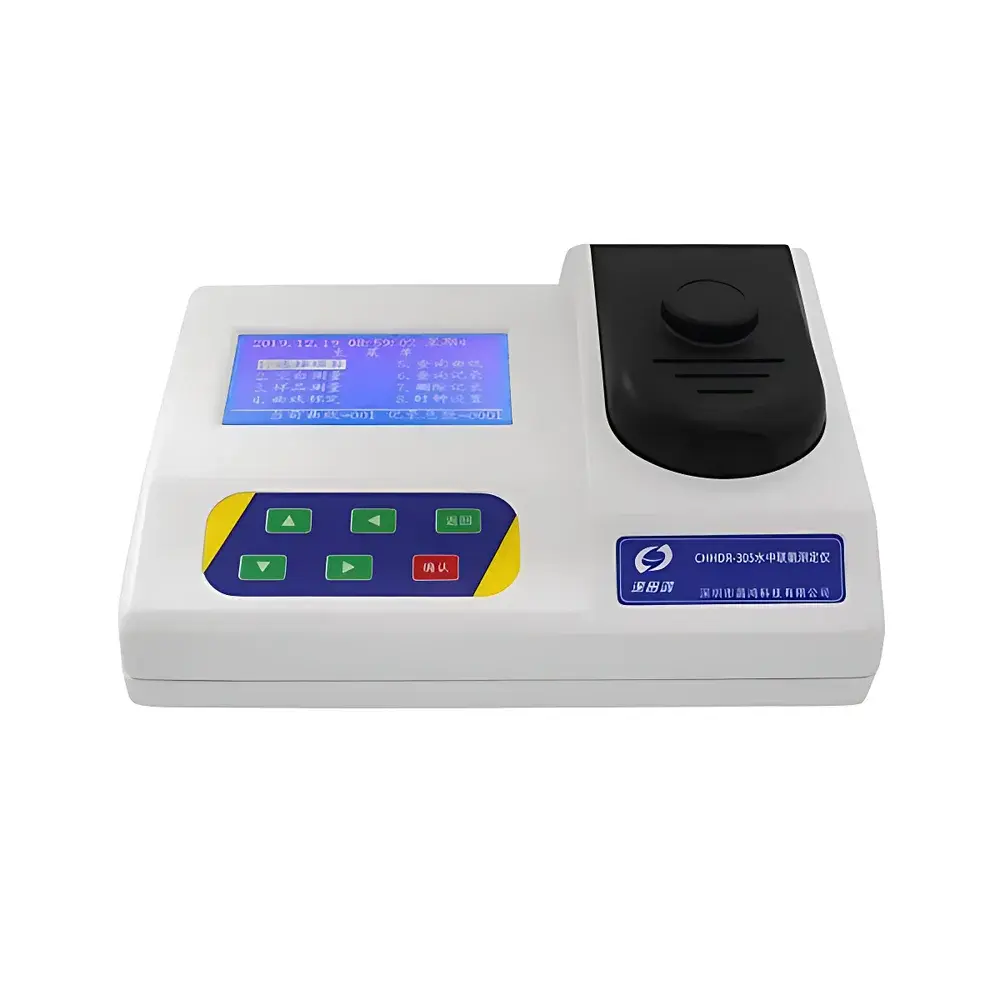
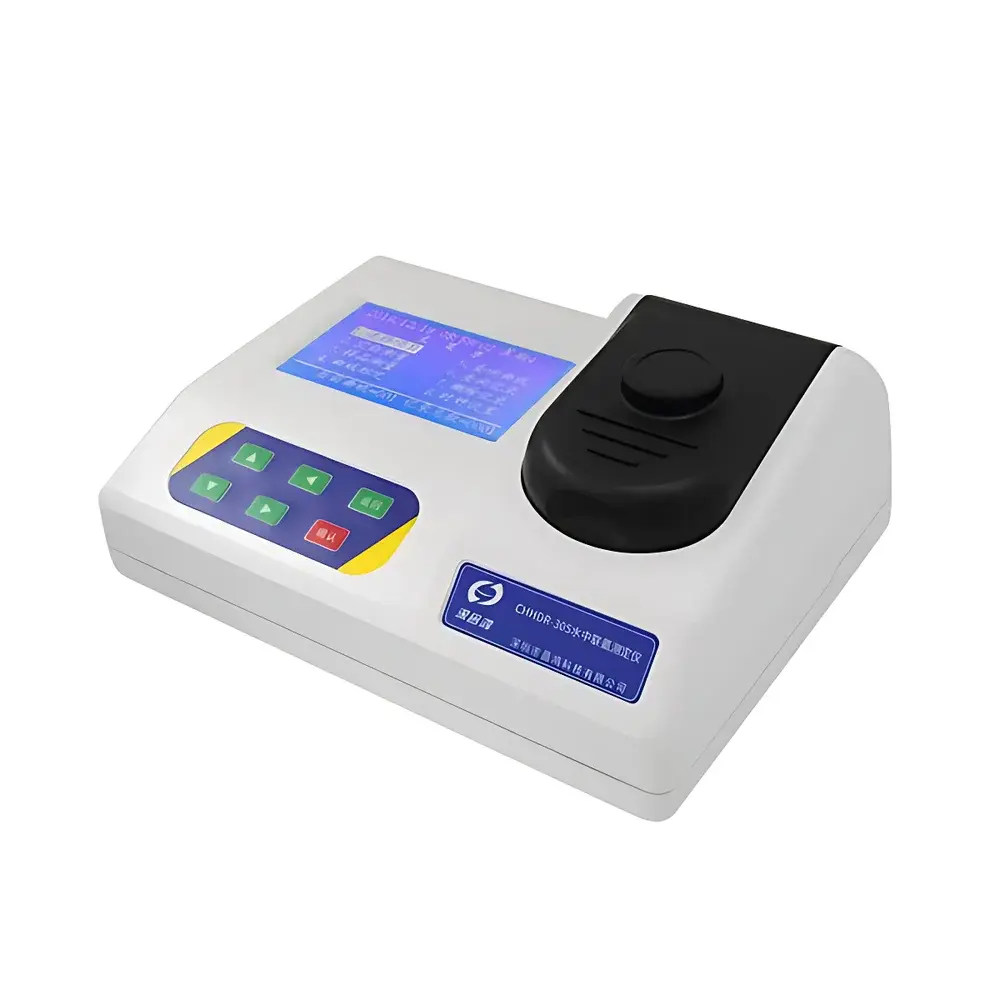
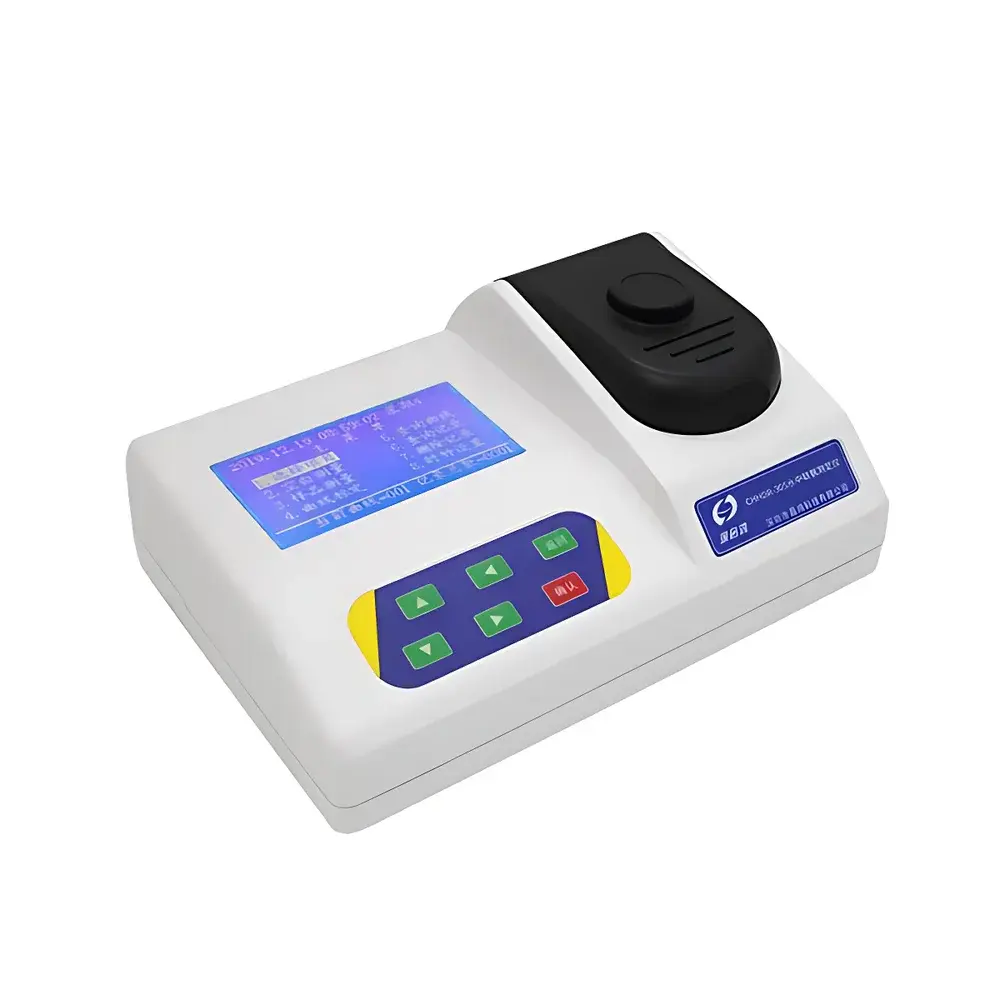
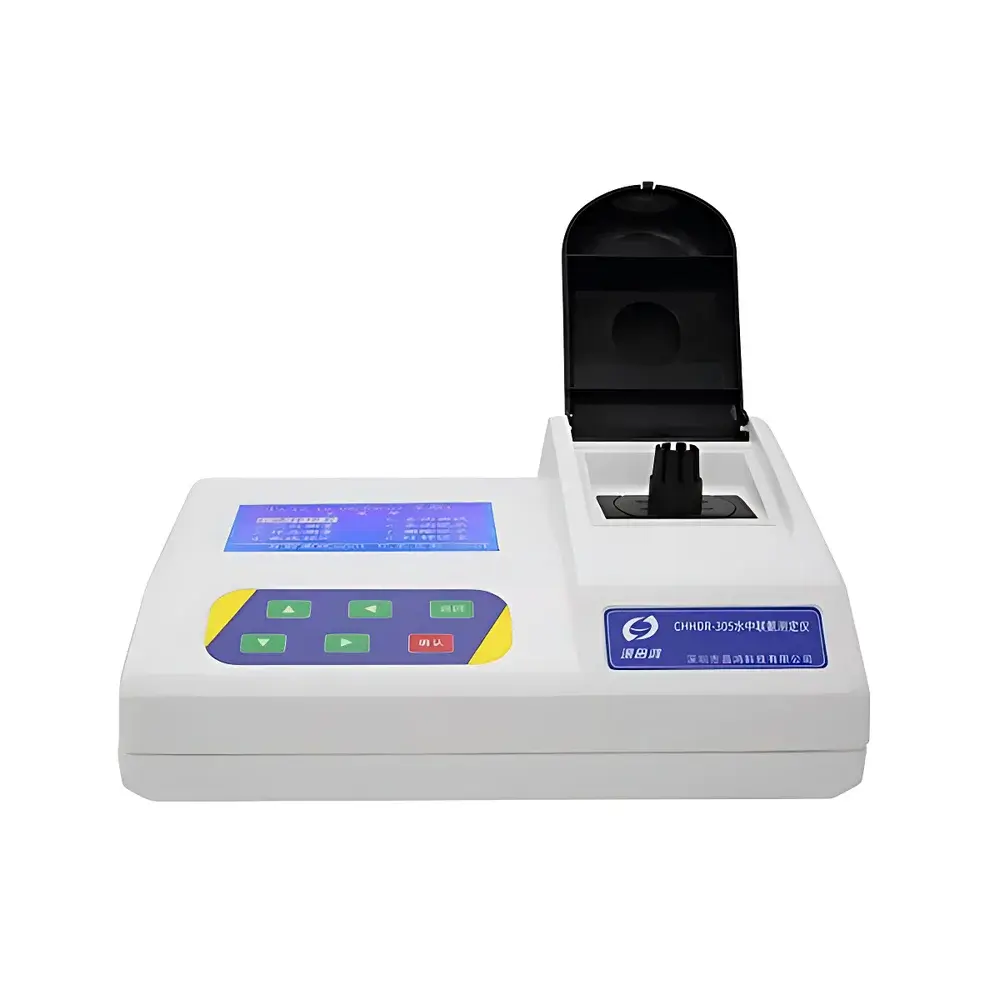
Shenchanghong CHHDR-305 Hydrazine in Water Analyzer
| Brand | Shenchanghong |
|---|---|
| Model | CHHDR-305 |
| Measurement Range | 0.01–0.50 mg/L (dilution applicable) |
| Resolution | 0.01 mg/L |
| Accuracy | ≤5% of full scale |
| Repeatability | ≤3% |
| Optical Stability | ≤0.002 A/20 min |
| Dimensions (H×W×D) | 130 mm × 266 mm × 200 mm |
| Power Consumption | 30 W |
| Weight | <1 kg |
| Light Source | High-brightness monochromatic cold LED (100,000 h lifetime) |
| Filter System | Narrow-band optical interference filter |
| Display | LCD with Chinese menu interface |
| Data Storage | Onboard memory for measurement records |
| Calibration | Factory-preloaded calibration curve + user-definable curve |
| Housing Material | Corrosion-resistant ABS polymer |
| Microcontroller | 16-bit low-power MCU |
| Application | Laboratory-based hydrazine quantification in aqueous matrices |
Overview
The Shenchanghong CHHDR-305 Hydrazine in Water Analyzer is a dedicated benchtop photometric instrument engineered for the precise, routine quantification of hydrazine (N2H4) in water samples using the colorimetric p-dimethylaminobenzaldehyde (p-DMAB) method. Hydrazine—widely used as an oxygen scavenger in high-pressure boiler feedwater systems and as a precursor in pharmaceutical and aerospace applications—poses significant health and environmental risks at trace concentrations. Regulatory limits (e.g., US EPA Method 351.2, ISO 7890-2, and China’s HJ 537–2009) require reliable detection down to 0.01 mg/L. The CHHDR-305 employs a stable, long-life monochromatic cold LED light source coupled with a narrow-band optical filter system to minimize spectral interference from turbidity, colored organics, or ambient light—ensuring high photometric fidelity across diverse sample matrices including potable water, surface water, groundwater, municipal wastewater, and industrial effluents.
Key Features
- Optical architecture optimized for hydrazine-specific absorbance at 455 nm, delivering high signal-to-noise ratio and minimal baseline drift (optical stability ≤0.002 A over 20 minutes).
- Integrated 16-bit low-power microcontroller enabling real-time data processing, automatic zeroing, and linear/nonlinear curve fitting for both factory-provided and user-defined calibration functions.
- Large-backlit LCD display with native Chinese menu navigation—designed for intuitive operation by laboratory technicians without advanced programming training.
- Durable housing constructed from injection-molded ABS polymer, providing resistance to common laboratory reagents, humidity, and mechanical impact.
- Onboard data storage supports retention of up to 500 measurement records with timestamp and sample ID fields—facilitating internal QA/QC traceability.
- Energy-efficient design (30 W max power draw) compliant with IEC 61000-3-2 harmonic emission standards for laboratory equipment.
Sample Compatibility & Compliance
The CHHDR-305 is validated for use with clarified, non-turbid aqueous samples. For samples exceeding 0.50 mg/L hydrazine, standardized dilution protocols (e.g., 1:10 or 1:100 with deionized water) are supported per ISO/IEC 17025 clause 7.7 on result validation. Interference testing confirms robustness against common co-analytes including residual chlorine (<2 mg/L), nitrite (<1 mg/L), and dissolved iron (<0.5 mg/L). While not certified to GLP or FDA 21 CFR Part 11 out-of-the-box, the instrument’s deterministic firmware, audit-ready calibration logs, and non-volatile memory align with foundational requirements for regulated environments when deployed within documented SOPs. It meets the performance criteria outlined in China’s HJ 537–2009 “Water Quality – Determination of Hydrazine – p-Dimethylaminobenzaldehyde Spectrophotometric Method” and serves as a functional equivalent to ASTM D3868–18 for hydrazine screening in industrial water treatment.
Software & Data Management
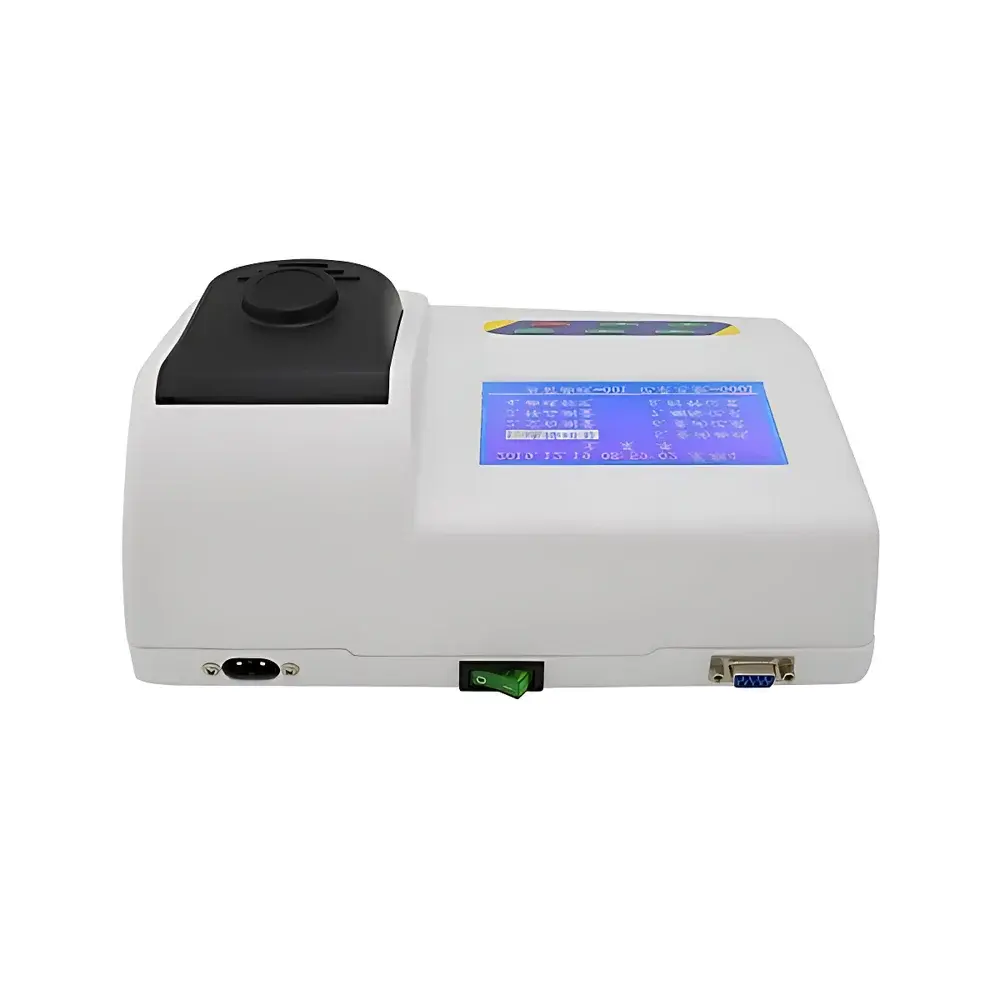
No external software driver or PC connection is required for basic operation. All calibration, measurement, and data recall functions execute autonomously via the embedded firmware. Users may store one factory-default calibration curve and up to two additional user-defined curves—each with up to 12 point-pairs—to accommodate matrix-matched standards or method modifications. Measurement results include concentration value (mg/L), date/time stamp, and optional sample identifier input. Data export is manual via visual transcription; for laboratories requiring electronic data interchange, integration with LIMS is achievable through optional RS-232 serial output (available upon request with firmware version ≥V2.3). All stored parameters persist during power cycling, and firmware updates are performed via secure USB interface under controlled service conditions.
Applications
- Monitoring hydrazine residuals in high-purity boiler feedwater circuits to prevent corrosion and ensure ASME B31.1 compliance.
- Environmental compliance testing of effluent discharge permits where hydrazine is listed as a priority pollutant (e.g., NPDES permits).
- Quality control of hydrazine-containing process streams in chemical synthesis and catalyst manufacturing.
- Educational laboratories conducting water chemistry experiments involving redox titrants and nitrogen-cycle analytes.
- Field-deployable lab verification for portable hydrazine test kits—used as a reference standard during method validation studies.
FAQ
What is the detection principle used by the CHHDR-305?
It applies the p-dimethylaminobenzaldehyde (p-DMAB) derivatization reaction, forming a yellow azine complex measurable at 455 nm via fixed-wavelength photometry.
Can the instrument measure hydrazine in seawater or high-salinity samples?
Direct analysis is not recommended due to chloride-induced interference; pre-treatment (e.g., ion exchange or distillation) is required per HJ 537–2009 Annex B.
Is the calibration curve linear across the full range?
The instrument supports both linear and quadratic curve fitting; linearity (R² ≥ 0.999) is typically achieved from 0.02–0.40 mg/L using certified reference standards.
How often must the optical system be recalibrated?
No routine optical recalibration is needed; annual verification against NIST-traceable hydrazine standards is recommended for ISO/IEC 17025 conformance.
Does the device comply with international electrical safety standards?
Yes—it conforms to GB 4793.1–2007 (equivalent to IEC 61010-1:2010) for laboratory electrical equipment safety, including dielectric strength and leakage current limits.
Related Products







