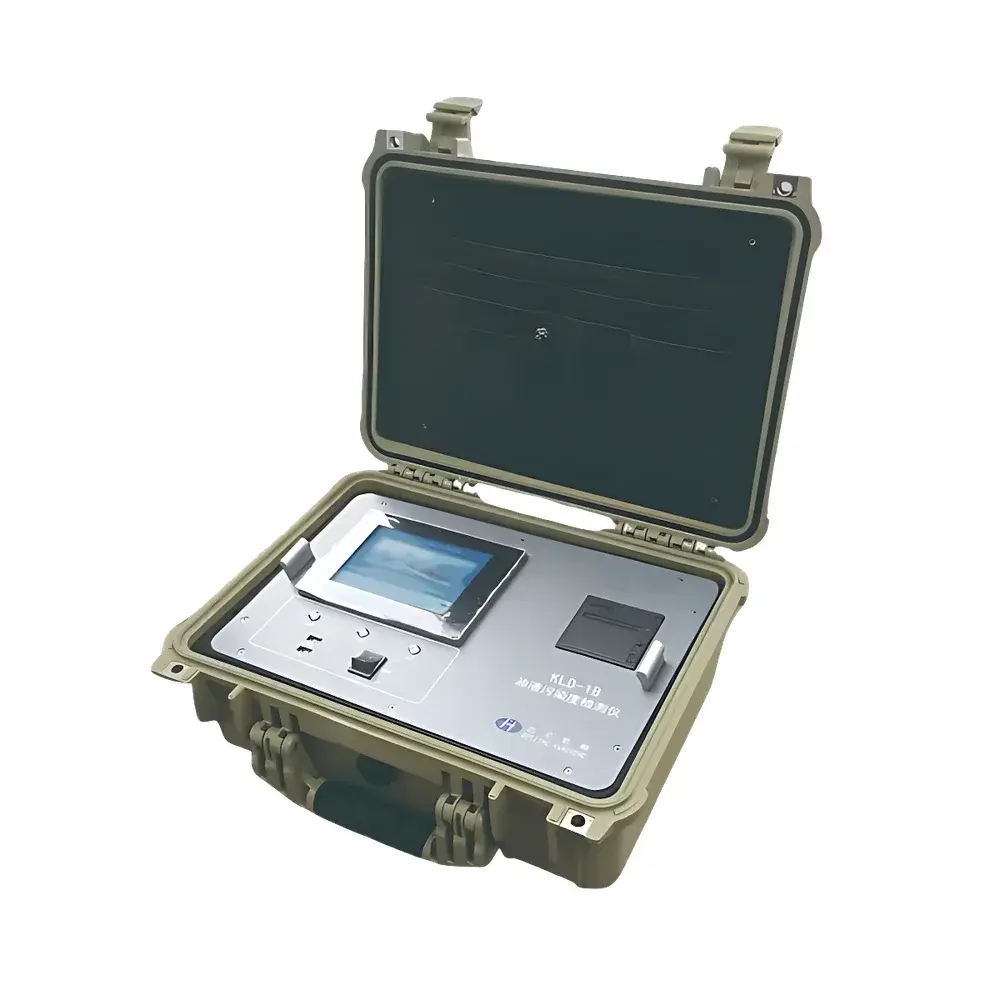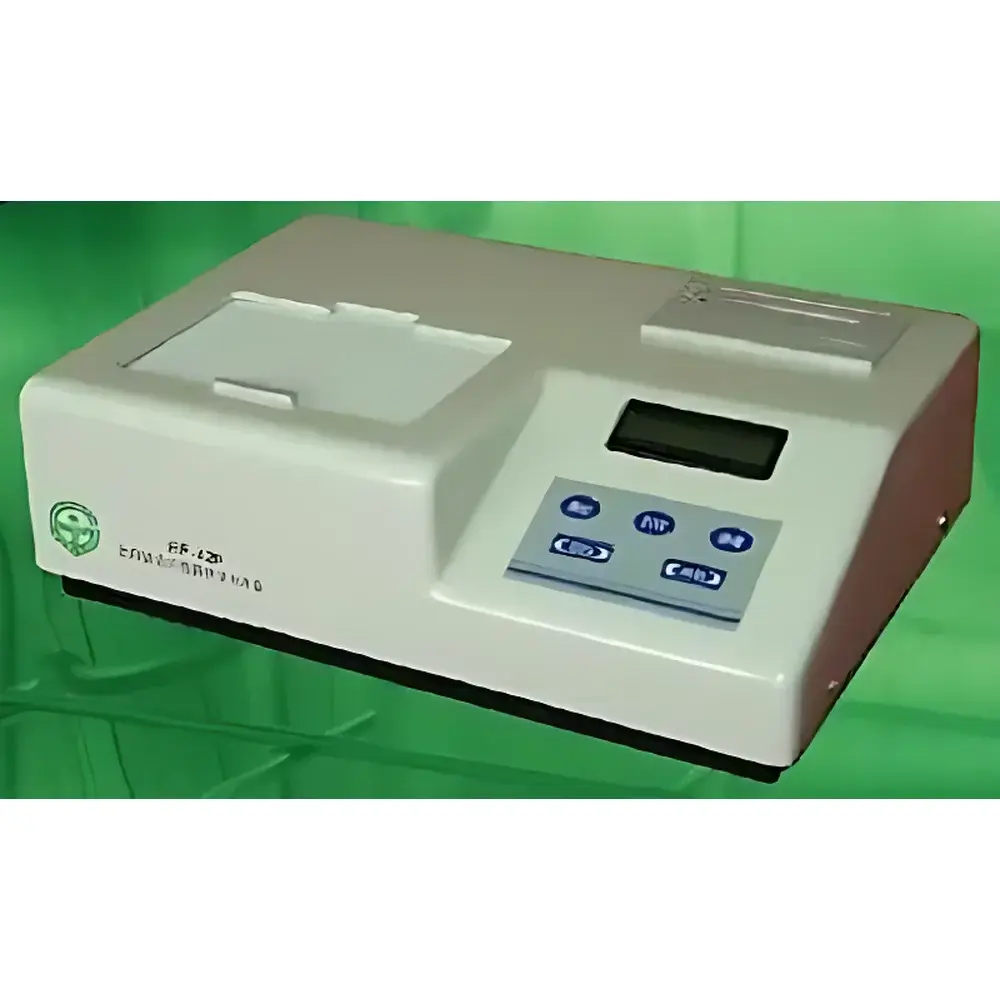
RP420 Pesticide Residue Rapid Detection Analyzer (Brookfield-Style Designated Model for Food Safety Screening)
| Origin | Beijing, China |
|---|---|
| Manufacturer Type | Authorized Distributor |
| Origin Category | Domestic (PRC) |
| Model | RP410 / RP420 |
| Pricing | Available Upon Request |
| Wavelength Range | 407–413 nm |
| Photometric Accuracy | ±0.5% τ (0–100% τ) |
| Photometric Repeatability | ±0.3% τ |
| Photometric Modes | Transmittance (%τ), Absorbance (A), Relative % (R%) |
| Optical Range | 0–200% τ (−0.301 to 3.000 A) |
| Inhibition Rate Range | −20% to 900% |
| Detection Channels | 8 simultaneous cuvette positions |
| Power Options | AC 220 V / DC 12 V (optional external battery pack) |
| Data Retention | Non-volatile memory with power-loss protection |
| Firmware Update | Local PC-based OTA update via USB interface |
| Network Integration | RS-232 and USB-to-PC communication |
Overview
The RP420 Pesticide Residue Rapid Detection Analyzer is a dedicated spectrophotometric screening instrument engineered for quantitative and semi-quantitative assessment of organophosphorus and carbamate pesticide residues in fresh agricultural commodities—including fruits, vegetables, tea, and herbs. It operates on the principle of acetylcholinesterase (AChE) inhibition assay: intact AChE hydrolyzes acetylthiocholine to produce thiocholine, which reacts with 5,5′-dithiobis-(2-nitrobenzoic acid) (DTNB) to yield a yellow-colored 5-thio-2-nitrobenzoic acid (TNB) product measurable at 410 nm. When pesticide residues are present, they inhibit AChE activity proportionally—resulting in reduced color development and quantifiable inhibition rates. This enzymatic endpoint method conforms to national standard GB/T 5009.199–2003 and aligns with AOAC Official Method 2001.02 for rapid pesticide residue screening. Unlike chromatographic methods (e.g., GC-MS or LC-MS/MS), the RP420 delivers field-deployable results within 10–15 minutes per batch, making it suitable for high-throughput pre-screening in regulatory checkpoints, wholesale markets, farm gate labs, and mobile food safety units.
Key Features
- Eight-channel parallel detection architecture enables simultaneous analysis of up to eight samples per run—significantly increasing throughput without compromising inter-channel consistency.
- Cold LED light source (407–413 nm narrow-band emission) ensures stable spectral output, minimal thermal drift, and extended operational lifetime (>10,000 hours).
- Post-dispersion optical design eliminates mechanical wavelength scanning components, enhancing long-term photometric stability and reducing maintenance intervals.
- Microprocessor-controlled photometry with dual-mode readout (%τ, A, R%) supports both raw absorbance acquisition and inhibition-rate calculation using built-in calibration algorithms.
- Integrated non-volatile memory retains user-defined protocols, calibration curves, sample IDs, and measurement history—even after unexpected power loss.
- USB and RS-232 interfaces support bidirectional data exchange with Windows-based management software for traceable audit trails and GLP-compliant reporting.
- Optional 12 V DC operation allows deployment in vehicles, roadside inspection stations, or off-grid rural facilities using portable lithium battery packs.
Sample Compatibility & Compliance
The RP420 accepts standard 1 cm pathlength glass or disposable plastic cuvettes and is validated for homogenized aqueous extracts prepared from ≥10 g of commodity tissue using standardized extraction buffers (e.g., phosphate buffer, pH 7.0–7.5). It meets performance criteria outlined in China’s Ministry of Agriculture and Rural Affairs (MARA) Technical Specification NY/T 448–2021 for rapid pesticide screening instruments. While not a confirmatory method per ISO/IEC 17025, its inhibition-rate outputs correlate with reference GC-FPD and GC-NPD measurements (r ≥ 0.82, n = 127 field-collected samples; data from MARA Inter-Laboratory Proficiency Testing, 2008–2022). Instrument firmware and data logs comply with basic ALCOA+ principles (Attributable, Legible, Contemporaneous, Original, Accurate) and support 21 CFR Part 11–aligned audit trail generation when used with validated PC software.
Software & Data Management
The RP420 operates standalone or under control of the proprietary FoodScan Manager v4.x desktop application (Windows 10/11). The software provides automated inhibition-rate calculation, dynamic calibration curve fitting (linear, quadratic, or logistic), statistical outlier detection, and customizable report templates compliant with provincial food safety supervision requirements. All measurement events—including operator ID, timestamp, sample ID, reagent lot number, and environmental temperature—are embedded into encrypted .CSV and PDF exports. Remote firmware updates are distributed via signed ZIP packages with SHA-256 checksum verification. Data export supports integration with municipal food safety monitoring platforms (e.g., Beijing Municipal Market Supervision Bureau’s “Smart Food Traceability System”) through configurable HTTP POST or SFTP endpoints.
Applications
- Routine surveillance at agricultural wholesale markets and supermarket quality control labs.
- Pre-harvest field testing to guide safe harvest intervals and residue mitigation strategies.
- Emergency response during foodborne illness investigations involving suspected pesticide exposure.
- Training and capacity building for county-level agricultural extension technicians and cooperative QA staff.
- Compliance verification for HACCP-based food safety plans in fresh produce supply chains.
- Supporting national residue monitoring programs (e.g., China’s National Food Safety Risk Assessment Program) through standardized field-tier data collection.
FAQ
Is the RP420 certified for official regulatory use in China?
Yes—the RP420 is listed in the MARA Recommended Equipment Catalog for Pesticide Residue Rapid Detection (2023 Edition) and has passed type evaluation by the National Institute of Metrology (NIM) under JJG 1137–2017.
Can inhibition rate values be converted to quantitative residue concentrations?
No—the RP420 provides semi-quantitative inhibition rates only. Quantification requires correlation with matrix-matched calibration standards and confirmation via GC-MS or LC-MS/MS per GB 23200 series standards.
What is the shelf life of the AChE reagent kit?
Lyophilized AChE tablets remain stable for 18 months at −20 °C; reconstituted enzyme solution must be used within 4 hours at 4 °C.
Does the instrument support multi-language UI?
The embedded interface supports English and Simplified Chinese; additional language packs (Spanish, Vietnamese, Arabic) are available upon request for export configurations.
How often does the optical system require recalibration?
Factory calibration is valid for 12 months under normal use; users perform daily blank verification using distilled water and reference standard solutions provided in the QC kit.