
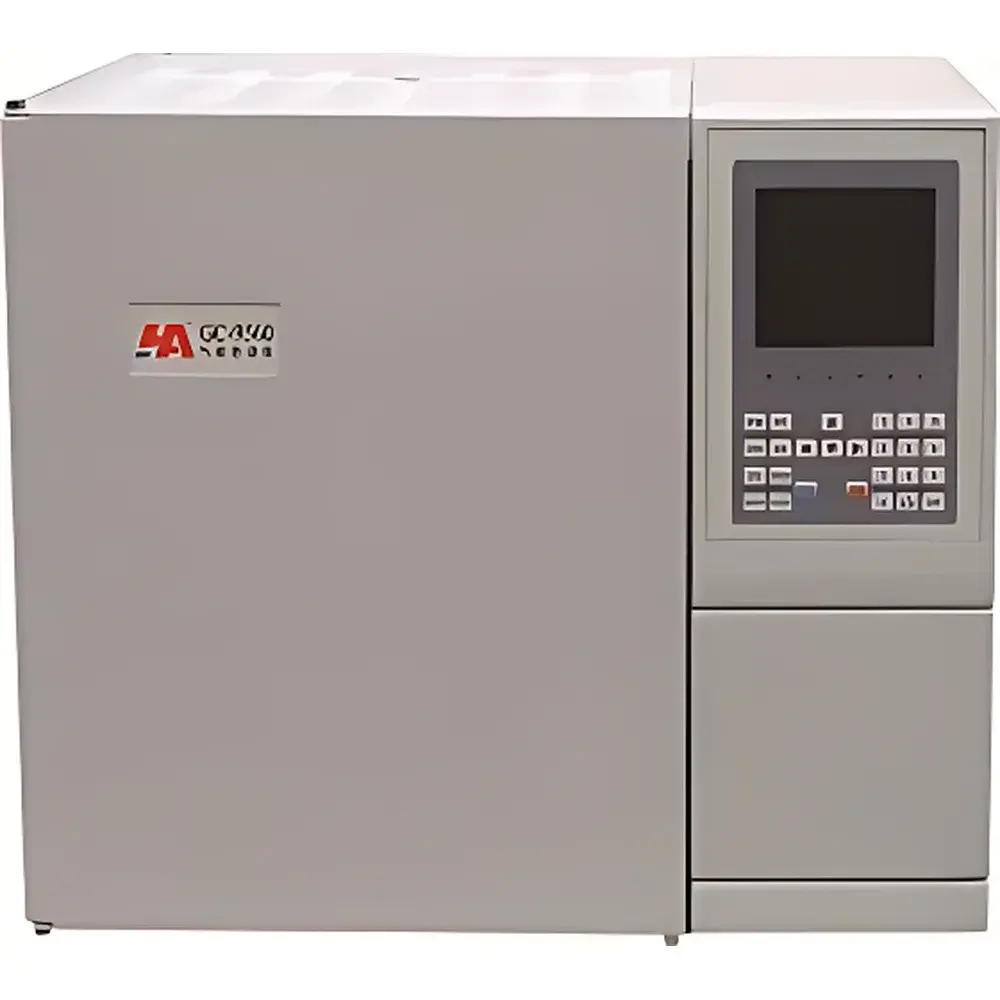
Huaai GC-9560 Helium Ionization Gas Chromatograph for Krypton Purity Analysis
| Brand | Huaai |
|---|---|
| Origin | Shanghai, China |
| Manufacturer Type | Direct Manufacturer |
| Region of Origin | Domestic (China) |
| Model | GC-9560 |
| Instrument Type | Laboratory Gas Chromatograph |
| Application Field | High-Purity Gas Analysis (Specialized for Kr, He, Ne, Xe, Ar) |
| Oven Temperature Range | 0–400 °C |
| Maximum Ramp Rate | 40 °C/min |
| Cooling Rate (350 °C → 50 °C) | ≤8 min |
| Carrier Gas Flow Control Range | 0–500 mL/min |
| Carrier Gas Pressure Control Range | 0–0.4 MPa |
| Injector Maximum Operating Temperature | 399 °C |
| Injector Pressure Setting Range | 0–0.4 MPa |
| Injector Total Flow Setting Range | 0–500 mL/min |
| Detection Limit (for N₂, O₂, CH₄, CO, CO₂, H₂, H₂O, CF₄) | ≤5 ppb (v/v) |
| Detector Type | High-Sensitivity Helium Ionization Detector (HID) |
| Column Configuration | Multi-Column Oven with Independent Temperature Zones |
| Sample Introduction | Dual-Channel Valve System with Purge-Protected Switching Valves |
| Flow Compensation | Automatic Inlet Pressure Correction Algorithm for Variable Base-Gas Matrices |
| Compliance Reference | GB/T 5829–2006 (Krypton Specification), GB/T 28123–2011 (High-Purity Noble Gases), ASTM D7606–22 (Trace Impurity Analysis in Ultra-High-Purity Gases) |
Overview
The Huaai GC-9560 Helium Ionization Gas Chromatograph is an engineered solution for ultra-trace impurity analysis in high-purity noble gases—specifically optimized for krypton (Kr) grade verification per GB/T 5829–2006 and complementary international specifications such as ASTM D7606–22. Unlike conventional flame ionization or thermal conductivity detectors, this system employs a helium-based ionization detection principle: trace analytes (N₂, O₂, Ar, H₂, CH₄, CO, CO₂, H₂O, CF₄, and Xe) are selectively ionized in a metastable helium plasma environment, generating signal amplitudes proportional to electron-capture cross-sections and ionization potentials. This yields sub-ppb (≤5 ppb v/v) detection sensitivity without cryogenic preconcentration—critical for semiconductor-grade gas certification, photolithography support gas monitoring, and rare gas refining QA/QC workflows.
Key Features
- Helium Ionization Detector (HID) with stable plasma discharge source and low-noise electrometer circuitry, delivering baseline stability <0.5 pA over 24 h at 350 °C detector temperature.
- Multi-zone column oven architecture supporting up to three independently controlled chromatographic columns (e.g., molecular sieve 5A, Porapak Q, and Hayesep D), enabling simultaneous separation of permanent gases, hydrocarbons, and oxidizable species.
- Dual-channel, purge-protected switching valve system with automated center-cutting capability—minimizing carryover and ensuring reproducible transfer of target fractions across matrix shifts (e.g., Kr vs. He vs. Ne base gases).
- Real-time inlet pressure compensation algorithm dynamically adjusts sample loop fill volume based on carrier gas density and backpressure, maintaining consistent mass-on-column across variable base-gas compositions.
- Thermally insulated injector block with precise PID-controlled heating (0.1 °C resolution) and pressure/flow decoupling—enabling robust operation at 399 °C while preserving septum integrity and minimizing adsorption artifacts.
- Integrated safety interlocks including overtemperature cutoff, helium flow monitoring, and plasma arc fault detection compliant with IEC 61010-1:2010 Class II requirements.
Sample Compatibility & Compliance
The GC-9560 is validated for direct injection of compressed noble gas matrices (Kr, He, Ne, Ar, Xe) at pressures up to 1.5 MPa (gauge), with certified compatibility for ISO 8573-1 Class 1 moisture and particle content. It meets analytical requirements defined in GB/T 5829–2006 for Kr purity grading (e.g., ≥99.9999% Kr, ≤2 ppb N₂, ≤1.5 ppb O₂+Ar, ≤0.5 ppb H₂), and supports method transfer to USP , EP 2.2.46, and ISO/IEC 17025-accredited laboratories. All hardware modules—including valves, fittings, and detector cell—are constructed from electropolished stainless steel (316L) with SilcoNert® deactivation to prevent surface-catalyzed decomposition of reactive impurities (e.g., CO, H₂O).
Software & Data Management
Chromatographic control and data acquisition are managed via Huaai ChromaSuite v4.2—a Windows-based platform supporting audit-trail-enabled operation per FDA 21 CFR Part 11 Annex 11 requirements. The software includes sequence-driven calibration (multi-point external standard curves), peak integration with retention time locking (RTL), and automatic report generation aligned with ISO/IEC 17025 clause 7.8. Raw data files (.chd) are stored in vendor-neutral HDF5 format with embedded metadata (instrument parameters, operator ID, environmental conditions). Optional LIMS integration is available via ASTM E1578-compliant API.
Applications
- Final release testing of electronic-grade krypton in semiconductor fab gas delivery systems.
- Monitoring trace oxygen and moisture breakthrough in Kr purification skids using cryogenic distillation or getter beds.
- Verification of xenon contamination in Kr batches intended for dark matter detection experiments (e.g., XENONnT, LZ).
- Batch-to-batch consistency assessment for Kr used in excimer laser gas mixtures (e.g., KrF, ArF).
- Supporting ISO 14644-8 cleanroom ambient gas qualification where Kr serves as a tracer or process purge medium.
FAQ
What detection technologies does the GC-9560 employ, and why is helium ionization preferred for noble gas analysis?
It uses a helium ionization detector (HID), which offers superior selectivity and sensitivity for permanent gases in noble matrices compared to TCD or FID—especially for low-ionization-potential species like H₂, He, Ne, and Ar. HID avoids quenching effects common in electron capture detectors and delivers linear response down to 5 ppb without derivatization.
Can the system analyze krypton samples containing >100 ppm xenon without column overload or detector saturation?
Yes—the multi-column configuration and center-cut valving allow selective routing of Kr-rich fractions to the detector while diverting high-concentration Xe to vent, preserving dynamic range and column longevity.
Is method validation documentation provided for compliance with ISO/IEC 17025 or GMP environments?
Yes—Huaai supplies IQ/OQ/PQ protocols, system suitability test templates, and uncertainty budgets aligned with EURACHEM/CITAC Guide CG4. Full validation packages are available under NDA upon request.
Does the instrument support unattended overnight operation for production lot testing?
Yes—equipped with autosampler-ready valve sequencing, thermal stabilization monitors, and automatic shutdown on abnormal pressure or temperature deviation.
Are replacement columns and HID sources available through global distribution partners?
Yes—standardized 1/8″ OD stainless columns and OEM HID emitter assemblies are stocked by authorized distributors in North America, EU, and APAC regions with lead times <10 business days.
Related Products




