
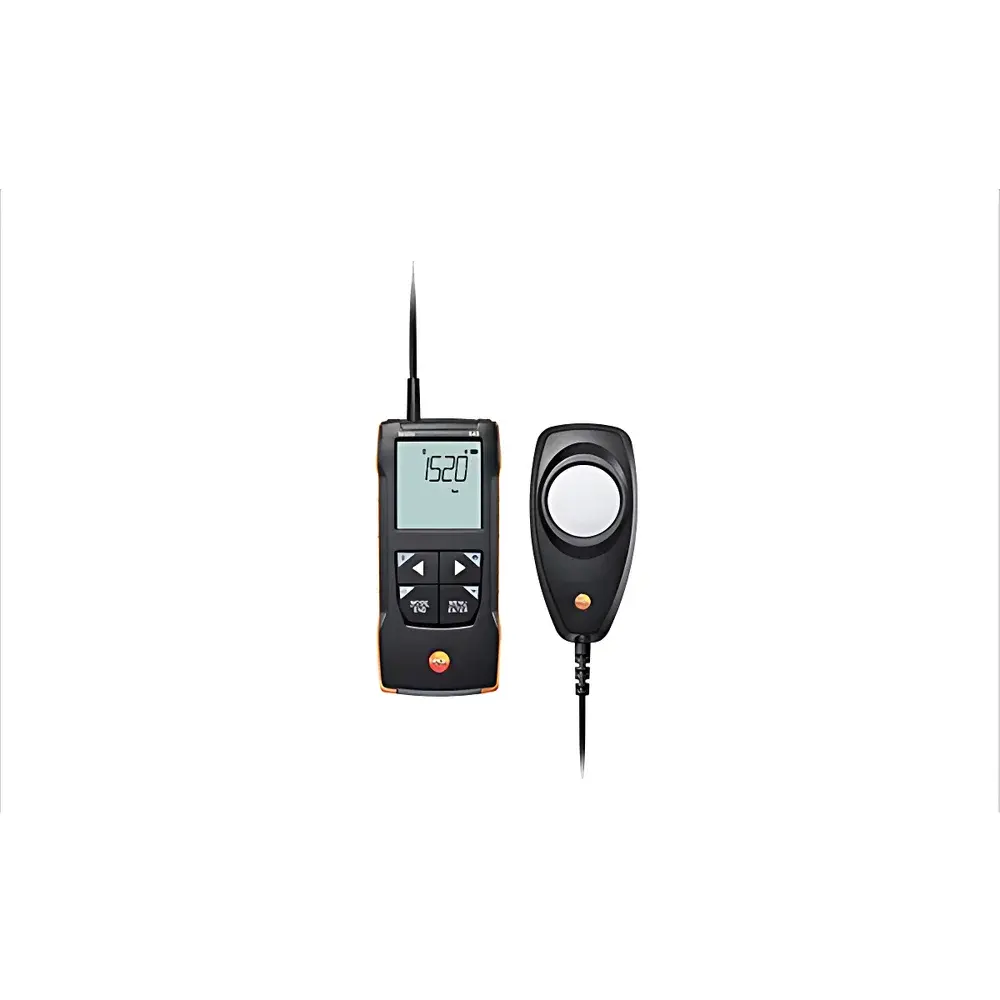
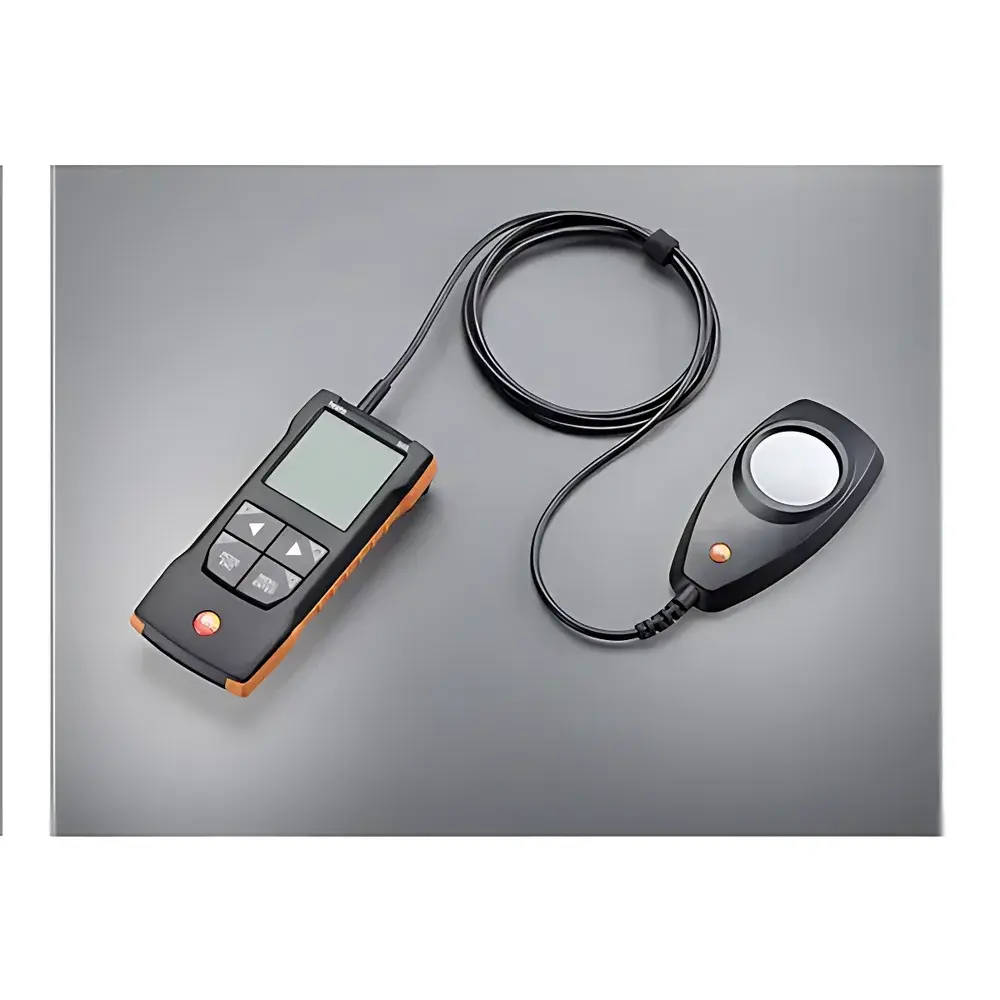
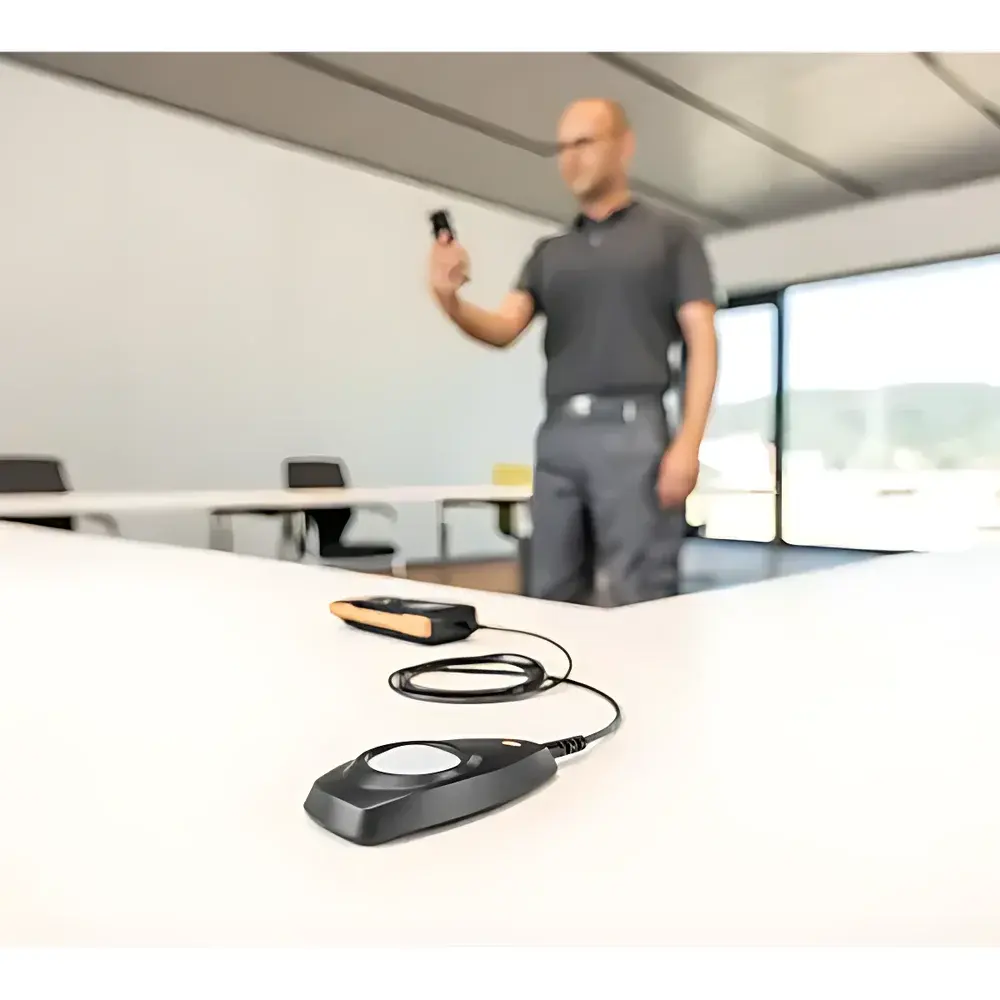
testo 545 Digital Illuminance Meter
| Brand | testo |
|---|---|
| Model | testo 545 |
| Measurement Range | 0.01 to 200,000 lx (typical) |
| Spectral Response | V(λ)-corrected per CIE 1931 standard |
| Accuracy | ±3% ±1 digit (at 25°C, 500 lx, tungsten reference) |
| Operating Temperature | 0 to +50°C |
| Battery | 3 × AA (included) |
| Connectivity | Bluetooth 4.2 LE |
| App Compatibility | testo Smart App (iOS/Android) |
| Compliance | EN 13032-1, DIN 5032-7, ISO/CIE 19476 |
Overview
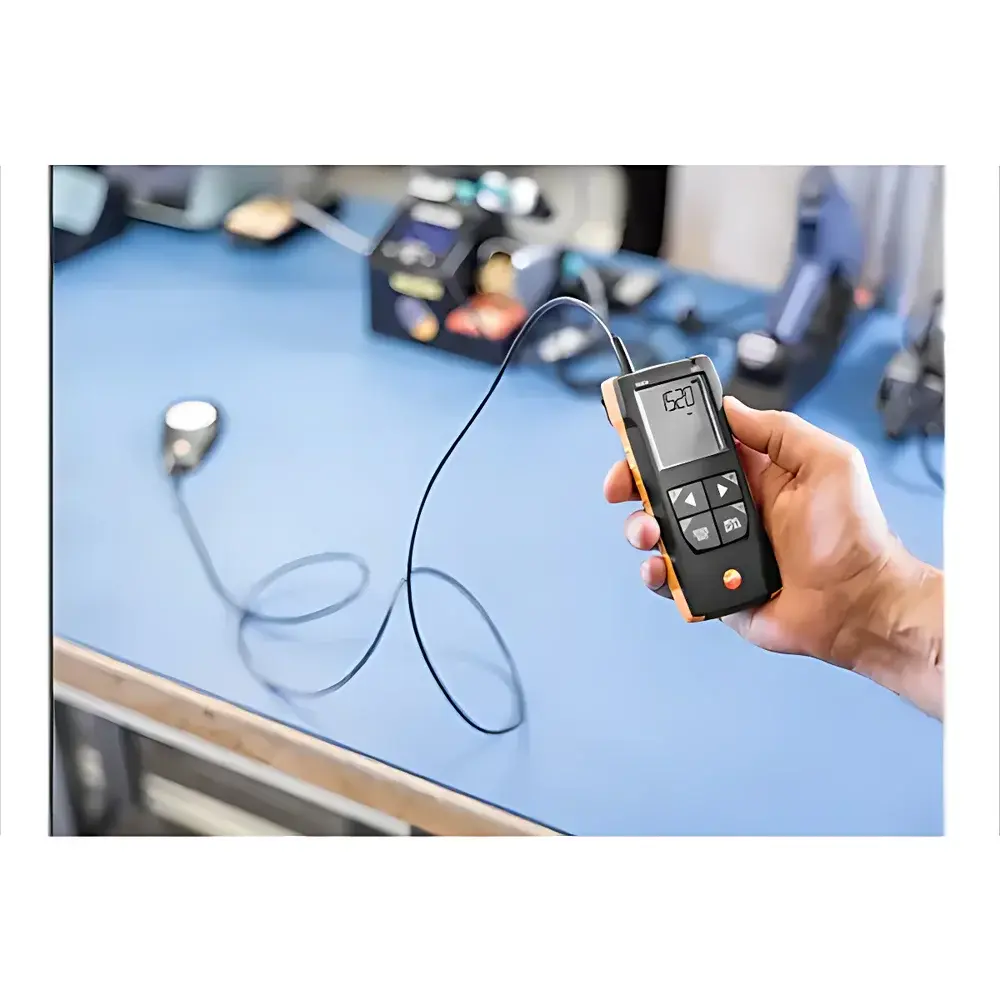
The testo 545 Digital Illuminance Meter is a precision optical measurement instrument engineered for reliable, V(λ)-weighted illuminance evaluation across diverse lighting environments. Based on the photopic luminosity function defined by the CIE 1931 standard, the device delivers traceable lux (lx) measurements that reflect human visual sensitivity under photopic conditions. Its silicon photodiode sensor features high-fidelity spectral correction—validated per EN 13032-1 and DIN 5032-7—to ensure accurate assessment of modern light sources, including warm-white and neutral-white LEDs (CCT ≤ 5000 K). Exclusion of monochromatic blue LED sources (e.g., 450 nm peak) is explicitly noted due to inherent limitations in V(λ) matching outside the broadband visible spectrum. Designed for industrial hygiene, occupational safety, facility management, and architectural lighting validation, the testo 545 supports quantitative verification of lighting compliance with workplace directives such as EN 12464-1 (Lighting of Workplaces) and national occupational exposure guidelines.
Key Features
- V(λ)-corrected photometric sensor calibrated to CIE 1931 spectral luminous efficiency function
- Wide dynamic measurement range: 0.01–200,000 lx with auto-ranging and selectable resolution (0.01 lx at low end)
- Real-time audible alarm with user-defined upper/lower thresholds—audible feedback triggers immediately upon limit violation
- On-device calculation of time-weighted averages (TWA) and multi-point spatial averages—enabling rapid assessment of uniformity and temporal stability
- Integrated Bluetooth 4.2 Low Energy module for seamless wireless pairing with the testo Smart App
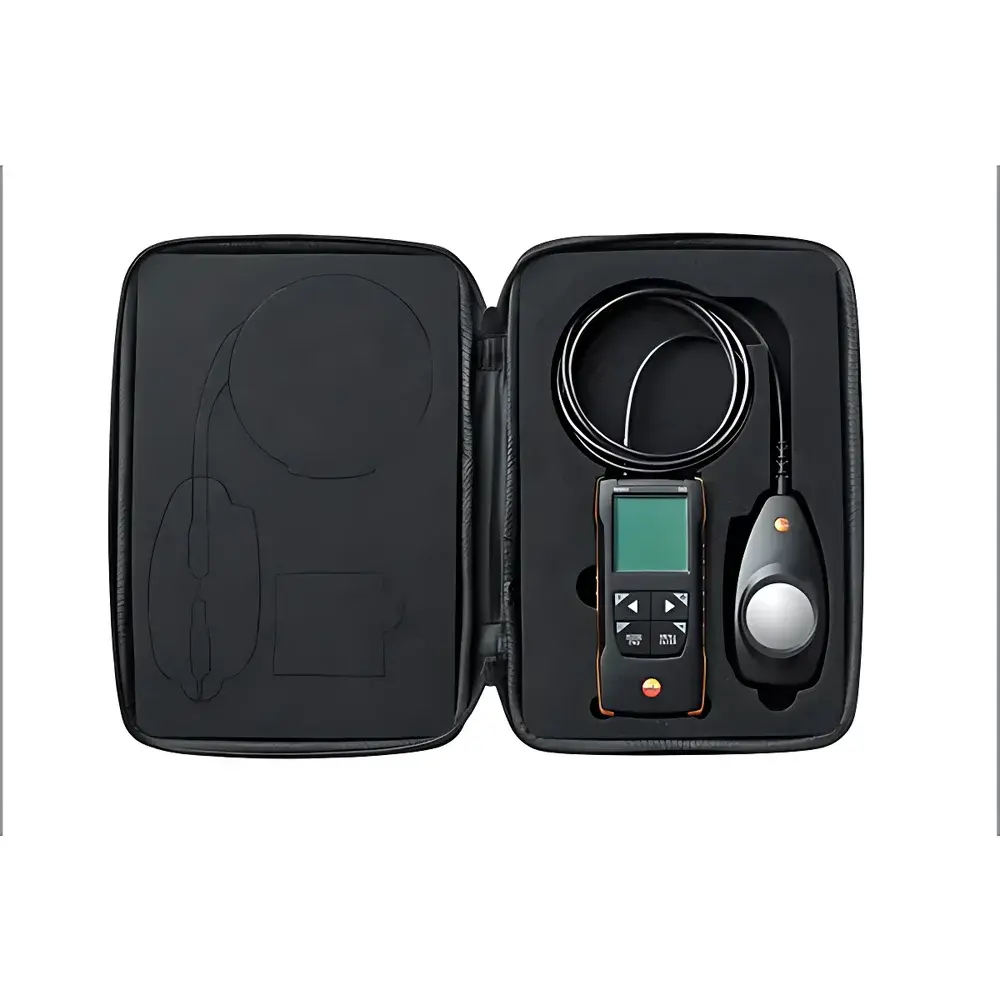
- Rugged, handheld ergonomics with IP52-rated enclosure; includes portable instrument case, calibration report, and three pre-installed AA alkaline batteries
Sample Compatibility & Compliance
The testo 545 is validated for use with common artificial lighting technologies: incandescent, halogen, fluorescent (including T5/T8), and white-light LEDs (CCT 2700–5000 K). It is not intended for narrowband or UV-emitting sources (e.g., single-chip blue LEDs, UV-C lamps, or laser-based illumination), where spectral mismatch exceeds acceptable f1′ error limits per CIE 19476. Device firmware and hardware design comply with metrological requirements outlined in ISO/CIE 19476:2014 (Photometry — Characterization of illuminance meters) and support audit-ready documentation for GLP-aligned environmental monitoring programs. Calibration certificates issued with each unit conform to ISO/IEC 17025:2017 principles and are traceable to national standards (e.g., PTB or NIST via accredited labs).
Software & Data Management
The testo Smart App serves as the primary interface for configuration, visualization, and data governance. Users can define custom measurement protocols—including logging intervals (1 s to 60 min), alarm thresholds, and averaging windows—directly from mobile devices. Real-time trend graphs display illuminance profiles over time; second-screen mode enables live projection during site audits or training sessions. All datasets export in CSV or PDF format with embedded metadata (timestamp, GPS coordinates if enabled, device ID, calibration due date). The app enforces secure local storage and supports optional cloud backup with role-based access control—facilitating compliance with internal QA workflows and external regulatory reviews (e.g., ISO 9001 clause 7.1.5.2, FDA 21 CFR Part 11 where electronic records are retained).
Applications
- OHS compliance auditing: Verifying illuminance levels against EN 12464-1 minimums (e.g., 500 lx for office desk work, 300 lx for corridors)
- Lighting retrofit validation: Quantifying efficacy gains before/after LED upgrades in commercial buildings or manufacturing facilities
- Healthcare environment monitoring: Ensuring appropriate light levels in patient rooms, operating theatres, and diagnostic imaging suites per IEC 62722-2-1
- Ergonomic workstation assessments: Correlating measured lux values with visual fatigue indicators in human factors studies
- Education and vocational training: Teaching photometric fundamentals, spectral weighting, and lighting design principles using field-deployable instrumentation
FAQ
Does the testo 545 require periodic recalibration?
Yes. We recommend annual recalibration against a reference standard traceable to a national metrology institute to maintain stated accuracy specifications and regulatory compliance.
Can the device measure pulsed or modulated light sources (e.g., PWM-driven LEDs)?
It is capable of measuring average illuminance under stable PWM conditions (≥100 Hz), but may underestimate peak intensity in high-frequency or duty-cycle-variable scenarios. For flicker analysis, dedicated instruments compliant with IEEE 1789 or IEC TR 61547-1 are advised.
Is the testo Smart App compatible with enterprise MDM systems?
Yes—the iOS and Android versions support standard MDM frameworks (e.g., Microsoft Intune, Jamf Pro) for centralized deployment, policy enforcement, and version control in corporate IT environments.
What is the typical battery life under continuous Bluetooth operation?
Approximately 15 hours at room temperature with active Bluetooth streaming and backlight enabled; power consumption drops significantly in standby mode, extending operational readiness to >100 hours.
Does the device support external sensor inputs or analog outputs?
No. The testo 545 is a self-contained illuminance meter with no provision for auxiliary sensors or 0–10 V / 4–20 mA signal output. Integration with building management systems requires intermediary gateways or API-mediated data ingestion via the testo Smart App.





