
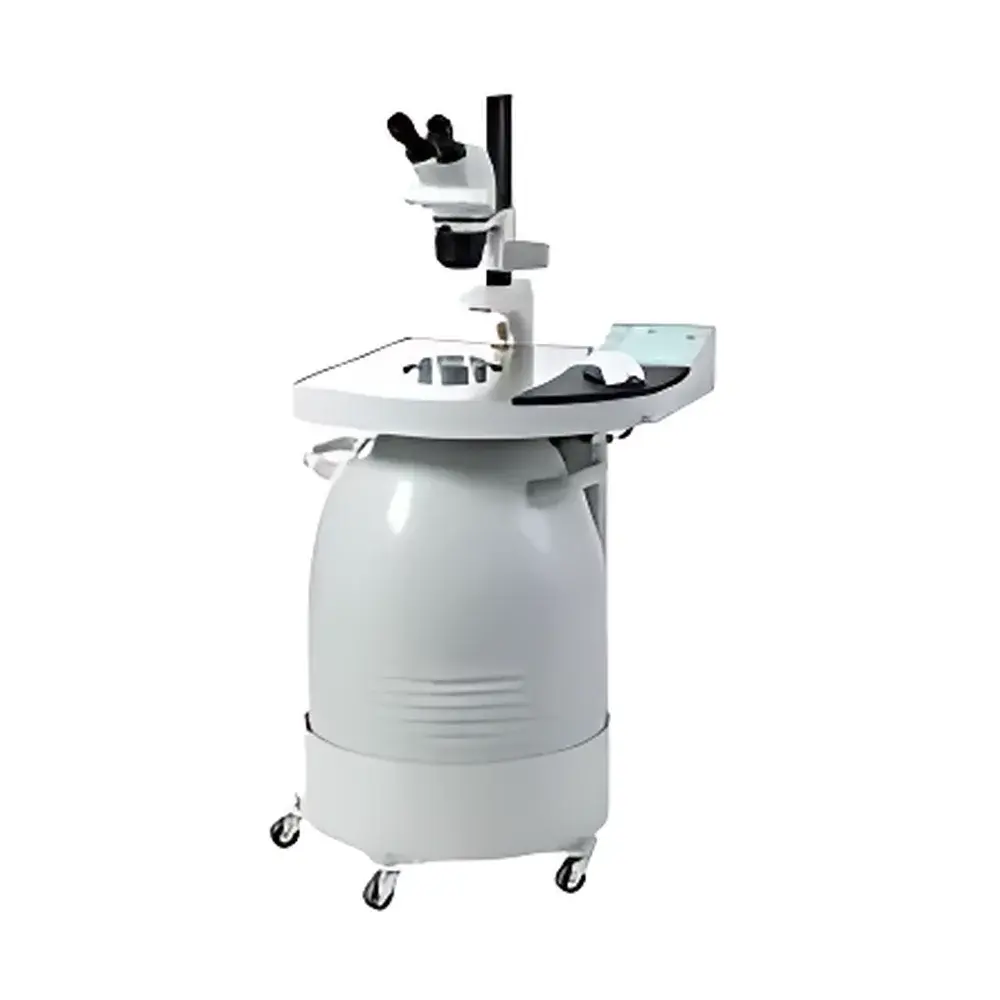
Leica EM AFS2 Cryosubstitution System
| Brand | Leica |
|---|---|
| Origin | Austria |
| Model | EM AFS2 |
| Temperature Range | –140 °C to +70 °C (precisely controlled) |
| Liquid Nitrogen Capacity | 35 L (supports up to 5 days of continuous operation) |
| Deep Freeze Mode | < –140 °C for cryo-transfer |
| TF (Trace-free) Mode | Active O₂/H₂O removal |
| UV Polymerization | Integrated LED UV source (365 nm) |
| User Storage | 10 user profiles, 99 programs per user |
| Interface | Full-color graphical touchscreen with mouse control |
| Safety | Built-in exhaust system for hazardous solvent vapors |
| Optional Module | Leica EM FSP Fluid Service Processor (automated reagent dispensing, dilution, exchange, and UV polymerization) |
Overview
The Leica EM AFS2 is a high-precision, fully programmable cryosubstitution system engineered for advanced electron microscopy sample preparation. It implements cryosubstitution — a low-temperature chemical dehydration technique in which water in vitrified biological specimens is replaced by organic solvents (e.g., acetone or methanol) at subzero temperatures (typically –90 °C to –130 °C), preserving ultrastructural integrity far beyond conventional chemical fixation. The system also supports gradient temperature processing (GTP), enabling controlled dehydration and resin infiltration of chemically fixed samples via precisely ramped thermal profiles. Subsequent UV-induced polymerization ensures consistent, low-shrinkage embedding — critical for high-resolution TEM tomography, CLEM (correlative light and electron microscopy), and immunogold labeling workflows. Designed for reproducibility and traceability, the EM AFS2 operates within a rigorously controlled inert atmosphere and integrates hardware-level safeguards aligned with GLP-compliant laboratory practices.
Key Features
- Precise temperature control from –140 °C to +70 °C with ±0.5 °C stability across the full range, achieved via dual-stage cooling (liquid nitrogen immersion + Peltier regulation)
- 35 L integrated liquid nitrogen reservoir with independent fill port; engineered for ≥120 hours of uninterrupted operation under typical cryosubstitution protocols
- “Deep Freeze” mode enables sample transfer at temperatures below –140 °C, minimizing ice recrystallization during cassette handling
- “TF” (Trace-free) function actively purges chamber atmosphere with dry nitrogen or argon, maintaining O₂ < 5 ppm and H₂O < 10 ppm to prevent oxidative damage and solvent hydrolysis
- Dedicated LED-based UV illumination (365 nm, 10–20 mW/cm²) with programmable intensity and exposure timing for uniform resin polymerization
- Full-color graphical interface with intuitive mouse-driven navigation; supports multilingual on-screen prompts and real-time protocol visualization
- Built-in exhaust manifold compatible with standard lab fume hood ducting or dedicated solvent abatement systems, ensuring safe disposal of volatile organic vapors
Sample Compatibility & Compliance
The EM AFS2 accommodates standard EM specimen carriers including aluminum planchettes (3 mm, 6 mm), brass specimen pins, and custom cryo-cassettes. It supports all major low-viscosity embedding resins (e.g., Lowicryl HM20, LR White, Epon/Araldite variants) and cryoprotectant-compatible solvents (acetone, methanol, propylene oxide). The system complies with ISO 13485 design controls for medical device-related research applications and meets mechanical safety requirements per IEC 61010-1. Its programmable logging architecture records timestamped temperature, solvent status, UV dose, and atmospheric conditions — generating audit-ready data compliant with FDA 21 CFR Part 11 when paired with validated LIMS integration.
Software & Data Management
All operational parameters are stored in non-volatile memory with cyclic redundancy checksum validation. Each user profile retains up to 99 fully parameterized protocols — including multi-step temperature ramps, solvent exchange sequences, dwell times, UV intensity gradients, and gas purge cycles. Event logs capture start/stop timestamps, deviations from setpoints (>0.3 °C), and manual interventions. Export is supported via USB 2.0 to CSV or XML formats for traceability review. When equipped with the optional Leica EM FSP module, the system executes closed-loop fluid handling: automatic reagent dilution (±1% volumetric accuracy), sequential solvent exchange with waste volume monitoring, and synchronized UV curing — all logged with version-stamped metadata.
Applications
- High-pressure frozen (HPF) biological samples requiring artifact-free cryosubstitution prior to resin embedding
- Cryo-ET (cryo-electron tomography) grid preparation with minimal ice contamination and optimal resin infiltration
- Immuno-EM workflows where antigenicity preservation demands low-temperature dehydration and UV polymerization
- Correlative microscopy (CLEM) using fluorescent protein tags embedded in UV-curable resins
- Materials science applications involving beam-sensitive nanocomposites or hydrated polymers
- Development and validation of novel cryoprotectant formulations under controlled thermal-solvent stress
FAQ
What is the minimum achievable temperature during sample transfer?
The “Deep Freeze” function enables stable operation down to –160 °C for brief (<90 s) manual or semi-automated transfer steps.
Can the EM AFS2 be integrated into an automated workflow with other Leica EM instruments?
Yes — it supports RS-232 and Ethernet communication protocols for synchronization with Leica EM UC7 ultramicrotomes and EM VCT500 cryo-transfer systems via Leica Application Suite (LAS X) EM Edition.
Is UV polymerization limited to specific resin types?
The 365 nm LED output is optimized for photoinitiator systems in Lowicryl resins, but intensity and duration are fully adjustable to accommodate alternative UV-curable formulations.
How is solvent purity maintained during extended runs?
The TF mode continuously monitors chamber dew point and oxygen concentration; solvent reservoirs feature septum-sealed ports and optional in-line molecular sieves to prevent ambient moisture ingress.
Does the system support remote monitoring or diagnostics?
Remote access is available via secure HTTPS interface for real-time status viewing, log retrieval, and emergency shutdown — configurable within institutional firewall policies.



