
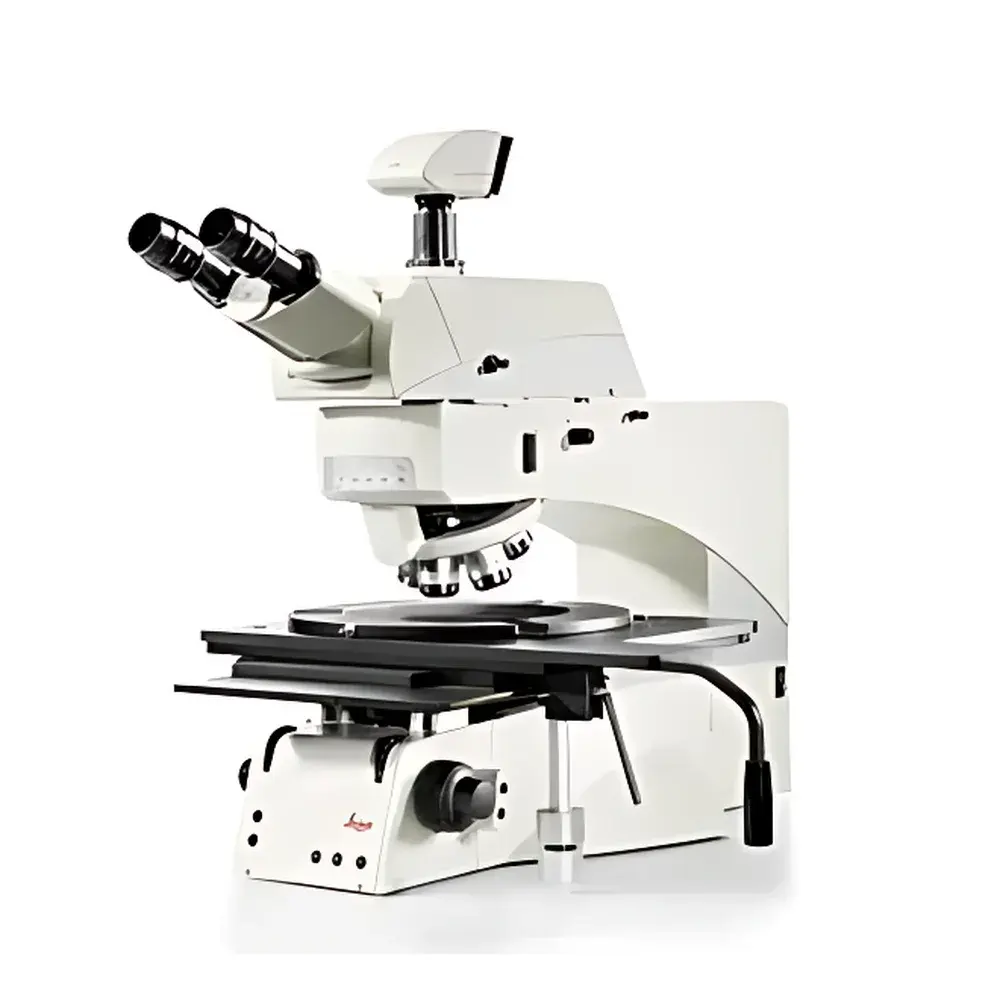
Leica DM8000 M Upright Metallurgical Microscope
| Brand | Leica |
|---|---|
| Origin | Germany |
| Model | DM8000 M |
| Configuration | Upright |
| Total Magnification | 1000× |
| Eyepiece | 10× |
| Objective | 100× |
| Field of View (Macro Mode) | 36 mm |
| Maximum Specimen Height | 42 mm |
| Illumination | Integrated LED (Visible + UV/OUV), Motorized Brightfield/Darkfield/Polarization/DIC/Oblique/Fluorescence/IR |
| Optical Path | Achromatic-Corrected, 25 mm Field Number |
| Turret | 6-Position Encoded Motorized Nosepiece |
| Stage | 200 × 200 mm (8″ Wafer Compatible) |
| Ergonomic Design | Adjustable Binocular Tube, Height-Adjustable Focus Knobs, Conductive Housing for ESD-Safe Cleanroom Use |
| Software Compatibility | Leica Application Suite (LAS X), GLP/GMP-Compliant Audit Trail, FDA 21 CFR Part 11 Ready |
Overview
The Leica DM8000 M is a research-grade upright metallurgical microscope engineered for high-precision microstructural analysis of solid-state materials in demanding industrial and academic laboratories. Designed around a fully apochromatic optical path with a 25 mm field number, it delivers diffraction-limited resolution across all contrast modes—including brightfield, darkfield, polarization, differential interference contrast (DIC), oblique illumination, fluorescence, and infrared—without optical compromise. Its core architecture adheres to ISO 10934-1 (optical microscopy terminology) and ASTM E3 (standard guide for preparation of metallographic specimens), ensuring metrological traceability in quality control and failure analysis workflows. The system operates on a rigid, vibration-damped mechanical platform with motorized, encoded components enabling repeatable, protocol-driven imaging sequences essential for semiconductor wafer inspection, aerospace alloy evaluation, and advanced ceramic characterization.
Key Features
- Modular optical design supporting both reflected-light (epi-illumination) and optional transmitted-light configurations for dual-mode material analysis.
- 6-position motorized and encoded nosepiece accommodating long-working-distance objectives up to 32 mm diameter; automatic scale bar registration per objective magnification.
- Dedicated 0.7× macro objective providing a 36 mm field of view for rapid wafer-level defect screening and macro-structural localization prior to high-magnification interrogation.
- Integrated dual-channel LED illumination: visible-spectrum (5,500 K CCT, ±200 K stability) and switchable UV/OUV (365 nm peak, ≤10 nm FWHM) for sub-micron lateral resolution enhancement and improved axial sectioning capability.
- ESD-safe conductive housing and sealed motorized turret meet ISO 14644-1 Class 5 cleanroom requirements; laminar airflow-compatible chassis geometry preserves unidirectional flow integrity.
- Ergonomic workstation integration: independently adjustable binocular tube inclination (0–35°), vertically positionable coarse/fine focus controls, and low-force Z-axis drive for sustained operator comfort during repetitive QC tasks.
Sample Compatibility & Compliance
The DM8000 M accommodates specimens up to 42 mm in height via optional “Material Stage” incident-light axis configuration, while maintaining compatibility with standard 8-inch wafers on its 200 × 200 mm motorized stage. It supports analysis of metals, alloys, sintered ceramics, polymer composites, dust particulates, and thin-film semiconductor substrates. All illumination modes comply with IEC 62471 (photobiological safety) and EN 61000-6-3 (EMC emissions). UV illumination operation conforms to ANSI Z136.1 laser safety guidelines when used with certified UV filters. System firmware and LAS X software support audit trail logging, electronic signatures, and user-access-level permissions aligned with FDA 21 CFR Part 11 and EU Annex 11 regulatory frameworks.
Software & Data Management
Leica Application Suite (LAS X) provides validated image acquisition, measurement, and reporting tools compliant with GLP and GMP environments. Key modules include Grain Size Analysis (ASTM E112), Phase Quantification (ISO 16700), Cast Iron Classification (ISO 945), Decarburization Depth Measurement (ASTM E1077), Inclusion Rating (ASTM E45), and Particle Contamination Assessment (ISO 16232). All calibration parameters—including light intensity, aperture diaphragm position, condenser height, and contrast mode—are stored per objective and recalled automatically. Raw image metadata embeds instrument configuration, operator ID, timestamp, and environmental conditions for full analytical reproducibility.
Applications
- Semiconductor manufacturing: Defect mapping on silicon wafers, lithography residue identification, bond pad inspection, and contamination analysis under UV-enhanced contrast.
- Aerospace & power generation: Fatigue crack initiation assessment in nickel-based superalloys, thermal barrier coating delamination quantification, and creep void characterization.
- Automotive metallurgy: Ferrite/pearlite ratio determination in steels, graphite nodule morphology in ductile iron, and inclusion-type classification per ASTM E45.
- Advanced materials R&D: Grain boundary engineering in nanocrystalline metals, phase transformation kinetics in shape-memory alloys, and interfacial reaction layer thickness measurement in brazed joints.
- Forensic metallurgy: Toolmark replication fidelity analysis, fracture surface topography reconstruction, and heat-affected zone profiling in welded assemblies.
FAQ
Does the DM8000 M support automated wafer handling integration?
Yes—it features standardized RS-232 and Ethernet interfaces compatible with third-party wafer handlers and SECS/GEM communication protocols for inline process monitoring.
Can the UV illumination be used for quantitative fluorescence intensity measurements?
UV LED output is stabilized and calibrated for relative intensity consistency; absolute photometric calibration requires optional NIST-traceable radiometric sensor integration.
Is the 0.7× macro objective parfocal with standard objectives?
No—the macro objective operates on a separate optical path and requires manual turret repositioning; however, coordinate mapping between macro and high-mag fields is supported via LAS X stage calibration.
What cleanroom certifications does the system hold?
The DM8000 M meets ISO 14644-1 Class 5 airborne particle limits when installed with recommended HEPA filtration and laminar airflow hoods; surface resistivity <1×10⁶ Ω/sq ensures ESD protection per ANSI/ESD S20.20.
How is focus drift compensated during long-duration time-lapse imaging?
The motorized Z-drive incorporates closed-loop piezoelectric feedback and thermal expansion compensation algorithms, reducing drift to <0.1 µm/h over 8-hour acquisitions at ambient ±1°C fluctuation.





