
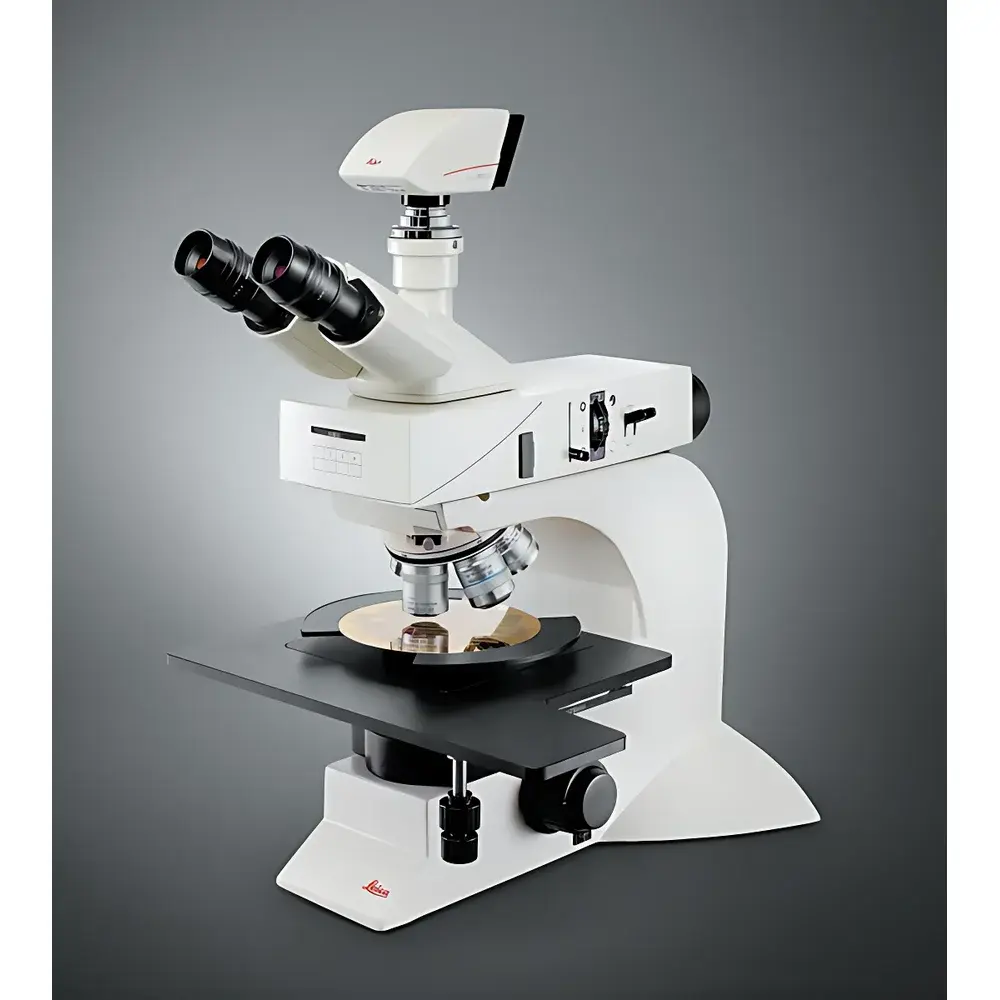
Leica DM3 XL Upright Metallurgical Microscope
| Brand | Leica |
|---|---|
| Origin | Germany |
| Model | DM3 XL |
| Configuration | Upright |
| Total Magnification | 500× |
| Eyepiece | 10× |
| Objective Lenses | 100× (with 5-position manual nosepiece for M32-thread objectives) |
| Imaging System | Integrated digital image analysis system |
| Illumination | High-power, constant-color-temperature white LED (20-year lifespan at 8 h/day) |
| Observation Modes | Brightfield, High-Contrast Darkfield, Polarization, Differential Interference Contrast (DIC), Patented Oblique Illumination |
| Compliance | SEMI S8/S2 and CE certified |
| Focusing Mechanism | Dual- or triple-step precision coarse/fine focus |
| Optional Macro Objectives | Field of view up to 35.7 mm |
| CCDA (Color-Coded Diaphragm Assistant) | Yes |
| Nosepiece Options | Three interchangeable nosepieces (BF/DF M32 supports up to 5 objectives |
Overview
The Leica DM3 XL is a high-performance upright metallurgical microscope engineered for rigorous microstructural analysis in semiconductor manufacturing, electronic materials R&D, and advanced metallography laboratories. Designed around the principles of Köhler illumination and optimized optical path integrity, the DM3 XL delivers diffraction-limited resolution across all standard contrast modalities—including brightfield (BF), high-contrast darkfield (DF), polarization (POL), differential interference contrast (DIC), and Leica’s proprietary oblique illumination. Its rigid, vibration-damped stand and thermally stable optical bench ensure measurement repeatability under extended operation cycles typical in 24/7 cleanroom environments. The system operates without oil immersion or mechanical alignment routines, minimizing operator dependency while maintaining compliance with industry-critical process control frameworks.
Key Features
- Upright configuration with ergonomic stage design optimized for large 6-inch wafers and bulk metallographic samples.
- 5-position manual nosepiece accommodating M32-thread objectives—compatible with Leica’s full suite of color-coded metallurgical objectives (e.g., 5×, 10×, 20×, 50×, 100×).
- Color-Coded Diaphragm Assistant (CCDA): A mechanical-optical integration linking objective magnification to aperture diaphragm position, enabling rapid, repeatable optimization of resolution, depth of field, and contrast without recalibration.
- Constant-color-temperature white LED illumination (6,000 K ± 150 K) delivering uniform spectral output across BF, DF, POL, and DIC modes—eliminating warm-up drift and lamp replacement cycles.
- Dual- or triple-stage focusing system with micrometer-scale fine-focus graduations (1 µm resolution) and backlash-free coarse drive—designed for precise Z-stack acquisition and serial sectioning workflows.
- Patented oblique illumination module integrated into the base optical path—enabling rapid surface topography assessment without reconfiguration or external add-ons.
Sample Compatibility & Compliance
The DM3 XL accommodates specimens up to 150 mm × 150 mm × 50 mm (W × D × H) on its motorized or manual XY stage. It supports both conductive and non-conductive samples—including polished silicon wafers, solder joints, thin-film stacks, sintered ceramics, and heat-treated alloys—without requiring conductive coating for routine BF/DF inspection. All optical components are sealed against particulate ingress, meeting ISO 14644-1 Class 5 cleanroom compatibility requirements. The instrument complies with SEMI S8 (safety) and SEMI S2 (environmental health) standards for semiconductor fabrication equipment, as well as EU Machinery Directive 2006/42/EC and Electromagnetic Compatibility Directive 2014/30/EU (CE marking). Mechanical stability and illumination consistency are validated per ISO 9001:2015 and ASTM E1558–21 (Standard Guide for Metallographic Photomicrography).
Software & Data Management
The integrated Leica Application Suite (LAS) X platform provides calibrated image capture, multi-channel annotation, grain size quantification (per ASTM E112), phase fraction analysis (ISO 13008), and automated report generation with embedded metadata (operator ID, timestamp, objective used, exposure settings). Raw image data is stored in TIFF or Leica’s proprietary LIF format with embedded EXIF-compliant calibration tags. Audit trails comply with FDA 21 CFR Part 11 requirements when deployed with optional user authentication and electronic signature modules. Data export supports CSV, PDF/A-2, and DICOM-SR formats for integration into LIMS or MES systems used in GMP-regulated semiconductor packaging lines.
Applications
- Semiconductor wafer defect review (scratches, pits, polishing residues) at sub-micron resolution.
- Metallographic grain structure characterization in aerospace-grade superalloys and additive-manufactured components.
- Failure analysis of solder interconnects and wire-bond interfaces in power electronics modules.
- Quality control of thermal spray coatings, brazed joints, and diffusion bonds in energy infrastructure components.
- Research-level DIC imaging of dislocation networks and strain fields in single-crystal turbine blade materials.
FAQ
Is the DM3 XL compatible with third-party camera sensors?
Yes—the C-mount interface (1× magnification factor) conforms to ANSI/SP-100-1998 specifications and supports industry-standard 1/1.8″ to 4/3″ sensors with pixel sizes ≥3.45 µm.
Can the CCDA system be retrofitted to older Leica models?
No—CCDA is mechanically and optically integrated into the DM3 XL’s nosepiece carrier and illumination column; it is not available as an aftermarket upgrade.
Does the LED illumination support fluorescence observation?
Not natively—the DM3 XL lacks excitation filter turrets and high-intensity UV/visible light sources required for fluorescence; however, the BF/FLUO nosepiece option enables future upgrade paths with Leica’s DFC9000 GT fluorescence camera and LED450 light source.
What is the maximum working distance achievable with macro objectives?
With the optional 1.25× macro objective, the system achieves a 35.7 mm field of view and 42 mm working distance—ideal for low-magnification PCB inspection and large-area sample screening.
Is GLP-compliant documentation provided with the instrument?
Yes—each unit ships with a Factory Calibration Certificate traceable to PTB (Physikalisch-Technische Bundesanstalt), IQ/OQ protocols, and a complete set of maintenance logs compliant with ISO/IEC 17025 and GLP Annex 3 requirements.




