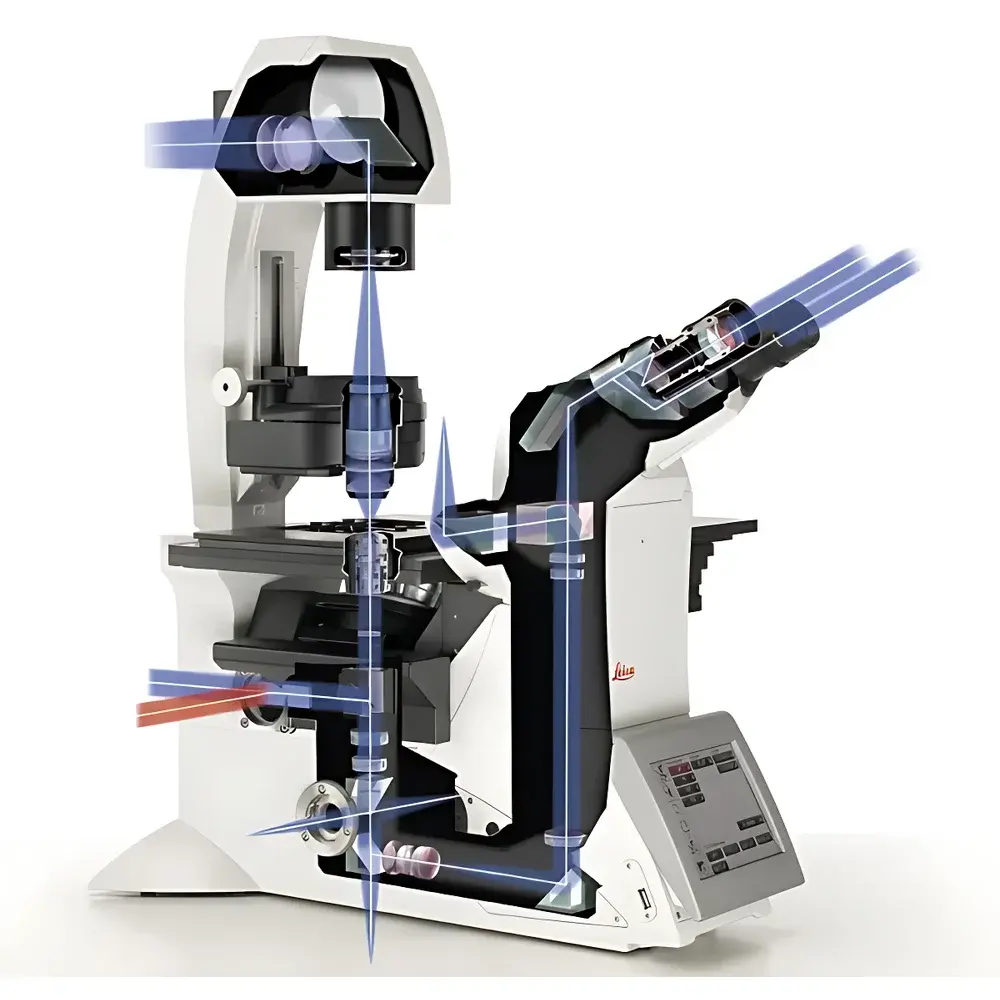
Leica DMi8 M Inverted Fluorescence Metallurgical Microscope
| Brand | Leica |
|---|---|
| Origin | Shanghai, China |
| Manufacturer Type | Authorized Distributor |
| Product Category | Domestic (China-assembled) |
| Model | DMi8 M |
| Configuration Type | Inverted |
| Price Range | USD 42,000 – 70,000 (FOB Shanghai) |
| Optical System | Infinity-Corrected CFI (Leica HCX/HC PL FLUOTAR Objectives) |
| Illumination | LED-based Köhler illumination with intensity stabilization |
| Contrast Modes | Brightfield (BF), Polarized Light (POL), Differential Interference Contrast (DIC), Fluorescence (up to 6 filter cubes), UC-3D™ 3D Contrast Illumination |
| Objective Turret | Manual 6-position M25 nosepiece |
| Macro Mode | 0.7× objective with 35.7 mm FOV |
| Magnification Range | 0.7×–100× (with optional zoom and intermediate optics) |
| Max Sample Weight Capacity | 30 kg |
| Focusing Mechanism | Dual-speed coaxial focus drive (coarse/fine), motorized Z-drive optional |
| Software Platform | Leica Application Suite (LAS) X v3.7+ with Steel Expert, Phase Expert, Grain Expert modules |
| Compliance | ISO 9001 certified manufacturing |
Overview
The Leica DMi8 M is a high-performance inverted metallurgical microscope engineered for precision microstructural analysis in industrial quality control, failure analysis, and advanced materials R&D. Its inverted optical architecture positions the objective lenses beneath the specimen stage—enabling direct observation of large, heavy, or topographically complex samples (up to 30 kg) without repositioning or risk of objective collision. The system employs Leica’s proprietary infinity-corrected optical path with HC PL FLUOTAR objectives, delivering diffraction-limited resolution down to 200 nm (at 100× with oil immersion) and exceptional flatness across wide fields of view. Integrated fluorescence capability supports multi-channel epifluorescence imaging for surface contamination detection, coating integrity assessment, or phosphor layer characterization. Unlike upright systems requiring repeated refocusing across magnifications, the DMi8 M maintains parfocality and parcentricity across its full magnification range (0.7×–100×), significantly reducing operator fatigue and measurement variability in repetitive inspection tasks.
Key Features
- Inverted configuration with ultra-stable mechanical base and vibration-damped stage—optimized for metallographic sample preparation workflows including mounted cross-sections, as-cast ingots, and finished components.
- UC-3D™ illumination—a Leica-exclusive directional LED-based contrast enhancement system that sequentially illuminates the sample from multiple azimuthal angles, generating pseudo-3D topographic contrast without mechanical tilting or scanning.
- Macro-to-nanometer seamless transition: 0.7× macro objective delivers a 35.7 mm field of view for rapid survey imaging; paired with standard 5×–100× objectives, enabling hierarchical analysis from bulk structure to grain boundary detail.
- Modular contrast flexibility: native support for brightfield, polarized light, DIC, and fluorescence—each mode automatically synchronized with objective selection and illumination intensity calibration via encoded turret and LED driver.
- Dual-speed coaxial focusing with ergonomic fine-focus travel (1 µm graduation) and coarse drive (15 mm range); optional motorized Z-axis enables repeatable height mapping and automated focus stacking.
- 6-position manual M25 nosepiece compatible with Leica’s full metallurgical objective portfolio—including long-working-distance, strain-free, and apochromatic variants for quantitative phase analysis.
Sample Compatibility & Compliance
The DMi8 M accommodates specimens up to 300 mm × 300 mm × 120 mm (W × D × H) and weighing up to 30 kg—making it suitable for castings, weldments, turbine blades, and semiconductor substrates. Stage movement is manually controlled with vernier-calibrated X/Y translation (76 mm × 52 mm travel). All optical components meet ISO 10110 surface quality standards; LED illumination complies with IEC 62471 photobiological safety Class 1 requirements. When equipped with LAS X Security Pack, the system satisfies FDA 21 CFR Part 11 requirements for electronic records and signatures—including user authentication, role-based access control, and immutable audit trails for all image acquisition, annotation, and measurement events. Routine calibration protocols align with ASTM E1558 (metallographic specimen preparation) and ISO 4287 (surface roughness evaluation).
Software & Data Management
Leica Application Suite (LAS) X v3.7 serves as the central platform for acquisition, analysis, and reporting. Preconfigured expert modules include Steel Expert (for ASTM E112 grain size quantification), Phase Expert (phase fraction and morphology analysis per ISO 13097), and Grain Expert (crystal orientation mapping integration via optional EBSD interface). All modules support batch processing, report templating (PDF/Excel export), and metadata embedding compliant with MIAME and FAIR data principles. Image storage follows DICOM-SR and TIFF 6.0 standards; raw data retention policies are configurable per GLP/GMP site requirements. Remote collaboration is enabled via Leica’s LAS X Connect server—allowing secure, browser-based review of annotated datasets without local software installation.
Applications
- Metallurgical QC: Grain size distribution, inclusion rating (ASTM E45), decarburization depth, and heat-affected zone (HAZ) characterization in ferrous and non-ferrous alloys.
- Microelectronics: Solder joint integrity, wire bond pull-test fracture analysis, and thin-film delamination detection using UC-3D™ enhanced edge contrast.
- Medical device manufacturing: Surface finish verification of orthopedic implants (ISO 14644-1 particulate counts), coating uniformity on stents, and biocompatibility assay validation.
- Failure analysis labs: Crack propagation path reconstruction, corrosion pit morphology classification, and intergranular vs transgranular fracture differentiation via polarized light and DIC.
- Research institutions: In situ thermal cycling studies (with optional heating stage), electrochemical corrosion monitoring (via fluorescence-labeled inhibitors), and additive manufacturing powder bed inspection.
FAQ
Is the DMi8 M fully assembled and calibrated before shipment?
Yes—each unit undergoes factory alignment of Köhler illumination, objective parfocality, and UC-3D™ angular calibration. A traceable certificate of conformance (CoC) with ISO/IEC 17025-accredited metrology is included.
Can the system be upgraded from manual to motorized operation post-purchase?
Yes—motorized Z-drive, encoded turret, and automated illumination modules are field-installable with minimal downtime and full backward compatibility.
Does LAS X support automated report generation for ISO/ASTM compliance?
Yes—templates for ASTM E112, E3, E45, and ISO 643 are preloaded; custom templates can be built using the LAS X Report Designer with embedded pass/fail logic and statistical process control (SPC) charts.
What fluorescence filter sets are available for metallurgical applications?
Standard configurations include DAPI/FITC/TRITC triple-band, UV-blue-green excitation sets optimized for oxide layer detection, fluorescent penetrant inspection (FPI) residue visualization, and phosphor coating homogeneity assessment.
Is service and technical support available outside Europe?
Leica Microsystems provides global service coverage through authorized service centers in North America, APAC, and EMEA—with 4-hour remote diagnostics SLA and 72-hour on-site response for critical systems under extended warranty contracts.