
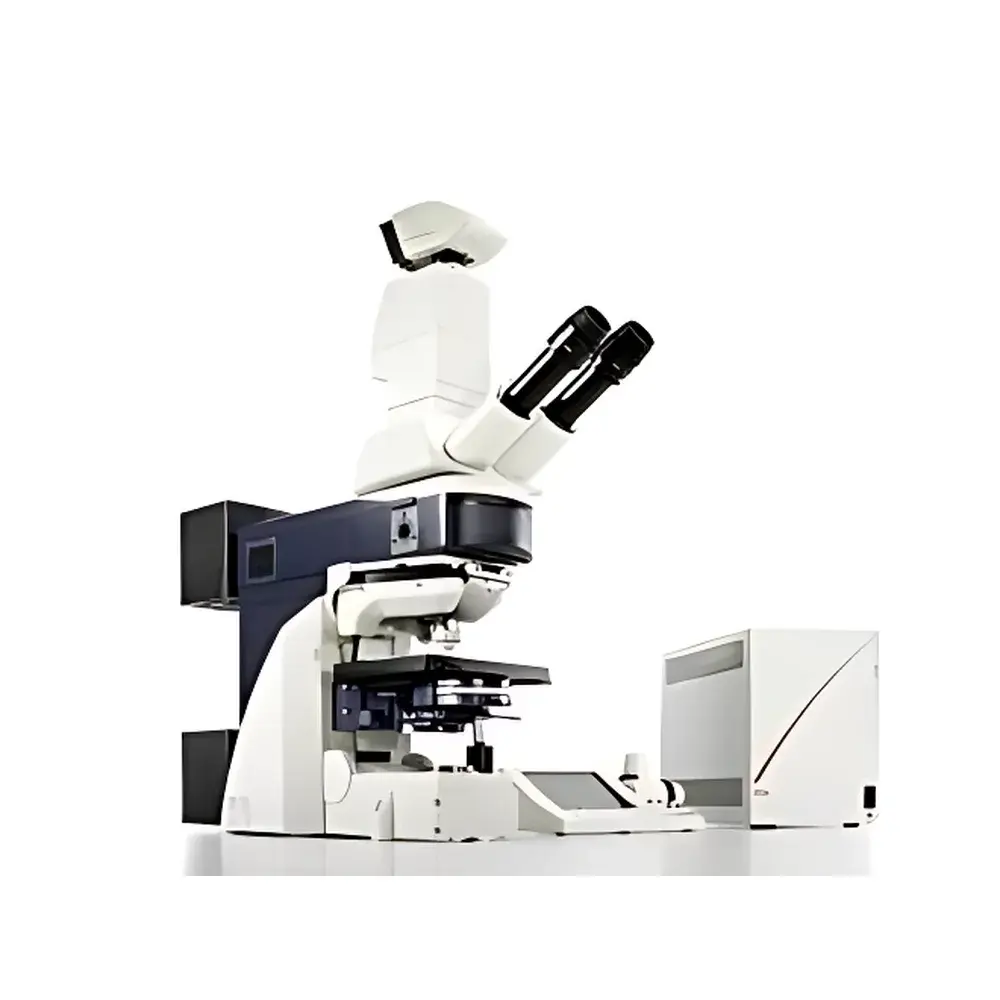
Leica DM6000 FS Fixed-Stage Electrophysiology Microscope
| Brand | Leica |
|---|---|
| Origin | Germany |
| Model | DM6000 FS |
| Type | Fixed-stage upright microscope with infrared DIC capability |
| Objective Compatibility | HCX IRAPO L 25×/0.95 W (water immersion, NA 0.95, WD 2.5 mm, 41° entry angle) |
| Illumination | IR-optimized transmitted light path with motorized DIC slider and Wollaston prism |
| Stage | Motorized fixed-stage platform with zero-drift thermal stabilization |
| Automation | Fully motorized nosepiece (6-position), optional 2-position converter or standalone lens mount |
| Compliance | Designed for GLP/GMP-aligned electrophysiology labs |
Overview
The Leica DM6000 FS is a purpose-engineered fixed-stage upright microscope optimized exclusively for demanding in vitro and slice-based electrophysiology applications. Unlike conventional research microscopes, the DM6000 FS integrates mechanical, optical, and electronic design principles to eliminate vibration coupling, thermal drift, and optical misalignment—three critical failure modes in long-duration patch-clamp, sharp-electrode, and multi-electrode array (MEA) experiments. Its core architecture employs a rigid monolithic baseplate, decoupled motor drive systems, and a thermally stabilized fixed-stage platform that maintains positional fidelity within ±50 nm over 4-hour recordings. The optical path is engineered for near-infrared (NIR) differential interference contrast (DIC) imaging, supporting simultaneous visualization and electrical recording without phototoxicity or signal interference. This system serves as a foundational imaging module in integrated rigs combining confocal imaging, two-photon excitation, and real-time electrophysiological feedback loops.
Key Features
- Fixed-stage mechanical architecture with passive thermal mass compensation and active air-current shielding—eliminates stage drift during prolonged whole-cell recordings.
- IR-optimized optical train featuring Leica’s HCX IRAPO L 25×/0.95 W water-immersion objective: 41° maximum beam entry angle, 2.5 mm working distance, and chromatic correction extended to 1300 nm for compatibility with NIR-guided electrode positioning.
- Dedicated Wollaston prism-based DIC system with motorized slider alignment—enables high-contrast, non-invasive visualization of unstained neurons, dendritic spines, and intracellular organelles in thick brain slices (up to 400 µm).
- Fully motorized 6-position objective turret with programmable acceleration profiles—ensures vibration-free switching between magnifications without disrupting seal formation or membrane capacitance measurements.
- Modular objective mounting options: supports integration of 6-position turrets, dual-objective converters, or independent lens mounts—facilitating hybrid configurations with UV-capable objectives for caged-compound uncaging or fluorescence calcium imaging.
- Electronically isolated control bus compliant with IEEE 11073-10201 (medical device communication standards)—enables synchronized triggering with Axon Digidata, HEKA EPC, or National Instruments DAQ systems.
Sample Compatibility & Compliance
The DM6000 FS accommodates standard electrophysiology sample holders—including perfusion chambers (RC-26GLP, Warner Instruments), custom-built slice recording rigs, and temperature-controlled interface chambers (TC-344B). Its open-stage geometry permits unobstructed access for micromanipulator arms (Sutter MP-285, Scientifica PatchStar) and multi-barrel perfusion systems. All optical components comply with DIN ISO 10110 surface quality standards; mechanical tolerances adhere to VDI/VDE 2622 for precision motion systems. The instrument meets electromagnetic compatibility requirements per EN 61326-1 for laboratory use and supports audit-ready configuration logging required under FDA 21 CFR Part 11 when paired with Leica LAS X software (v3.7+).
Software & Data Management
Control and acquisition are managed via Leica LAS X Core with Electrophysiology Module—a deterministic, low-latency software environment supporting hardware-synchronized timestamping (<10 µs jitter) across camera, stage, illumination, and external analog/digital inputs. The system exports metadata-rich TIFF stacks with embedded DIC retardation calibration data, objective-specific point-spread function (PSF) profiles, and environmental logs (ambient temperature, humidity, CO₂ concentration if interfaced). Data integrity is maintained through SHA-256 checksum validation on all exported files and optional integration with LabArchives ELN or Benchling for GLP-compliant experiment tracking.
Applications
- Intracellular and whole-cell patch-clamp recording in acute brain slices and cultured neurons.
- Sharp-electrode impalement of identified neuronal subtypes in zebrafish, rodent, and human iPSC-derived organoids.
- Combined optogenetic stimulation and electrophysiological readout using NIR-compatible opsins (e.g., ChRmine, ReaChR).
- High-resolution morphological reconstruction via serial DIC Z-stacks prior to biocytin filling and EM processing.
- Real-time monitoring of dendritic spine dynamics during synaptic plasticity protocols (LTP/LTD).
- Multi-modal correlation of electrical activity, calcium transients, and structural remodeling in chronic slice cultures.
FAQ
Is the DM6000 FS compatible with third-party electrophysiology amplifiers and digitizers?
Yes—the microscope features TTL, analog voltage, and USB-C trigger interfaces conforming to Axon Instruments’ pCLAMP synchronization protocol and HEKA’s PatchMaster hardware handshake specifications.
Can the HCX IRAPO L 25×/0.95 W objective be used with conventional visible-light DIC?
No—it is specifically corrected for wavelengths from 700–1300 nm; visible-light DIC requires separate Leica HC PL FLUOTAR objectives with matched Wollaston prisms.
Does the fixed-stage design support XYZ micromanipulator integration?
Yes—stage clearance exceeds 85 mm vertically, and the baseplate includes M6 threaded mounting points aligned to ISO 8573-1 pneumatic interface standards for rigid manipulator coupling.
What maintenance intervals are recommended for long-term stability?
Leica recommends annual calibration of stage position encoders and quarterly verification of DIC bias voltage stability using NIST-traceable reference slides (Leica Calibration Kit #11594007).
Is remote operation supported for core facility shared-resource environments?
Yes—LAS X supports role-based access control (RBAC), encrypted RDP sessions, and centralized license management via Leica Enterprise Server (LES) v2.4+.




