
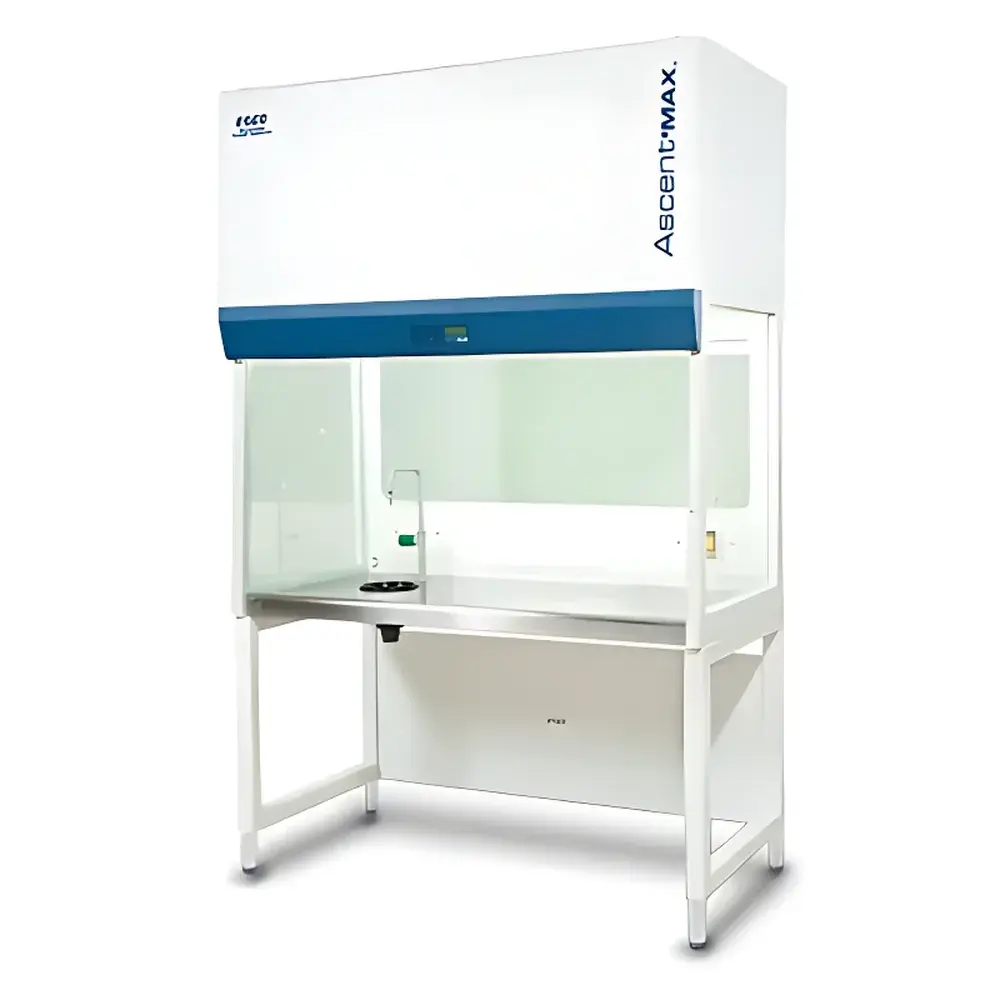
Esco Ascent MAX Ductless Fume Hood ADC-D
| Brand | Esco |
|---|---|
| Origin | Singapore |
| Manufacturer Type | Manufacturer |
| Origin Category | Imported |
| Model | ADC-D |
| Construction | All-Steel, Single-Face Operation |
| Airflow Inflow Velocity | 0.4 m/s |
| Internal Work Area Dimensions (L×W×H) | 1268 × 596 × 765 mm |
| External Dimensions (L×W×H) | 1340 × 736 × 1455 mm |
| Filter Options | Nanocarb™ Activated Carbon Filters (VOC, Acid, Mercury, Sulfur, Halogen, Aldehyde, Ammonia, Ether/Chloroform) |
| Compliance | ASHRAE 110, EN 14175-3, AFNOR NF X 15-203, BS 7989, BS 7258 |
| Surface Coating | ISOCIDE™ Antimicrobial Coating |
| Control System | Sentinel™ Microprocessor-Based Controller |
| Optional Accessories | VOC Sensor, Polypropylene Sink & Faucet (PP), Adjustable Height Stand (SAL), Mobile Stand with Casters (SPC), International Power Outlets, Retrofit Utility Services (Air/Water/Vacuum/Gas) |
Overview
The Esco Ascent MAX Ductless Fume Hood ADC-D is an engineered solution for safe, energy-efficient containment of low-to-moderate volatility chemical vapors in teaching laboratories, research facilities, and quality control environments where ducted exhaust infrastructure is unavailable or impractical. Unlike conventional ducted hoods, the ADC-D operates on a recirculating principle: ambient air is drawn through the sash opening at a certified inflow velocity of 0.4 m/s, passed sequentially through pre-filters and high-capacity Nanocarb™ activated carbon filter modules, and returned to the laboratory after >99.9% adsorption efficiency for targeted contaminants. Its defining feature—the transparent rear acrylic wall—enhances visibility across the full depth of the internal work area (1268 × 596 × 765 mm), making it ideal for live demonstration, student observation, and real-time procedural verification in academic settings. Constructed entirely from corrosion-resistant 304 stainless steel work surfaces and galvanized steel side panels, the ADC-D meets stringent international performance standards including ASHRAE 110 (2016), EN 14175-3 (2021), AFNOR NF X 15-203 (2017), BS 7989 (2001), and BS 7258 (2001), ensuring validated containment integrity under dynamic operational conditions.
Key Features
- Transparent rear acrylic panel improves line-of-sight access to the entire work zone—critical for instructional transparency and ergonomic posture during extended use.
- ISOCIDE™ antimicrobial coating applied to all exposed interior surfaces inhibits microbial colonization on stainless steel and polymer components without leaching or compromising material integrity.
- Sentinel™ microprocessor-based control system continuously monitors sash position, airflow stability, and filter saturation status; triggers audible and visual alarms upon deviation from safe operating thresholds.
- Front-access service panel enables full maintenance—including filter replacement, sensor calibration, and internal component inspection—without relocating the unit or removing rear enclosures, supporting wall-mounted installation to conserve floor space.
- Integrated front-edge upstand (15 mm height) prevents accidental spill migration beyond the work surface, retaining liquids within the containment boundary per ISO 15195:2022 guidance for laboratory safety design.
- Eight specialized Nanocarb™ filter configurations are available—including formulations optimized for VOCs, organic acids, mercury vapor, sulfur compounds, halogens, aldehydes, ammonia, and chlorinated solvents—allowing precise matching to application-specific hazard profiles.
- Ergonomic sliding sash frame features smooth, low-friction operation with balanced counterweights and soft-stop positioning to minimize user fatigue and mechanical wear over time.
Sample Compatibility & Compliance
The ADC-D is validated for use with non-radioactive, non-explosive, and non-particulate-generating chemical processes emitting vapors within the adsorption capacity and breakthrough limits of its selected Nanocarb™ filter configuration. It is not intended for use with perchloric acid, hydrofluoric acid, or substances generating submicron aerosols or radioactive isotopes. All units undergo factory-certified ASHRAE 110 tracer gas testing (SF6) prior to shipment, with full test reports traceable to NIST-calibrated instrumentation. The hood’s structural compliance with EN 14175-3 includes rigorous evaluation of face velocity uniformity, containment leakage, and resistance to thermal and mechanical stress. For regulated environments, the Sentinel™ controller supports optional audit trail logging compatible with GLP/GMP documentation requirements, and optional VOC sensor integration provides real-time concentration monitoring aligned with OSHA PEL and ACGIH TLV reference values.
Software & Data Management
The Sentinel™ controller operates as a standalone embedded system with no external software dependency. It stores up to 30 days of operational logs—including sash position history, average inflow velocity, cumulative runtime, and filter usage hours—in non-volatile memory. Data export is supported via USB interface (CSV format) for integration into institutional LIMS or EHS management platforms. Optional VOC sensor output can be configured for analog 4–20 mA signal transmission or digital Modbus RTU protocol, enabling connection to building automation systems (BAS) or centralized environmental monitoring dashboards. Firmware updates are performed via secure USB key with version-controlled release notes and SHA-256 checksum validation.
Applications
- Undergraduate and graduate chemistry laboratory instruction—especially for titrations, solvent extractions, and reagent dispensing where visual supervision is required.
- Pharmaceutical QC labs performing routine assay preparation, standard dilution, and HPLC sample handling with volatile organic solvents.
- Materials science labs conducting polymer synthesis, thin-film deposition, or catalyst activation using moderate-hazard precursors.
- Hospital pharmacy compounding areas adhering to USP and guidelines for non-sterile hazardous drug handling, when paired with appropriate filter media.
- Environmental testing facilities performing EPA Method 8260/8270 preparatory steps involving VOC-spiked matrices.
FAQ
What types of chemicals can be safely handled in the ADC-D?
The ADC-D is suitable for low-to-moderate volatility organic and inorganic vapors—including acetone, ethanol, methanol, toluene, formaldehyde, nitric acid fumes, and mercury vapor—provided the correct Nanocarb™ filter type is selected and replaced according to usage-based saturation indicators or scheduled intervals.
Does the ADC-D require external ductwork or make-up air systems?
No. It is a fully self-contained, recirculating system requiring only standard 220–240 VAC, 50 Hz power input and no connection to building exhaust infrastructure.
How often must the carbon filters be replaced?
Filter service life depends on chemical type, concentration, exposure duration, and airflow rate. Esco recommends monitoring via Sentinel™ alerts and replacing filters every 6–12 months under typical academic use, or sooner if VOC sensor readings exceed preset thresholds.
Can the ADC-D be installed flush against a wall?
Yes. Front-access maintenance design allows wall-mounting without rear clearance, maximizing usable lab floor area while maintaining full serviceability.
Is the unit compliant with FDA 21 CFR Part 11 for electronic records?
While the base Sentinel™ controller does not include Part 11–compliant electronic signature functionality, optional firmware and audit-log modules are available for validated environments requiring ALCOA+ data integrity principles.



