
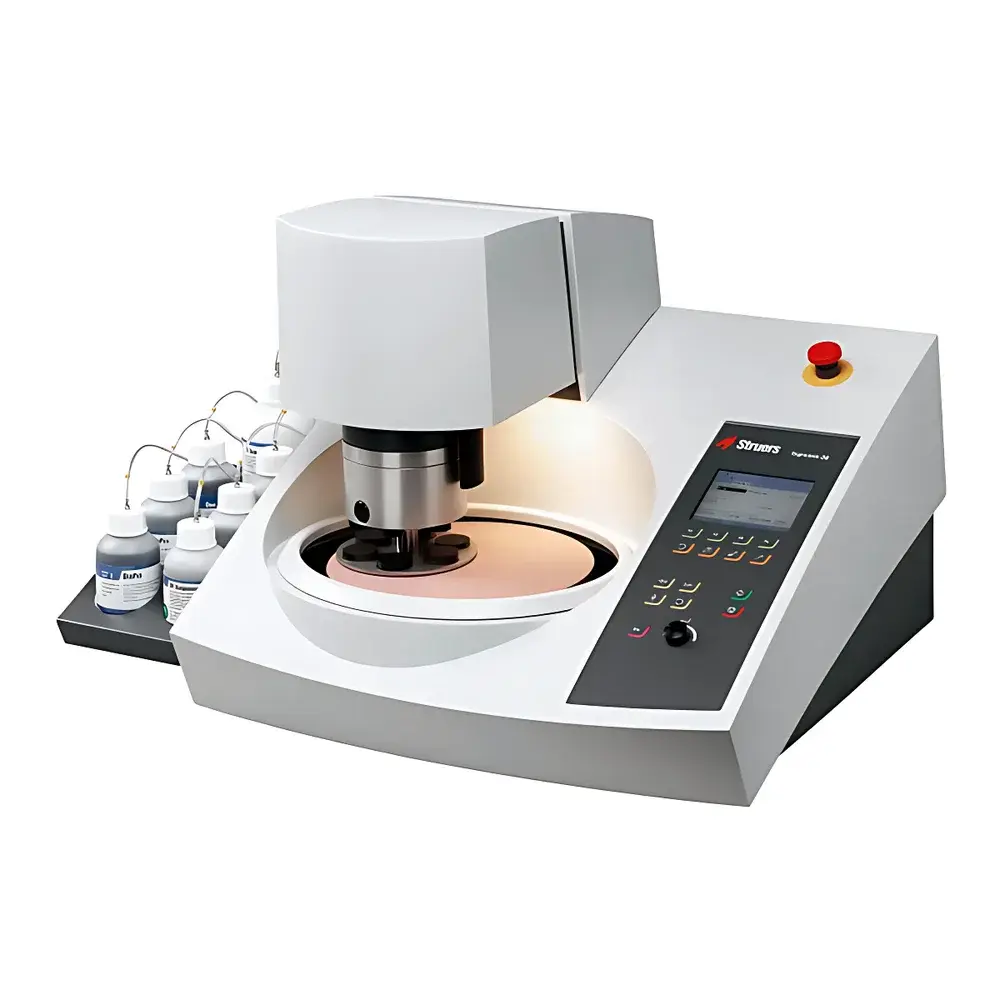
Struers Tegramin Automated Grinding and Polishing System
| Brand | Struers |
|---|---|
| Origin | Denmark |
| Model | Tegramin |
| Grinding Plate Count | 1 |
| Plate Diameter Options | 200 mm / 250 mm / 300 mm |
| Platen Speed Range | 40–600 rpm |
| Specimen Holder Rotation Speed | 50–150 rpm |
| Dimensions (L×W×H) | 480 × 600 × 650 mm |
| Sample Capacity (Tegramin-30) | up to six 50-mm-diameter specimens or one 160/200-mm-diameter multi-specimen holder |
| Sample Capacity (Tegramin-25) | up to six 40-mm-diameter specimens or three 50-mm-diameter specimens plus one 140/160-mm-diameter holder |
| Sample Capacity (Tegramin-20) | up to four 40-mm-diameter specimens |
Overview
The Struers Tegramin Automated Grinding and Polishing System is a precision-engineered, modular specimen preparation platform designed for reproducible, high-throughput metallographic and materials science sample preparation. Built upon Struers’ decades of expertise in microstructural analysis workflows, the Tegramin system employs controlled rotational motion—comprising independent platen rotation and synchronized specimen holder orbital motion—to deliver uniform material removal, minimal edge rounding, and consistent surface planarity across diverse material classes. Its architecture integrates mechanical stability with programmable speed control, enabling precise adaptation to brittle ceramics, soft polymers, hard alloys, and composite laminates. Unlike manual or semi-automated grinders, the Tegramin operates under defined force-speed-time parameters, ensuring inter-laboratory comparability and compliance with standardized preparation protocols referenced in ASTM E3, ISO 14487, and EN 10365.
Key Features
- Three scalable configurations: Tegramin-20 (200-mm platen), Tegramin-25 (250-mm platen), and Tegramin-30 (300-mm platen), each optimized for distinct throughput and specimen geometry requirements.
- Independent dual-speed control: Platen rotation adjustable from 40 to 600 rpm; specimen holder rotation from 50 to 150 rpm—enabling low-speed finishing for sensitive phases (e.g., intermetallics or thin coatings) and high-speed stock removal for rapid pre-grinding.
- Robust cast-iron base and vibration-damped column structure ensure mechanical rigidity during extended operation, minimizing runout and preserving surface flatness within ±0.02 mm over full platen diameter.
- Intuitive interface with preloaded method templates for common material systems (e.g., aluminum alloys, stainless steels, WC-Co cermets, SiC composites), supporting seamless transition between grinding, fine grinding, and polishing stages.
- Integrated coolant delivery system with adjustable flow rate and directional nozzles ensures consistent lubrication and thermal management—critical for preventing phase transformation in heat-sensitive alloys such as Ti-6Al-4V or austenitic stainless steels.
Sample Compatibility & Compliance
The Tegramin accommodates single specimens (up to 50 mm Ø), multi-specimen holders (140–200 mm Ø), and custom fixtures for irregular geometries including cross-sectioned wires, thin foils, and additively manufactured tensile coupons. Its mechanical design conforms to IEC 61000-6-2 (EMC immunity) and IEC 61000-6-4 (EMC emission) standards. All operational parameters—including speed setpoints, dwell time per stage, and applied load profiles—are fully loggable and exportable, supporting audit readiness for GLP and GMP environments. When paired with Struers’ Opal software and compliant documentation packages, the system meets traceability requirements aligned with ISO/IEC 17025 and FDA 21 CFR Part 11 for electronic records and signatures.
Software & Data Management
The Tegramin operates natively with Struers’ Opal software suite, which provides method-driven workflow control, real-time parameter monitoring, and secure user-level access management. Each preparation cycle generates a timestamped digital record containing platen speed, holder speed, elapsed time per stage, coolant status, and operator ID—stored locally or on networked servers with configurable retention policies. Export formats include CSV and PDF reports compatible with LIMS integration. Audit trail functionality logs all parameter modifications, user logins, and method revisions, fulfilling ALCOA+ principles (Attributable, Legible, Contemporaneous, Original, Accurate, Complete, Consistent, Enduring, Available) for regulated quality assurance labs.
Applications
The Tegramin serves critical roles in failure analysis laboratories, foundry QC departments, academic metallurgy programs, and aerospace component certification facilities. Typical use cases include: preparation of cross-sections for SEM-EDS phase identification; planarization of turbine blade coatings prior to nanoindentation; edge-preserving grinding of battery electrode cross-sections for porosity quantification; and serial sectioning of additive manufacturing builds to assess layer bonding integrity. Its repeatability supports statistical process control (SPC) initiatives where >95% consistency in surface roughness (Ra) and subsurface deformation depth is required across batches of 50+ specimens.
FAQ
What platen sizes are available for the Tegramin system?
The Tegramin is offered in three configurations: Tegramin-20 (200 mm platen), Tegramin-25 (250 mm platen), and Tegramin-30 (300 mm platen), each with corresponding specimen holder compatibility.
Can the Tegramin be integrated into an automated lab workflow?
Yes—the system supports RS-232 and Ethernet communication protocols, enabling integration with robotic sample loaders and central laboratory information management systems (LIMS).
Is calibration documentation provided with the instrument?
Struers supplies factory calibration certificates for rotational speed accuracy (±1 rpm tolerance) and torque consistency (±2% FS), traceable to DKD/DAkkS-accredited standards.
Does the Tegramin support both dry and wet grinding protocols?
The system is engineered exclusively for wet grinding and polishing using aqueous or oil-based lubricants; dry operation is not supported due to thermal and wear constraints.
What maintenance intervals are recommended for long-term reliability?
Platen bearing inspection every 1,500 operating hours; coolant filter replacement every 200 hours; and full mechanical alignment verification annually—or after relocation—per Struers’ Service Manual SM-TEG-001 Rev. D.



