
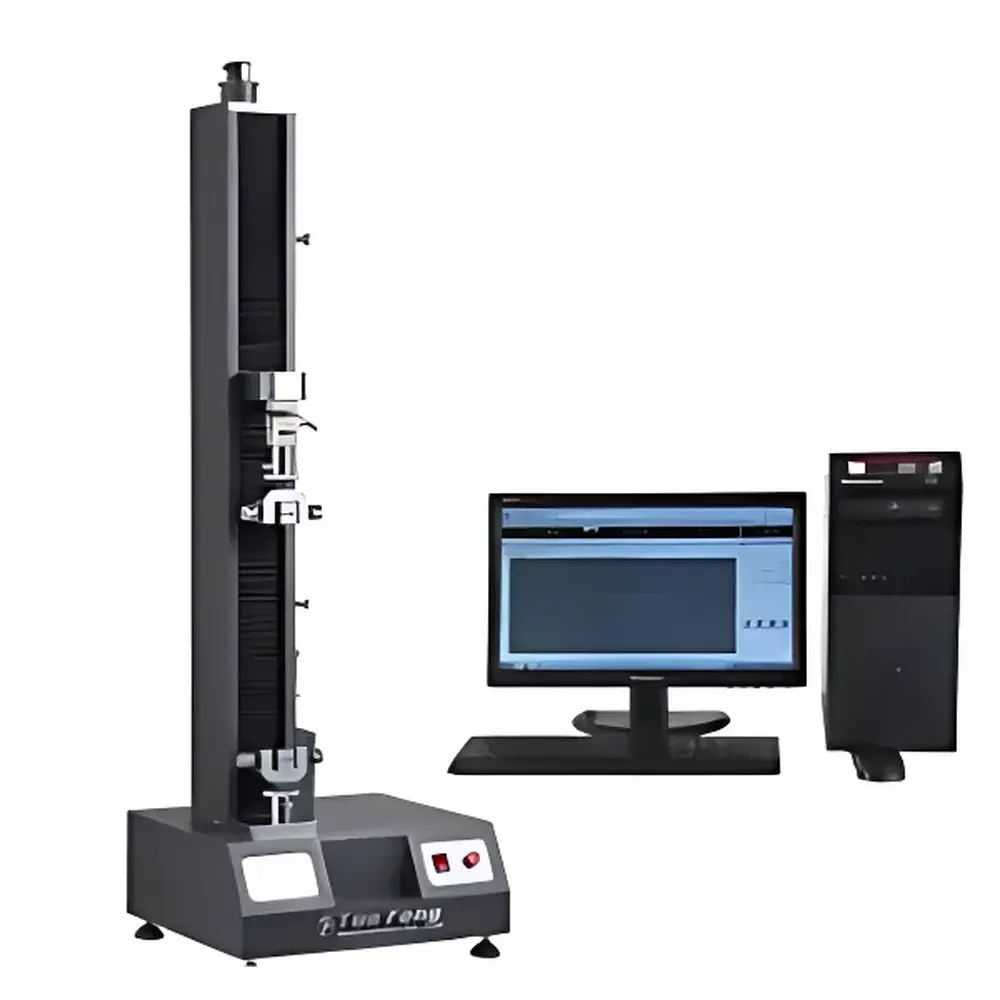
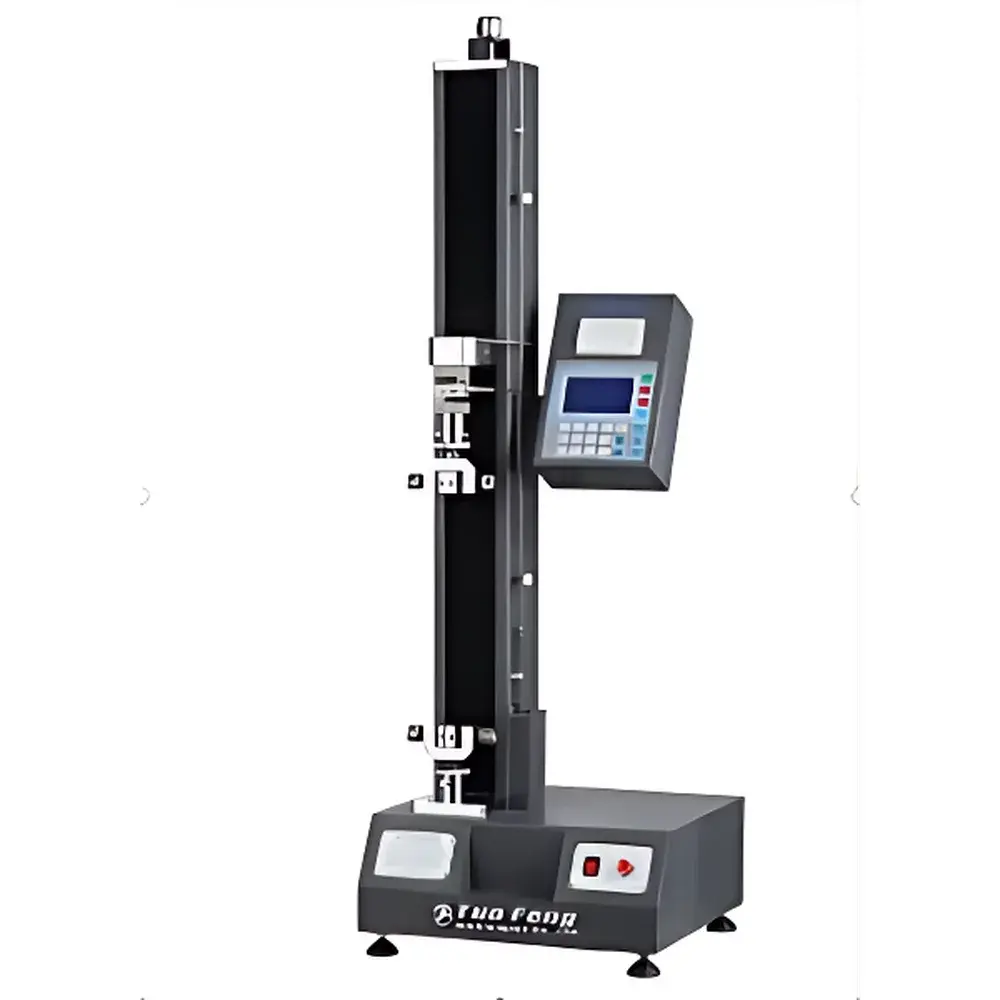
Tuofeng TFL-5 Microcomputer-Controlled Electronic Tensile Testing Machine
| Brand | Tuofeng |
|---|---|
| Origin | Shanghai, China |
| Manufacturer Type | Direct Manufacturer |
| Regional Classification | Domestic (China) |
| Model | TFL-5 |
| Instrument Category | Electronic Tensile Testing Machine |
| Maximum Test Load | 5 kN |
| Force Measurement Range | 0.4%–100% of Full Scale (FS) |
| Force Accuracy | ±0.5% of reading |
| Crosshead Travel | 700 mm |
| Displacement Resolution | ±0.5% of reading |
Overview
The Tuofeng TFL-5 Microcomputer-Controlled Electronic Tensile Testing Machine is an electromechanical static testing system engineered for precision mechanical property evaluation of solid materials under uniaxial tension, compression, peel, tear, and flexural loading conditions. Based on servo-controlled motor actuation and high-stability load cell transduction, the system operates according to fundamental principles of Hooke’s law and standardized stress–strain constitutive modeling. It delivers repeatable, traceable force and displacement measurements aligned with international mechanical testing frameworks—including ASTM E4, ASTM E8/E8M, ISO 6892-1, GB/T 228.1, JIS Z 2241, and DIN 50125—making it suitable for quality control laboratories, R&D centers, and third-party certification facilities requiring GLP-compliant data acquisition.
Key Features
- High-fidelity 5 kN load capacity with dual-range or seamless full-scale transduction, calibrated to Class 0.5 accuracy per ISO 7500-1 and verified traceable to national metrological standards.
- Robust crosshead architecture with 700 mm vertical travel, supporting extended specimen lengths and modular fixture integration; optional height extension available upon request.
- Precision displacement measurement via optical encoder with resolution stability maintained across the entire stroke, achieving ±0.5% displacement accuracy per ISO 6892-1 Annex B.
- Wide-speed actuation range: 0.01–500 mm/min, continuously adjustable without gear shifting—enabling low-strain-rate creep studies and high-speed peel tests within a single platform.
- Integrated safety subsystems including electronic limit switches, emergency stop circuitry, overload protection (>110% FS), and programmable return-to-start protocols.
- Modular test table with three-speed motorized elevation (fast/medium/slow), manual jog control, and automatic post-test retraction to initial position.
Sample Compatibility & Compliance
The TFL-5 accommodates a broad spectrum of specimen geometries and material classes: metallic wires and foils (diameters ≥0.1 mm), polymer films and elastomers, textile yarns and nonwovens, paperboard and corrugated substrates, adhesive tapes and laminates, and biomedical packaging films. Fixture adaptability includes wedge-action grips, pneumatic clamps, peel arms, and custom-designed holders for terminals, connectors, and micro-components. All test procedures comply with mandatory reporting requirements under ISO/IEC 17025 for accredited testing labs. Data integrity meets audit readiness criteria for FDA 21 CFR Part 11 when configured with user authentication, electronic signatures, and immutable audit trails—available via optional software modules.
Software & Data Management
The Windows-based TensilePro™ testing software (compatible with Windows 10/11, 64-bit) provides full IEC 62304-aligned control and analysis functionality. It supports multiple test modes—including constant rate of extension (CRE), constant load ramping, hold-to-failure, and cyclic loading—with real-time switching between load–time, load–displacement, stress–strain, and extension–time plots. Units are freely convertible among SI, imperial, and legacy systems (e.g., N/kN/lbf, mm/in, MPa/psi). Calculated outputs include tensile strength, yield point (0.2% offset), modulus of elasticity, elongation at break, peel adhesion (N/mm), and tear resistance (kN/m). Raw data exports to CSV, XML, or PDF formats; batch comparison overlays up to 12 curves; statistical summaries (mean, min, max, CV%) auto-generate per test series. Software updates and technical support are provided free of charge for the instrument’s operational lifetime.
Applications
- Metallurgical QA: Verification of yield strength and ductility in drawn copper wire, stainless steel foil, and aluminum alloy strips per ASTM B667 and GB/T 3190.
- Packaging Integrity: Quantification of seal strength, burst pressure, and puncture resistance in medical pouches and food-grade laminates per ASTM F88, ASTM F1140, and ISO 11607-2.
- Textile & Nonwoven Testing: Evaluation of breaking tenacity, knot strength, and seam slippage in technical fabrics per ASTM D5035 and ISO 13934-1.
- Electronics Manufacturing: Pull-testing of solder joints, crimped terminals, and flexible printed circuit board (FPCB) interconnects per IPC-J-STD-001 and IEC 61189-2.
- Adhesive Development: Characterization of lap-shear, T-peel, and 180° peel performance across temperature-humidity gradients using environmental chamber integration.
FAQ
What standards does the TFL-5 support out-of-the-box?
The system includes pre-configured test methods for ASTM E8, ISO 6892-1, GB/T 228.1, JIS Z 2241, and DIN 50125. Custom method templates can be imported or built via the software’s scripting interface.
Can the TFL-5 be integrated with LIMS or MES platforms?
Yes—via TCP/IP or RS232 communication protocols, the controller supports ASTM WK52709-compliant data streaming and SCADA-level integration with laboratory information management systems.
Is calibration documentation included with shipment?
Each unit ships with a factory calibration certificate compliant with ISO/IEC 17025, listing as-found/as-left values for load and displacement channels, traceable to CNAS-accredited reference standards.
What is the recommended maintenance schedule?
Load cell verification every 6 months; mechanical alignment and lubrication annually; encoder and firmware validation during each scheduled recalibration event.
Does the system support extensometer attachment?
Yes—the TFL-5 features standard analog and digital input ports compatible with clip-on, video, and laser extensometers meeting ISO 9513 Class 1 or better specifications.
Related Products



