
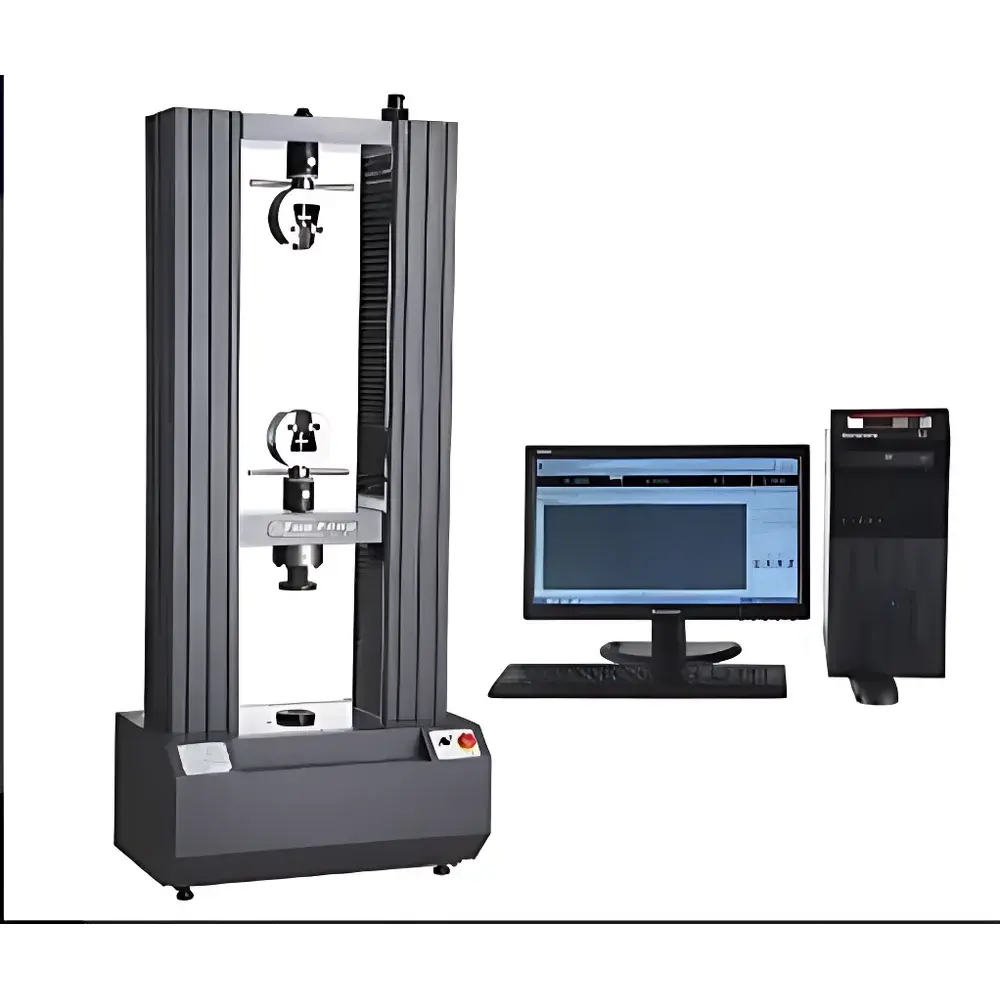
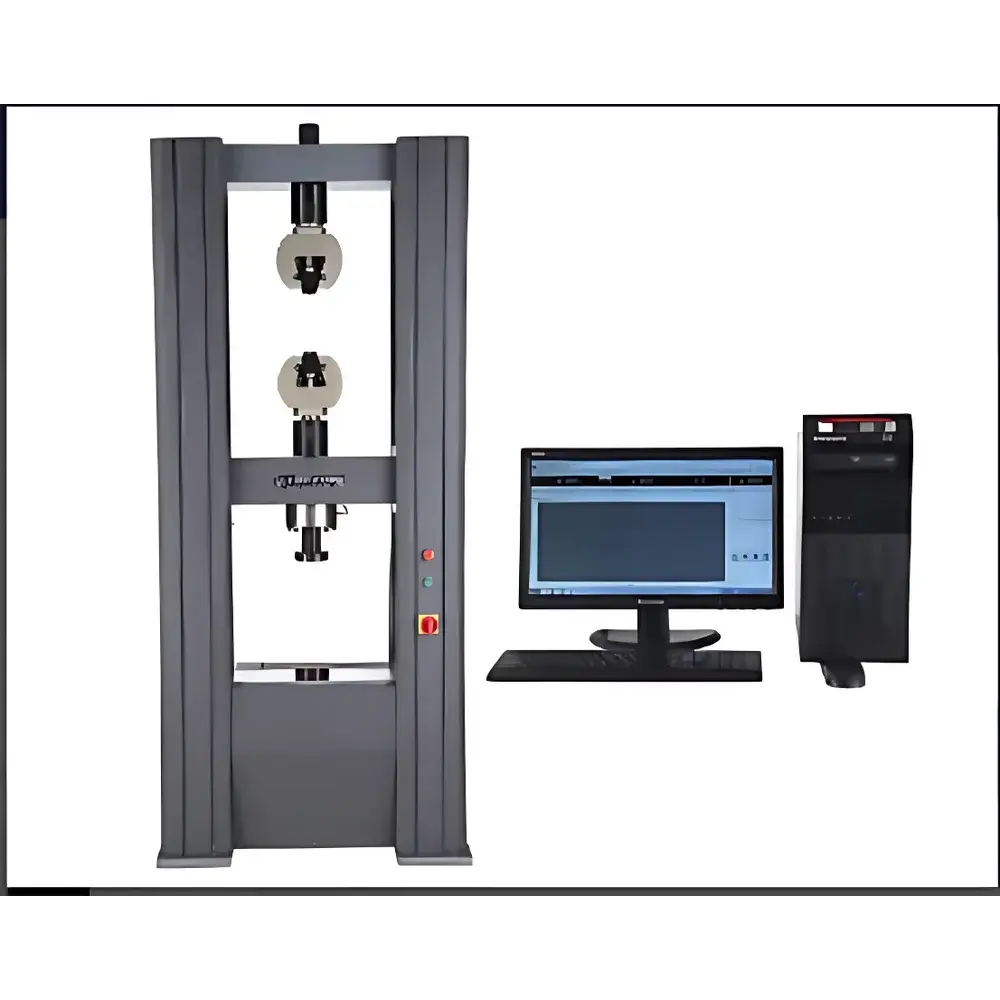
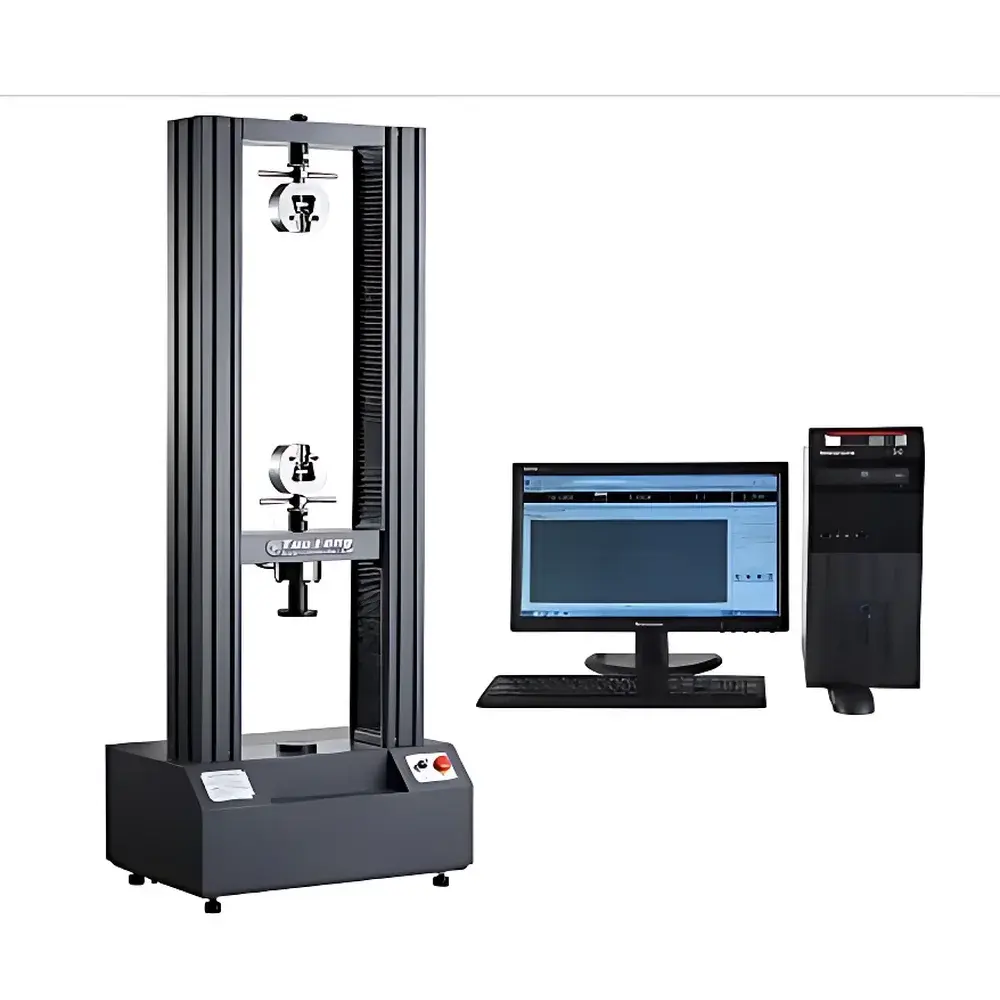
Tuofeng TFW-109 Microcomputer-Controlled Electronic Universal Tensile Testing Machine
| Brand | Tuofeng |
|---|---|
| Origin | Shanghai, China |
| Manufacturer Type | Direct Manufacturer |
| Product Category | Domestic |
| Model | TFW-109 |
| Instrument Type | Electronic Universal Testing Machine |
| Maximum Test Load | 200 kN |
| Force Measurement Range | 0.2%–100% of Full Scale (FS) |
| Force Accuracy | ±0.5% of reading |
| Test Stroke | 1000 mm |
| Displacement Resolution | 0.001 mm |
| Control System | PC-based closed-loop microprocessor control |
| Drive System | Imported servo motor with precision worm gear reducer |
| Actuation Mechanism | High-accuracy preloaded ball screw |
| Effective Test Width | 600 mm (customizable) |
| Speed Range | 0.001–500 mm/min (infinitely variable, programmable) |
| Displacement Measurement | Optical encoder |
| Displacement Accuracy | ±0.005% of reading |
| Strain Measurement | Optional extensometer (clip-on or video-based) |
| Safety Protection | Dual-limit electronic positioning, emergency stop, overload cutoff (>110% FS), automatic return after test |
| Compliance | GB/T 16491–2008, JJG 475–2008, ASTM E4, ASTM E8/E21, ISO 6892-1, ISO 7500-1, DIN 51221, JIS Z2241, BS EN 10002-1 |
Overview
The Tuofeng TFW-109 Microcomputer-Controlled Electronic Universal Tensile Testing Machine is a high-precision static mechanical testing system engineered for standardized uniaxial mechanical characterization of metallic, polymeric, composite, and ceramic materials. Based on closed-loop servo-controlled electromechanical actuation, the system applies controlled tensile, compressive, flexural, shear, tear, peel, and puncture loads while synchronously acquiring force, displacement, and (optionally) strain data at sub-millisecond intervals. Its modular architecture supports full compliance with international mechanical testing standards—including ASTM E4 (load verification), ASTM E8/E21 (tensile testing of metals), ISO 6892-1 (metallic materials), ISO 7500-1 (static calibration), and GB/T 16491–2008 (Chinese electronic universal testing machine specification). Designed for laboratory and industrial QA/QC environments, the TFW-109 delivers traceable, repeatable, and auditable mechanical property measurements under GLP- and GMP-aligned operational frameworks.
Key Features
- 200 kN maximum load capacity with dual-range high-stability load cell calibrated to ISO 7500-1 Class 0.5 accuracy.
- Full-scale force measurement range from 0.2% to 100% FS without range switching—ensuring consistent resolution across low-force polymer testing and high-load structural metal evaluation.
- Precision preloaded ball screw transmission system coupled with imported servo motor and worm gear reducer, enabling smooth, backlash-free motion control and long-term mechanical stability.
- Optical encoder-based displacement measurement with 0.001 mm resolution and ±0.005% linearity—validated per JJG 475–2008 metrological requirements.
- Dual-speed motorized crosshead adjustment (fast/slow modes) with programmable return-to-start functionality and position memory for multi-step test protocols.
- Integrated hardware safety suite: electronic dual-limit switches, emergency stop circuitry, real-time overload detection (>110% FS), and automatic shutdown with audible/visual alert.
- Modular fixture interface supporting ASTM- and ISO-compliant grips—including wedge-action, pneumatic, hydraulic, and custom-designed tooling for flat, round, or irregular specimens.
Sample Compatibility & Compliance
The TFW-109 accommodates specimens ranging from thin films (≥0.05 mm thickness) to structural steel coupons (up to 50 mm thick), with customizable test widths (400–600 mm) and stroke extensions (up to 1000 mm). Standard configurations include flat-plate and cylindrical grip sets compliant with ASTM E8 Annex A1 and ISO 6892-1 Annex B. Optional accessories include clip-on axial extensometers (ISO 9513 Class 1), video extensometry systems (for non-contact strain mapping), environmental chambers (−70°C to +300°C), and high-temperature furnaces (up to 1200°C). All hardware and firmware are validated against national and international regulatory expectations—including traceability to NIM (National Institute of Metrology, China) and compatibility with FDA 21 CFR Part 11–compliant audit trails when configured with optional electronic signature modules.
Software & Data Management
The Windows-based Tuofeng TestSuite v4.2 software provides ISO/IEC 17025-aligned test execution and reporting. It supports seven predefined control modes: constant rate of extension (CRE), constant rate of loading (CRL), constant stress, constant strain, hold (load/position/time), cyclic loading, and ramp-hold-ramp sequences. Real-time plotting includes force–time, force–displacement, stress–strain, displacement–time, and dual-channel extension curves—with overlay capability for comparative analysis of up to 16 datasets. All raw data (force, displacement, time stamps, temperature if equipped) are stored in encrypted binary format with embedded metadata (operator ID, sample ID, standard reference, calibration date). Export options include CSV, XML, PDF reports (with digital signature support), and direct integration with LIMS via ODBC or REST API. Software updates are delivered remotely with version-controlled changelogs and validation documentation available upon request.
Applications
The TFW-109 serves as a primary mechanical testing platform across R&D, production QA, and third-party certification laboratories. In aerospace, it validates tensile properties of Ti-6Al-4V sheet stock per AMS 2300 and carbon fiber laminates per ASTM D3039. In automotive manufacturing, it verifies weld strength (ASTM C1174), rubber bushing compression set (ASTM D395), and brake pad shear integrity (SAE J661). For medical device manufacturers, it performs peel testing of sterile packaging (ASTM F88), suture tensile strength (ISO 10993-12), and polymer film puncture resistance (ASTM F1306). In construction materials, it determines compressive strength of concrete cylinders (ASTM C39), flexural modulus of FRP rebar (ACI 440.3R), and adhesion of waterproof membranes (EN 13914-1). Academic users leverage its open API for custom algorithm development in constitutive modeling and digital twin calibration.
FAQ
What standards does the TFW-109 comply with for force calibration?
The system meets ISO 7500-1 Class 0.5 requirements and is supplied with NIST-traceable calibration certificates covering the full 0.2–100% FS range.
Can the machine perform cyclic fatigue testing?
Yes—when equipped with optional high-cycle controller and thermal management module, it supports sinusoidal, trapezoidal, and block-loading waveforms up to 5 Hz (dependent on specimen mass and stroke amplitude).
Is remote operation and monitoring supported?
Standard Ethernet connectivity enables secure remote access via VNC or TeamViewer; optional cloud telemetry module provides real-time health monitoring and predictive maintenance alerts.
How is data integrity ensured for regulated environments?
Audit trail logging, electronic signatures, user role-based permissions, and 21 CFR Part 11–compliant configuration files are available through the validated software add-on package.
What is the typical lead time for custom fixture design?
Standard fixtures ship within 5 business days; application-specific tooling (e.g., ASTM D638 dog-bone grips, ISO 527-2 multipurpose tabs) requires 12–18 working days following final dimensional approval.



