
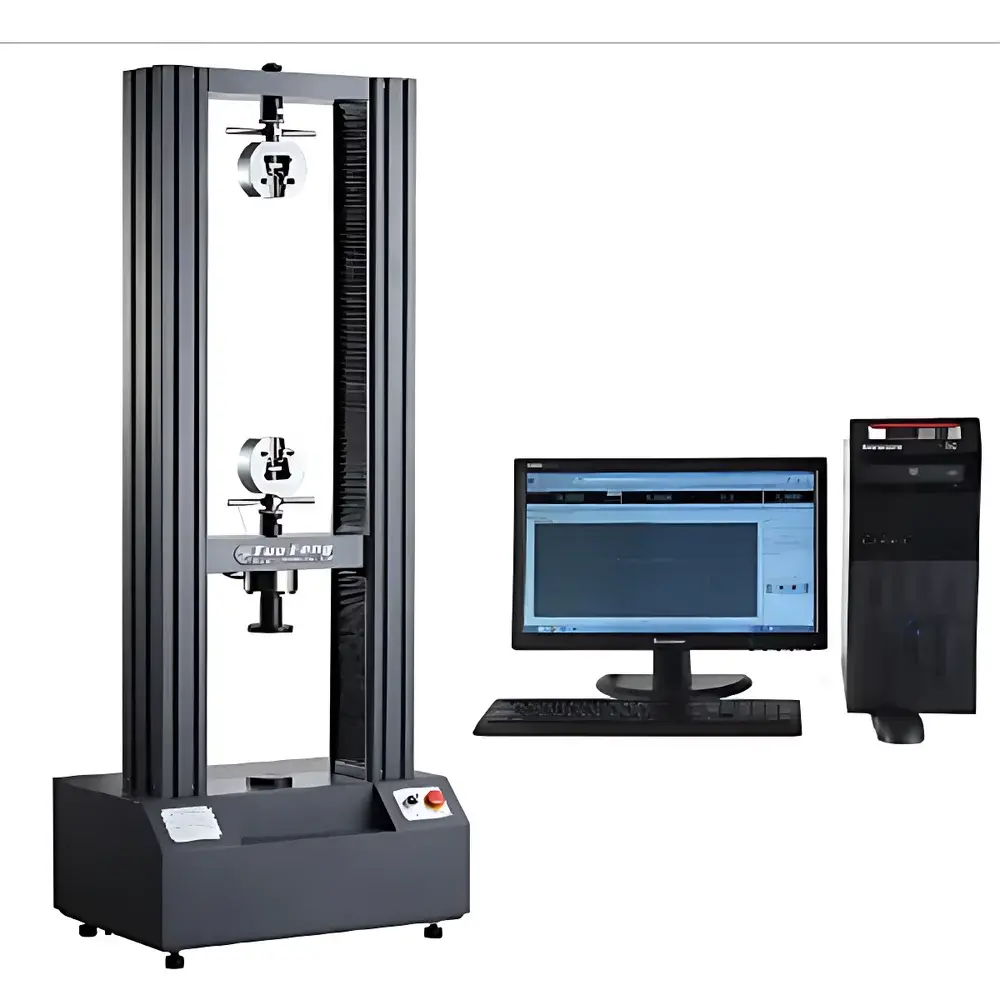
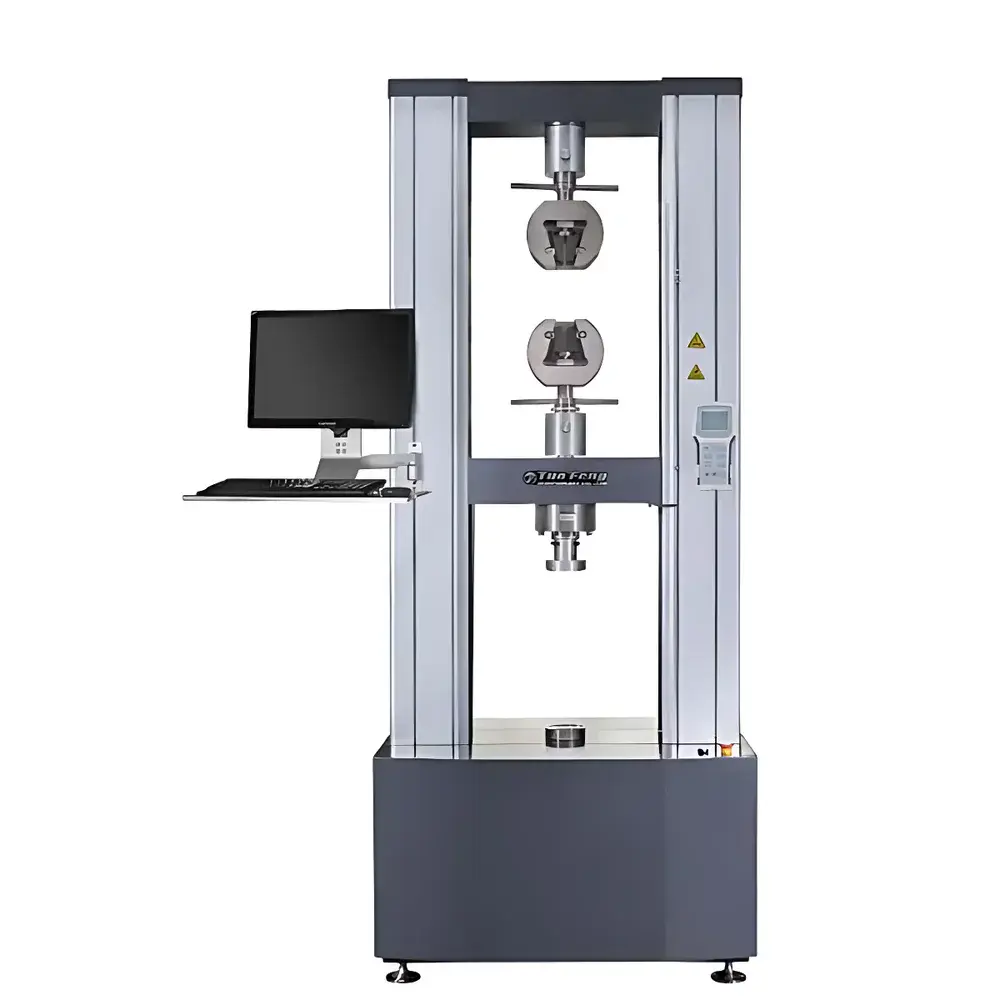
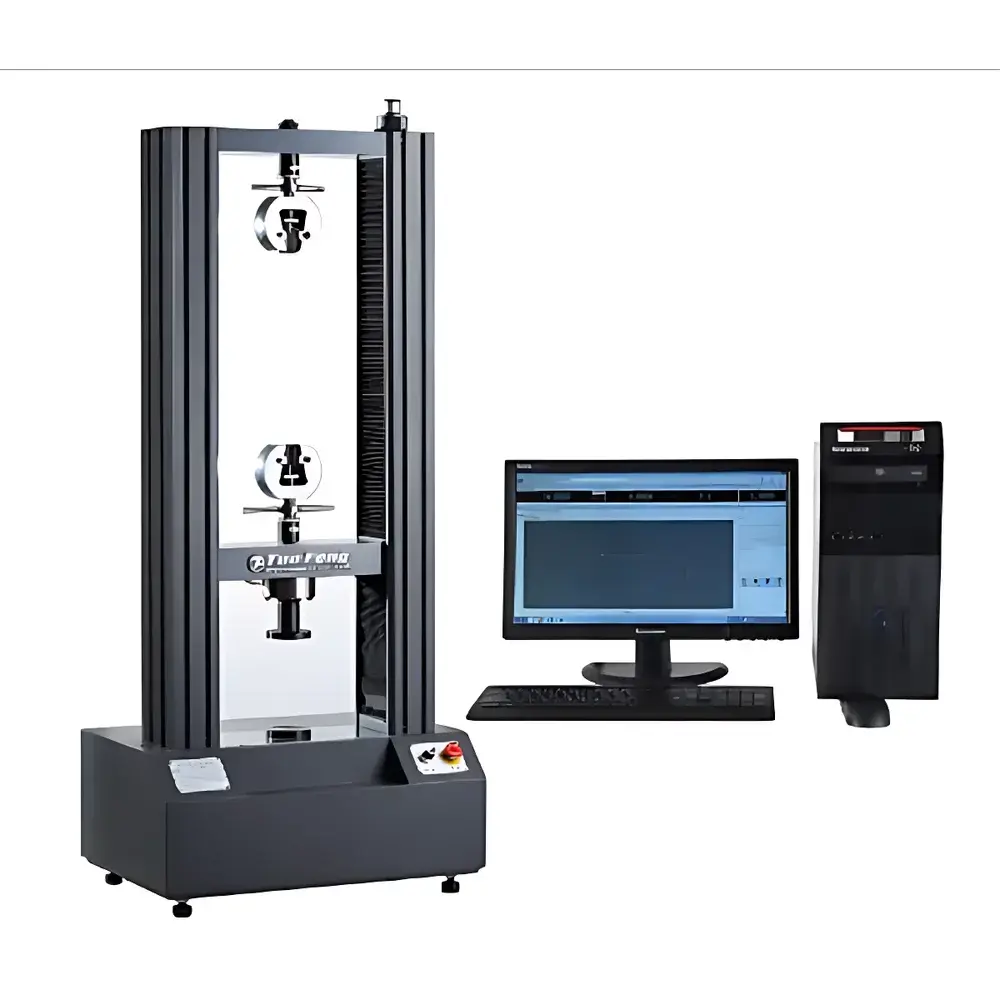
Tuofeng TFW-303 Computer-Controlled Servo-Powered Dual-Column Universal Testing Machine
| Brand | Tuofeng |
|---|---|
| Origin | Shanghai, China |
| Manufacturer Type | Direct Manufacturer |
| Instrument Type | Electromechanical Universal Testing Machine |
| Model | TFW-303 |
| Load Capacity | 300 kN |
| Load Accuracy | ±0.5% |
| Compliance | GB/T 16491-2008, JJG 475-2008, ASTM E4, ISO 7500-1, DIN 51221, JIS B 7721 |
| Accuracy Class | 0.5 |
| Effective Force Range | 0.2–100% of full scale |
| Force Resolution | 1 part in 500,000 full-scale code (fixed resolution, no range switching) |
| Speed Range | 0.001–500 mm/min (infinitely variable) |
| Displacement Accuracy | ±0.005% of reading |
| Extensometer Compatibility | Clip-on or video extensometer (optional) |
| Safety Features | Electronic limit switches, emergency stop, overload protection (110% FS auto-shutdown) |
Overview
The Tuofeng TFW-303 is a high-precision, dual-column electromechanical universal testing machine engineered for static mechanical property characterization of metallic, polymeric, composite, and ceramic materials under tension, compression, bending, shear, peel, tear, and puncture loading conditions. Built upon a rigid, low-resonance frame with preloaded high-accuracy ball screws and a servo-controlled drive system, the TFW-303 delivers repeatable force application and displacement control across its full 300 kN capacity range. Its measurement architecture complies with ISO 7500-1 Class 0.5 requirements for force transducers and adheres to ASTM E4 guidelines for verification of universal testing machines—ensuring traceability and metrological integrity in regulated environments. Designed for integration into QA/QC laboratories, R&D centers, and third-party testing facilities, the system supports both routine compliance testing and advanced material behavior analysis—including stress relaxation, creep, and load-hold protocols.
Key Features
- High-stiffness dual-column steel frame with vibration-damped base and precision-machined crosshead guides for minimal deflection during high-load testing
- Imported AC servo motor coupled with planetary gear reduction and ground ball screw transmission—enabling smooth, silent, and backlash-free motion control
- Load cell calibrated to ISO 376 Class 0.5 accuracy, with built-in temperature compensation and digital signal conditioning
- Optical encoder-based displacement measurement system with ±0.005% reading accuracy and real-time position feedback
- Dual-speed motorized crosshead adjustment (fast/slow modes) with programmable return-to-start functionality post-test
- Comprehensive safety architecture: electronic end-limit sensors, hardware emergency stop circuit, and software-enforced overload cutoff at 110% of rated capacity
- Modular fixture interface compatible with standardized wedge, pneumatic, hydraulic, and custom-designed grips per ASTM E8, ISO 6892-1, and GB/T 228.1
Sample Compatibility & Compliance
The TFW-303 accommodates specimens ranging from thin films (via micro-peel fixtures) to structural steel coupons (up to 600 mm wide × 800 mm stroke), with optional extended-width columns and height-adjustable test zones. It supports standard test geometries including dog-bone tensile bars, cylindrical compression samples, three- and four-point bending beams, and layered laminate stacks. All operational parameters—including force ramp rates, hold durations, and strain thresholds—are configurable to meet mandatory requirements of GB/T 16491-2008 (Chinese national standard), JJG 475-2008 (metrological verification), ASTM D638/D695/D790, ISO 527/604/178, DIN EN 10002-1, and JIS Z 2241. The system’s mechanical design and calibration documentation satisfy audit readiness for GLP and GMP-regulated workflows, including FDA 21 CFR Part 11-compliant electronic record retention when paired with validated software modules.
Software & Data Management
The Windows-based TestMaster Pro software provides multi-mode closed-loop control—including constant rate of extension (CRE), constant load, constant strain, and dwell-hold sequences—with real-time PID tuning capabilities. Users may toggle between Simplified Chinese, Traditional Chinese, and English UIs; switch force units (N, kN, lbf), displacement units (mm, in), and stress units (MPa, psi) on-the-fly. During testing, synchronized plots of load vs. time, load vs. displacement, stress vs. strain, and strain vs. time are rendered live, with overlay capability for comparative analysis of up to 12 datasets. Post-test, the software automatically calculates and tabulates ASTM/ISO-compliant metrics: ultimate tensile strength, yield strength (0.2% offset), Young’s modulus, elongation at break, compressive yield stress, flexural modulus, peel adhesion, and tear resistance. Raw data exports to CSV, XML, or PDF formats include full metadata (operator ID, timestamp, environmental conditions, calibration certificates). Audit trails log all parameter changes, test executions, and report generations—supporting 21 CFR Part 11 compliance when configured with user authentication and electronic signatures.
Applications
The TFW-303 serves as a primary mechanical characterization platform across industries requiring rigorous material validation. In aerospace manufacturing, it verifies tensile properties of aluminum alloys (e.g., 7075-T6 per AMS 4027) and carbon-fiber laminates (per ASTM D3039). Automotive suppliers use it for crash-relevant component testing—including seat-belt webbing tensile strength (SAE J1870) and battery module housing compression (UN 38.3). Construction labs apply it to rebar yield testing (ASTM A615), concrete cylinder compression (ASTM C39), and geotextile tensile performance (ASTM D4595). Polymer compounders rely on its high-resolution load control for elastomer hysteresis loops and thermoplastic melt strength profiling. Additionally, medical device manufacturers deploy it for suture tensile evaluation (ISO 10555-1) and orthopedic implant fixation testing (ASTM F543).
FAQ
What standards does the TFW-303 comply with for calibration and verification?
The system conforms to ISO 7500-1 Class 0.5 for force measurement, ASTM E4 for verification of universal testing machines, and JJG 475-2008 for metrological verification in China.
Can the machine perform cyclic or fatigue testing?
No—the TFW-303 is designed for quasi-static monotonic and dwell-controlled tests only; it is not rated for dynamic or high-cycle fatigue applications.
Is extensometer support included as standard equipment?
A basic clip-on axial extensometer is available as an optional add-on; video extensometry and large-strain systems require separate configuration.
What is the maximum specimen width accommodated without modification?
Standard configuration supports 400 mm effective test width; optional 500 mm and 600 mm column widths are available upon order.
Does the software support automated report generation per ISO/IEC 17025 requirements?
Yes—TestMaster Pro includes customizable templates with embedded uncertainty calculations, instrument calibration status flags, and operator traceability fields required for accredited laboratory reporting.
Related Products



