
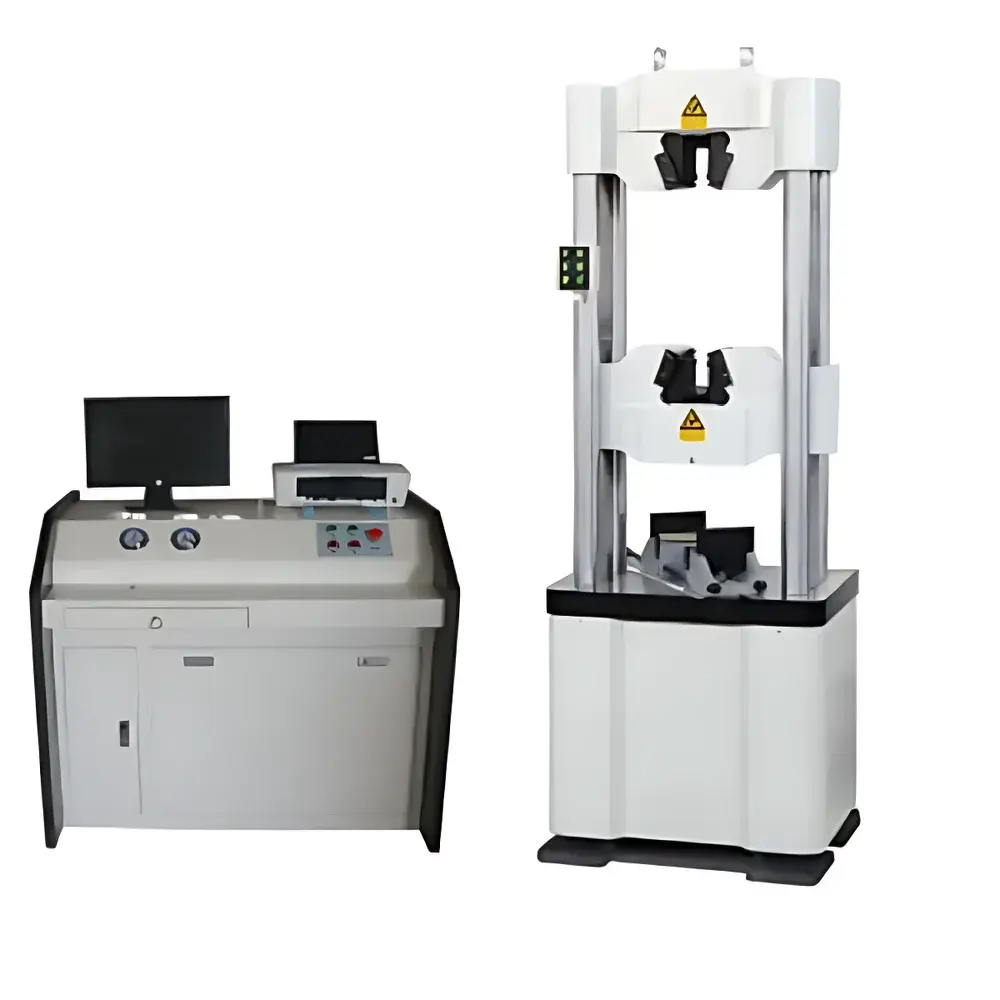
YANRUN WAW-600D Microcomputer-Controlled Electro-Hydraulic Servo Universal Testing Machine
| Brand | YANRUN |
|---|---|
| Origin | Shanghai, China |
| Manufacturer Type | Direct Manufacturer |
| Model | WAW-600D |
| Instrument Type | Electro-Hydraulic Servo Testing Machine |
| Load Capacity Range | 20 kN – 600 kN |
| Load Measurement Accuracy | ±0.5% FS |
| Displacement Resolution | 0.01 mm |
| Control Modes | Constant Load / Constant Deformation / Constant Displacement (0.4–100% FS) |
| Control Accuracy | ±1.0% FS (setpoint <10% FS) |
| Strain Rate Control Accuracy | ±2.0% (rate <0.05% FS) |
| Max Crosshead Speed | 80 mm/min |
| Max Tensile Test Space | 600 mm |
| Max Compressive Test Space | 550 mm |
| Flat Specimen Clamp Thickness | 0–15 mm (15–30 mm optional) |
| Round Specimen Clamp Diameter | φ13–φ40 mm |
| Compression Platen Size | 200 × 200 mm |
| Bend Support Span | 350 mm |
| Support Width | 140 mm |
| Support Pin Diameter | 50 mm |
| Piston Stroke | 200 mm |
| Gripping Method | Hydraulic Actuated Clamping |
| Transducer | Integrated Hydraulic Load Cell |
| Signal Conditioning | PCI-Mounted Programmable Amplifier with Auto-Zero & Auto-Calibration |
| Host Dimensions (W×D×H) | 860 × 750 × 2300 mm |
| Power Unit Dimensions (W×D×H) | 1100 × 700 × 950 mm |
| Total Weight | 3200 kg |
Overview
The YANRUN WAW-600D is a microcomputer-controlled electro-hydraulic servo universal testing machine engineered for high-precision mechanical property evaluation of metallic, polymeric, composite, and ceramic materials under static tensile, compressive, flexural, and shear loading conditions. Built upon a dual-cylinder, four-column rigid frame architecture, the system employs closed-loop hydraulic actuation with real-time feedback from a high-stability oil-pressure load cell and linear displacement transducers. Its core measurement principle relies on force equilibrium in a controlled servo-valve-driven hydraulic circuit, enabling traceable, repeatable load application across the full 20 kN to 600 kN range with ≤±0.5% full-scale accuracy—compliant with ISO 7500-1 Class 1 and ASTM E4 verification requirements. The machine integrates a dedicated industrial PC running proprietary control software, supporting fully automated test sequences, multi-stage ramp/hold profiles, and synchronized acquisition of load, displacement, and extensometer-derived strain data at up to 100 Hz sampling rate.
Key Features
- Rigid four-column load frame with preloaded tie rods ensures minimal deflection (<0.05 mm under 600 kN), preserving geometric fidelity during high-force testing.
- Electro-hydraulic servo system featuring proportional pressure-control valves and high-bandwidth piston actuators delivers precise crosshead velocity control from 0.005 to 80 mm/min, meeting ISO 6892-1 displacement rate tolerances.
- Hydraulic wedge-action grips with automatic clamping pressure modulation provide uniform stress distribution across flat specimens (0–15 mm thick standard; 15–30 mm optional) and round bars (φ13–φ40 mm), minimizing slippage and premature failure.
- Integrated PCI-based programmable amplifier supports auto-zeroing, automatic sensor calibration, and real-time gain adjustment—eliminating manual recalibration between test configurations.
- Modular platen and fixture interface compatible with standard ISO 7500-1 and ASTM E10/E290 accessory kits, including bending fixtures (350 mm span, 140 mm support width, 50 mm pin diameter) and compression platens (200 × 200 mm).
- Full-system synchronization of load, displacement, and optional extensometer signals ensures accurate modulus calculation per ASTM E111 and ISO 527-1.
Sample Compatibility & Compliance
The WAW-600D accommodates a broad spectrum of standardized and custom specimens: flat sheet/tensile coupons (ASTM E8/E21, ISO 6892-1), round machined bars (ASTM E8M), cast or forged components (ISO 6892-2), compression cylinders (ASTM C39/C109), and three-point bend beams (ASTM D790, ISO 178). Its mechanical design conforms to ISO 7500-1:2018 Class 1 verification criteria for force measurement systems and satisfies structural stability requirements per ASTM E4. All control algorithms implement digital filtering and anti-aliasing consistent with ISO 13384-1 for dynamic signal integrity. The system supports GLP-compliant operation through audit-trail-enabled test logging, user access levels, and electronic signature capability—fully aligned with FDA 21 CFR Part 11 data integrity expectations when configured with validated software modules.
Software & Data Management
The embedded Windows-based control platform provides intuitive graphical setup for tensile, compression, cyclic, and creep tests—including multi-step load/displacement ramps, dwell periods, and conditional branching logic. Real-time plotting displays load vs. displacement, stress vs. strain, and time-series derivatives. Raw data exports to ASCII, CSV, and XML formats include metadata headers (test ID, operator, timestamp, calibration IDs, environmental conditions). Automated report generation complies with ISO 14289-1 (PDF/A-1b) archival standards and includes customizable templates for ASTM, ISO, and internal QA documentation. Optional database integration enables centralized test result storage, trend analysis, and SPC charting across multiple instruments via ODBC or REST API interfaces.
Applications
- Mechanical characterization of structural steels, aluminum alloys, and titanium grades per ASTM A370 and EN 10002-1.
- Quality assurance of welded joints and heat-affected zones using sub-size tensile specimens per AWS D1.1 Annex Q.
- Compression testing of concrete, mortar, and geopolymer composites in accordance with ASTM C39 and ISO 4108.
- Flexural strength and modulus determination of fiber-reinforced polymer laminates (ASTM D7264) and thermoset resins (ISO 178).
- Validation of material models for finite element analysis (FEA), including true stress–strain curves derived from necking correction algorithms.
- Research-grade cyclic fatigue pre-conditioning and monotonic failure mapping for additive-manufactured metal parts (ASTM F3049).
FAQ
What standards does the WAW-600D comply with for force calibration and verification?
It meets ISO 7500-1:2018 Class 1 requirements for static force measurement systems and is verifiable per ASTM E4 procedures using certified reference load cells.
Can the system be used for ASTM E8/E8M tensile testing of metallic materials?
Yes—the machine supports all required displacement rates, grip configurations, and extensometer interfacing for both metric and imperial test protocols.
Is hydraulic fluid temperature stabilization included?
The integrated power unit features thermostatically regulated cooling and a 20-liter reservoir with particle filtration (ISO 4406 17/14), ensuring viscosity stability across ambient temperatures of 10–40°C.
Does the control software support third-party extensometers?
Yes—it accepts analog voltage inputs (±10 V) and digital TTL/RS-422 signals from commercial clip-on, video, or laser extensometers with configurable scaling and zeroing.
What maintenance intervals are recommended for long-term accuracy retention?
Load cell and amplifier calibration verification every 12 months; hydraulic oil replacement every 24 months or 2000 operating hours; servo valve inspection every 36 months per ISO 4406 contamination monitoring records.



