
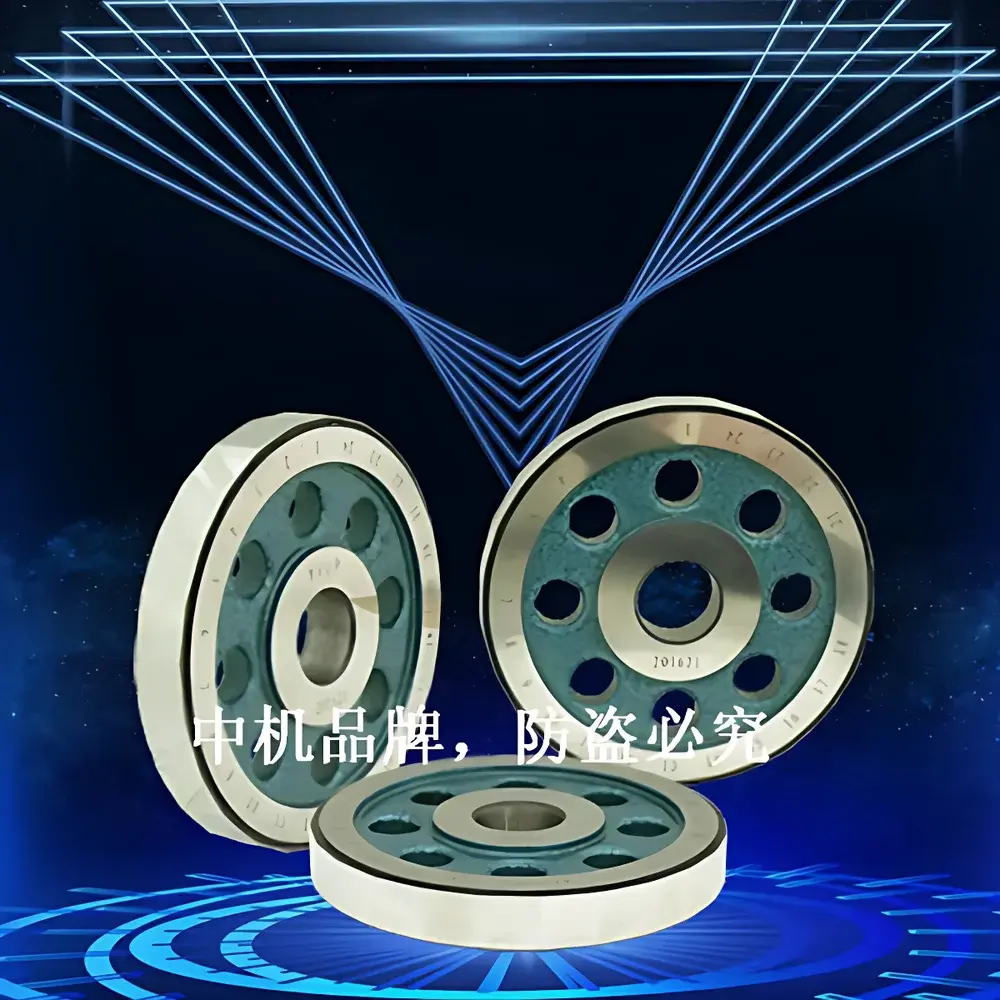
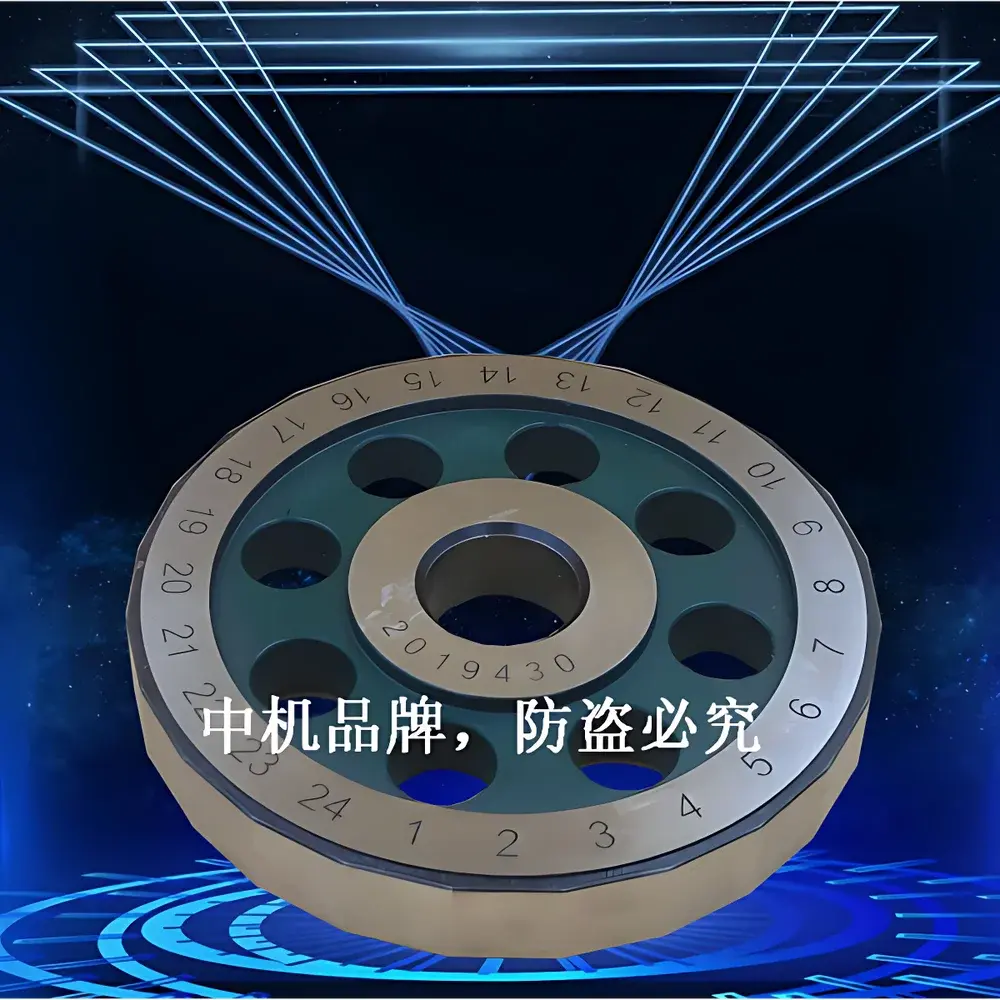
YANRUN Precision Polygon Prism (8-, 12-, 17-, 23-, 24-, 36-, and 72-Faced), Grade 0
| Brand | YANRUN |
|---|---|
| Origin | Shanghai, China |
| Manufacturer Type | Direct Manufacturer |
| Country of Origin | China |
| Model | Metal Polygon Prism, Grade 0 |
| Component Category | Angular Calibration Standard |
| Face Count Options | 8, 12, 17, 23, 24, 36, 72 |
| Circumscribed Diameter | φ80 mm (8-face), φ100 mm (12-/17-face), φ120 mm (23-/24-face), φ150 mm (36-face) |
| Thickness | 17 mm |
| Central Bore Diameter | φ25 mm |
| Material | GCr15 bearing steel |
| Hardness | HRC 62–65 |
| Surface Flatness (Grade 0) | ≤0.03 µm |
| Perpendicularity (Grade 0) | ≤5 arcseconds |
| Surface Roughness | Ra ≤0.025 µm |
| Parallelism (top to reference base) | ≤2 µm |
| Working Angle Deviation (Grade 0) | ±1″ |
| Working Angle Measurement Uncertainty (Grade 0) | 0.2″ |
| Effective Working Area | ≥φ15 mm circular area |
Overview
The YANRUN Precision Polygon Prism is a high-accuracy angular reference standard engineered for metrological calibration of rotary positioning systems in precision manufacturing and optical metrology laboratories. Based on the principle of multi-faceted symmetry and deterministic angle subdivision, this polygon prism leverages the geometric self-calibration capability inherent in regular polyhedral geometry—where each working face defines a precisely known angular increment relative to the rotational axis. Unlike conventional angular encoders or interferometric rotary tables, the polygon prism provides an absolute, drift-free, and traceable angle reference without reliance on electronic feedback or real-time interpolation. Its primary metrological function is the evaluation of systematic errors in circular division instruments—including optical dividing heads, indexing tables, autocollimators, and high-end goniometers—by enabling reversal and reversal-difference measurements across diametrically opposed faces.
Key Features
- Manufactured from vacuum-melted GCr15 high-carbon chromium bearing steel, heat-treated to HRC 62–65 for dimensional stability and wear resistance under repeated contact loading during autocollimator alignment.
- Grade 0 specification meets stringent national and international angular standard requirements: working angle deviation ≤±1 arcsecond, measurement uncertainty ≤0.2″, surface flatness ≤0.03 µm, and perpendicularity ≤5″—fully compliant with JJG 113–2015 (Chinese National Verification Regulation for Polygons) and aligned with ISO 230-7:2020 Annex C recommendations for polygon-based angular calibration.
- Configurable face counts (8, 12, 17, 23, 24, 36, 72) support both integer-degree and non-integer-degree angular subdivisions—enabling separation of harmonic error components in rotary axes: even-faced polygons (e.g., 24-face = 15°/face) isolate large-period errors (e.g., bearing runout), while prime-numbered faces (e.g., 17-face ≈ 21.176°/face) enable simultaneous assessment of both large- and small-period errors (e.g., encoder scale error, gear tooth pitch variation).
- Central φ25 mm bore permits secure mounting on precision spindles with minimal runout; 17 mm thickness ensures torsional rigidity during handling and thermal equilibrium during extended calibration sessions.
- Surface finish Ra ≤0.025 µm minimizes scattering in autocollimation setups, supporting reliable detection of reflected beam centroids with sub-arcsecond resolution using digital autocollimators (e.g., Thorlabs ACL2520, Mitutoyo QM-AG series).
Sample Compatibility & Compliance
The YANRUN Polygon Prism is designed for integration into ISO/IEC 17025-accredited calibration workflows. It is routinely employed in the verification of instruments subject to ASTM E2922–22 (Standard Practice for Calibrating Optical Dividing Heads), ISO 10791-7 (Test conditions for machining centres — Part 7: Accuracy of rotary axes), and national standards such as GB/T 20957.7–2022 (Geometrical accuracy of numerical control machine tools). The Grade 0 tolerance class satisfies requirements for primary-level calibration laboratories performing accredited angular calibrations per ILAC-P10:2022. All units are supplied with individual calibration certificates traceable to NIM (National Institute of Metrology, China) or equivalent NMIs via direct comparison against master polygons calibrated by laser interferometric angle measurement systems.
Software & Data Management
While the polygon prism itself is a passive mechanical standard, its use is integral to software-supported calibration protocols. When used with commercial angular calibration suites—such as METRILOG Angular Calibration Software, PC-DMIS Rotary Axis Module, or custom MATLAB/Python-based least-squares harmonic analysis scripts—the prism enables full harmonic decomposition (up to 12th order or higher) of angular error motion. Raw autocollimator data (e.g., peak-to-valley deviations per face) is imported to compute periodic error maps, which are then exported for machine tool error compensation (e.g., Fanuc SERVO GUIDE, Siemens SINUMERIK Run MyAutomation). Audit trails, certificate generation, and uncertainty budgeting align with GLP/GMP documentation requirements and FDA 21 CFR Part 11-compliant electronic record systems when deployed in regulated manufacturing environments (e.g., aerospace component machining, medical device assembly).
Applications
- Calibration of optical dividing heads and precision indexing tables in metrology labs and national standards institutes.
- Verification and error mapping of rotary axes in 5-axis CNC machine tools, coordinate measuring machines (CMMs), and ultra-precision diamond turning lathes.
- Reference standard for inter-laboratory comparison exercises organized under APMP (Asia Pacific Metrology Programme) or COOMET angular metrology working groups.
- Teaching aid in advanced metrology courses covering circular division error theory, harmonic analysis, and self-calibration methodologies.
- Baseline reference for in-house development of high-resolution angle encoders and optical rotary sensors requiring traceable validation.
FAQ
What distinguishes Grade 0 from Grade 1 or Grade 2 polygons?
Grade 0 represents the highest metrological class defined in JJG 113–2015, with tighter tolerances on working angle deviation (±1″ vs. ±2″/±5″), surface flatness (0.03 µm vs. 0.05/0.1 µm), and angular measurement uncertainty (0.2″ vs. 0.5″/1.0″). Grade 0 is mandatory for primary calibration laboratories and accredited angular verification services.
Can this polygon be used with digital autocollimators only, or also with laser interferometers?
It is optimized for autocollimator-based measurement (standard practice per ISO 230-7), but can be integrated into laser interferometer-based angular calibration systems (e.g., HP/Keysight 5530 with angular optics) when mounted on a stabilized air-bearing rotation stage with sub-microradian repeatability.
Is thermal expansion compensated in the design?
No active compensation is built-in; however, the GCr15 material exhibits low thermal expansion (≈11.5 × 10⁻⁶ /°C), and all specifications assume operation at 20 °C ±0.5 °C in a thermally stable environment per ISO 1:2016. Users must apply standard temperature correction factors if operating outside this range.
Do you provide mounting fixtures or alignment accessories?
Standard mounting adapters (e.g., collet chucks, kinematic V-block supports) and alignment verification kits (including reference mirrors and adjustable bases) are available separately upon request and are compatible with common metrology platforms including ZYGO GPI, TRIOPTICS OptiCentric, and OptoTech MMS series.
How often does a Grade 0 polygon require recalibration?
Per ISO/IEC 17025:2017 Clause 7.8.2, recalibration is recommended annually—or after any event involving mechanical shock, excessive cleaning abrasion, or environmental exposure beyond specified limits—to maintain traceability and documented uncertainty performance.





