
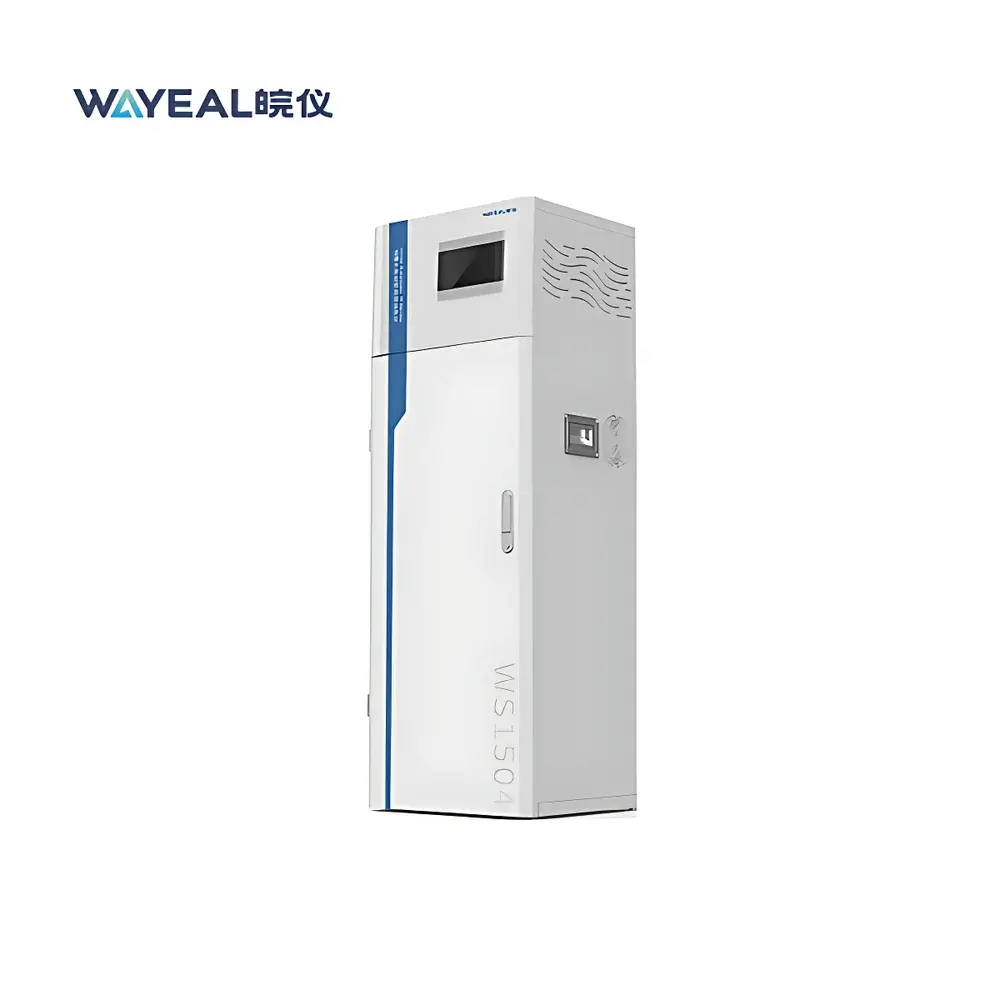
WAYEAL WS1504 Online Total Phosphorus Water Quality Analyzer
| Brand | WAYEAL |
|---|---|
| Origin | Anhui, China |
| Manufacturer Type | Original Equipment Manufacturer (OEM) |
| Country of Origin | China |
| Model | WS1504 |
| Pricing | Available upon Request |
Overview
The WAYEAL WS1504 Online Total Phosphorus Water Quality Analyzer is an automated, laboratory-grade spectrophotometric instrument engineered for continuous, unattended measurement of total phosphorus (TP) concentration in surface water, wastewater effluents, and industrial discharge streams. It operates on the standardized molybdenum blue colorimetric method—fully compliant with ISO 6878:2004, EPA Method 365.4, and HJ 670–2013 (China’s Environmental Protection Standard). In this method, all phosphorus species—including orthophosphate, condensed phosphates, and organically bound phosphorus—are quantitatively oxidized to orthophosphate under high-temperature (120–125 °C), high-pressure alkaline digestion using potassium persulfate. The resulting orthophosphate reacts with ammonium molybdate in acidic medium to form phosphomolybdic acid, which is subsequently reduced by ascorbic acid in the presence of antimony potassium tartrate to yield a stable, intensely blue-colored heteropoly complex. Absorbance is measured at 880 nm using a precision dual-beam photometer with temperature-stabilized LED light source and interference-filtered detection. Concentration is calculated in real time via the Lambert–Beer law, with calibration traceable to NIST-certified phosphate standards.
Key Features
- Triple-stage precision photometric metering system: Ensures sub-microliter reagent dispensing accuracy and long-term volumetric repeatability, minimizing drift from peristaltic pump tube fatigue.
- Adaptive thermal compensation algorithm: Dynamically corrects for optical path length and detector responsivity shifts across ambient temperatures ranging from 5 °C to 40 °C.
- Active ambient light rejection: Integrated optical shielding and synchronous signal demodulation eliminate interference from fluctuating ambient illumination during outdoor or non-climate-controlled installations.
- Fail-safe digestion module: Features redundant pressure transducers, PT100 temperature sensors, and leak-detection electrodes—triggering automatic shutdown and alarm logging upon overpressure (>0.5 MPa), overheating (>130 °C), or fluid leakage.
- Field-editable maintenance sequence logic: Enables operators to customize cleaning cycles, calibration intervals, and diagnostic routines directly via the HMI without firmware updates or PC connectivity.
- Integrated thermoelectric cooling unit: Maintains reagent storage compartment at 4–8 °C, extending shelf life of ascorbic acid and molybdate solutions beyond 90 days without refrigeration infrastructure.
- Motorized safety interlock door: Automatically de-energizes high-voltage heating elements and digestion chamber actuators when opened—certified to IEC 61508 SIL2 functional safety requirements.
Sample Compatibility & Compliance
The WS1504 accepts raw influent and effluent samples with turbidity ≤ 100 NTU and suspended solids ≤ 50 mg/L without pre-filtration. It supports automatic sample filtration (optional 5-µm inline filter cartridge) and pH adjustment (0–14 range) prior to digestion. All wetted components—including digestion vessels, metering lines, and flow cells—are constructed from PTFE, quartz, and 316L stainless steel to resist corrosion from acidic digestates and chloride-rich matrices. The system complies with ISO/IEC 17025:2017 for testing laboratories, meets CE marking requirements under the EU Machinery Directive 2006/42/EC and EMC Directive 2014/30/EU, and supports audit-ready data integrity per FDA 21 CFR Part 11 through secure user authentication, electronic signatures, and immutable audit trails.
Software & Data Management
Embedded firmware (v3.2+) provides local data logging at 1-minute resolution with 32 GB internal flash memory (≥18 months retention). Remote access is enabled via Modbus TCP, OPC UA, and MQTT protocols for integration into SCADA, DCS, or cloud-based environmental monitoring platforms. Calibration curves are stored with full metadata (date, operator ID, standard lot number, R² value). All measurements include timestamped QC flags for digestion efficiency, blank drift, and photometric saturation. Software supports GLP-compliant reporting with PDF export, configurable alarm thresholds (e.g., TP > 0.5 mg/L), and automated email/SMS alerts via SMTP or GSM gateway.
Applications
- Real-time compliance monitoring at municipal wastewater treatment plant (WWTP) final effluent discharge points per EU Urban Wastewater Treatment Directive (91/271/EEC) and China’s GB 18918–2002 Class A limits.
- Continuous surveillance of industrial outfalls from phosphate fertilizer plants, food processing facilities, and textile dyeing operations subject to local TP discharge permits.
- Early-warning detection of eutrophication precursors in reservoirs and river basins as part of national water quality surveillance networks (e.g., China’s National Surface Water Monitoring Network).
- Performance verification of tertiary phosphorus removal units (e.g., lanthanum-based adsorption filters or enhanced biological phosphorus removal systems).
FAQ
What digestion temperature and pressure does the WS1504 use, and how is it validated?
The system maintains a controlled digestion temperature of 120 ± 1 °C at 0.2–0.3 MPa for 30 minutes, verified by dual independent PT100 sensors and logged in every analytical cycle.
Does the analyzer support multi-point calibration and drift correction?
Yes—up to 6-point calibration curves are supported, and daily zero/span verification with certified standards is programmable; automatic baseline correction compensates for photometric drift between calibrations.
Can the WS1504 operate unattended for extended periods in remote locations?
With optional solar power integration, cellular telemetry, and 90-day reagent autonomy (including cooled storage), it achieves ≥6 months of uninterrupted operation in off-grid monitoring stations.
How is data integrity ensured during power interruptions or communication outages?
All measurements are buffered locally with battery-backed RTC and written to non-volatile memory; synchronization resumes automatically upon network recovery without data loss.
Is the system compatible with third-party LIMS or enterprise environmental dashboards?
Yes—via standard RESTful API, ODBC drivers, and configurable CSV/JSON export templates supporting ISO 13843-compliant data exchange formats.
Related Products







