
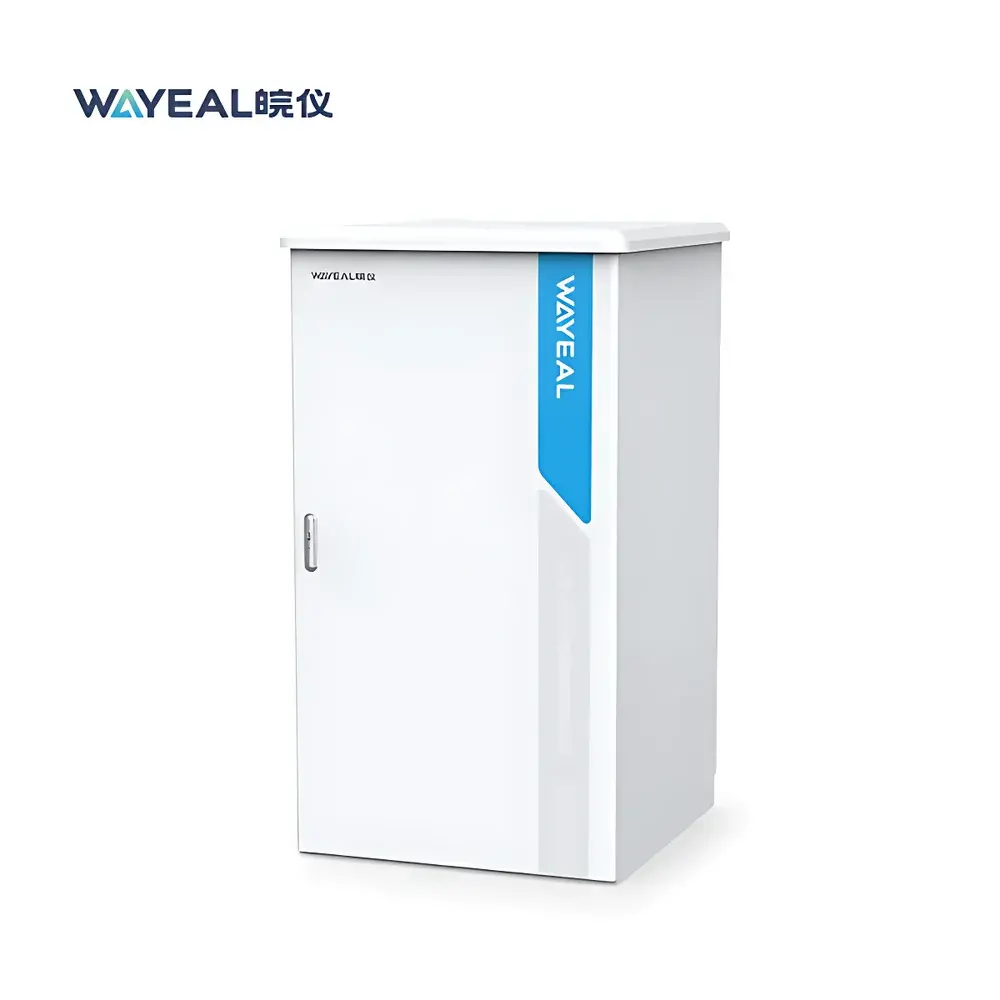
WAYEAL WMS1800s Outdoor Compact Online Water Quality Monitoring System
| Brand | WAYEAL |
|---|---|
| Origin | Anhui, China |
| Manufacturer Type | Original Equipment Manufacturer (OEM) |
| Country of Origin | China |
| Model | WMS1800s |
| Pricing | Available upon Request |
Overview
The WAYEAL WMS1800s Outdoor Compact Online Water Quality Monitoring System is a fully integrated, self-contained field-deployable station engineered for continuous, unattended water quality surveillance in challenging outdoor environments. Designed according to Chinese national standards (e.g., HJ 915–2017, HJ 353–2019, HJ 354–2019), the system implements standardized analytical methodologies—including potentiometric pH measurement, electrochemical dissolved oxygen sensing, conductometric conductivity detection, nephelometric turbidity analysis, and spectrophotometric determination of permanganate index, ammonia nitrogen, total phosphorus, and total nitrogen. Its modular architecture supports simultaneous real-time monitoring of nine core parameters without external laboratory intervention. The system operates autonomously under ambient conditions ranging from −20 °C to +50 °C, enabled by an integrated climate control unit maintaining internal cabinet temperature between 15–30 °C and relative humidity below 80% RH—critical for sensor stability, reagent integrity, and optical path consistency.
Key Features
- Compact footprint: ≤1.3 m² floor area; suitable for constrained urban, riparian, or remote deployment sites where traditional station construction is impractical.
- IP55-rated outdoor enclosure with reinforced rainproof canopy, surge-protected power input (Type II+III hybrid SPD), and galvanic isolation for RS-485/4–20 mA analog and Modbus TCP digital communications.
- Automated sample handling: Programmable peristaltic pump-driven intake, filtration, and multi-stage conditioning (including air-burst backflushing, ultrasonic probe cleaning, and low-concentration ozone dosing for biofouling mitigation).
- Intelligent environmental supervision: Dual-sensor smoke detection, capacitive water immersion alarm, dual-point temperature/humidity monitoring with threshold-triggered audible/visual alerts and remote notification via SNMP or MQTT.
- Self-maintaining operation: Scheduled automatic calibration verification using standard reference solutions; onboard diagnostics log with timestamped fault codes compliant with IEC 62443-3-3 cybersecurity guidelines.
Sample Compatibility & Compliance
The WMS1800s is validated for use with natural freshwater matrices including rivers, lakes, reservoirs, urban stormwater conduits, drinking water source intakes, and estuarine transition zones. It meets technical requirements specified in China’s “Technical Specifications for Automatic Monitoring of Surface Water Quality” (HJ 915–2017) and “General Technical Requirements for Water Quality Automatic Monitoring Stations” (HJ 353–2019). Sensor outputs are traceable to NIM (National Institute of Metrology, China) certified reference materials. Data acquisition intervals support both event-triggered sampling (e.g., rainfall-induced runoff) and fixed-interval reporting (e.g., hourly or 15-minute cycles), with raw sensor values and derived metrics stored locally on industrial-grade SSD with ≥1-year retention capacity. All firmware and data logs conform to GLP principles for auditability.
Software & Data Management
The embedded Linux-based controller runs WAYEAL’s proprietary WQ-Monitor Suite v3.2, supporting local HMI touchscreen operation and remote web-based access via HTTPS-secured portal. Data export formats include CSV, XML, and JSON; integration with SCADA platforms (e.g., Siemens Desigo, Schneider EcoStruxure) is achieved through OPC UA and RESTful API endpoints. Audit trails record all configuration changes, calibration events, maintenance actions, and alarm acknowledgments—with immutable timestamps and operator ID tagging. Optional cloud synchronization enables secure TLS 1.3 transmission to private AWS S3 buckets or municipal environmental data centers, satisfying regional data sovereignty mandates.
Applications
- River basin management: Real-time tracking of nutrient loading gradients across tributary confluences and dam-regulated reaches.
- Urban water infrastructure: Continuous monitoring of combined sewer overflows (CSOs), wastewater treatment plant influent/effluent, and distributed stormwater retention basins.
- Drinking water protection: Early warning detection of organic contamination spikes or algal bloom precursors at raw water abstraction points.
- Ecological assessment: Long-term trend analysis of trophic state indicators (TP, TN, CODMn) in eutrophic lakes and wetlands.
- Regulatory compliance reporting: Automated generation of daily/monthly summary reports aligned with provincial ecological environment departments’ reporting templates.
FAQ
Does the WMS1800s support third-party sensor integration?
Yes—via configurable 4–20 mA analog inputs and Modbus RTU/TCP interfaces, enabling connection of certified external sensors (e.g., chlorophyll-a fluorometers, nitrate analyzers) with user-defined scaling and validation protocols.
What is the recommended maintenance interval for consumables?
Reagent cartridges require replacement every 30 days under continuous operation; quartz flow cells and ozone generator electrodes are rated for ≥12 months of service life with quarterly visual inspection.
Is the system compatible with ISO/IEC 17025-accredited laboratories?
While the WMS1800s itself is not a certified testing laboratory, its measurement data—when collected under documented chain-of-custody procedures and validated against accredited reference methods—may be used as supplementary evidence in ISO/IEC 17025 conformity assessments.
Can the system operate during extended grid outages?
Standard configuration includes a 24 VDC/30 Ah sealed lead-acid backup battery supporting ≥72 hours of nominal operation; optional solar-charged lithium iron phosphate (LiFePO₄) extension kits are available for off-grid deployments.
How is cybersecurity implemented at the device level?
Firmware signing, disabled default credentials, role-based access control (RBAC), encrypted local storage, and automatic security patching via signed OTA updates ensure alignment with NIST SP 800-82 Rev. 2 guidance for industrial control systems.
Related Products







