
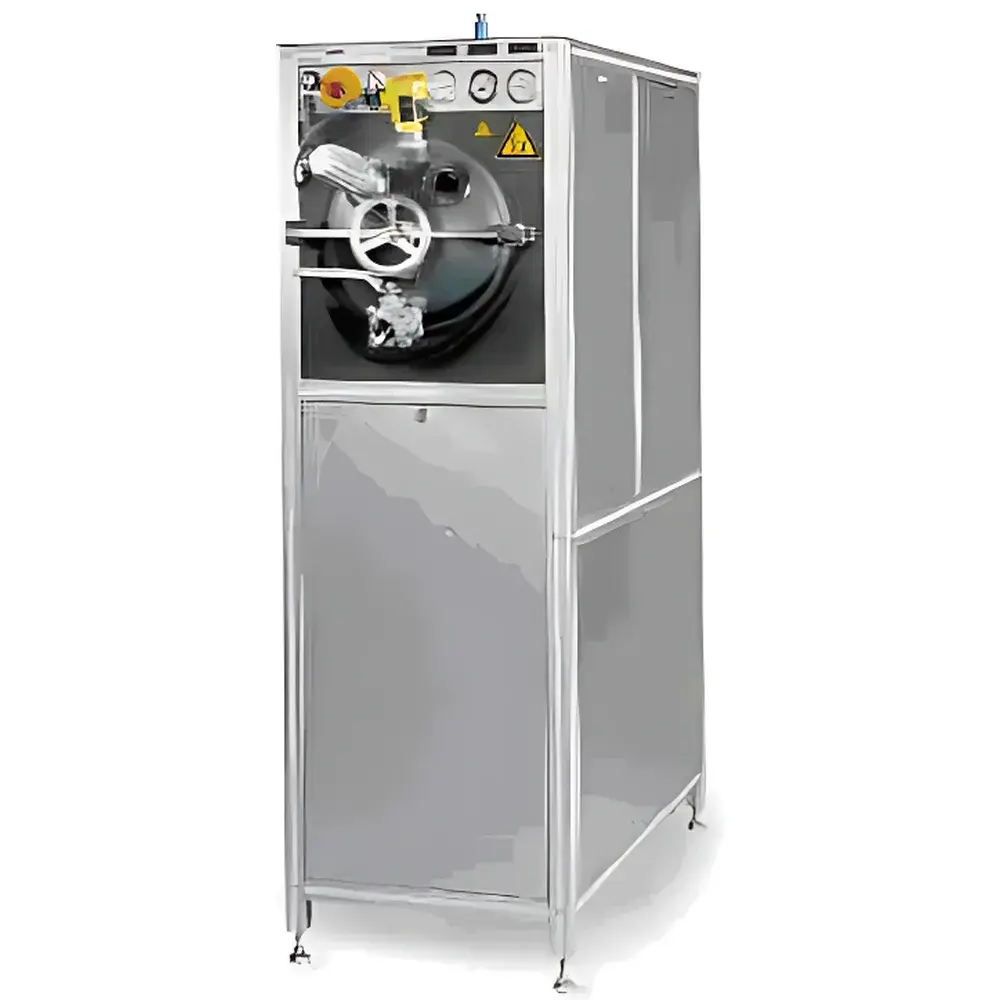
LOEMI VRA Series ATEX-Certified Automatic Vacuum Distillation & Solvent Recovery System
| Brand | LOEMI |
|---|---|
| Origin | Germany |
| Model | VRA-50 / VRA-150 / VRA-250 |
| Total Volume | 50 L / 150 L / 250 L |
| Operating Volume | 25–30 L / 5–100 L / 140–170 L |
| Distillation Rate (typ.) | 8–20 L/h / 25–60 L/h / 30–80 L/h |
| Max. Operating Temperature | 200 °C |
| Pressure Range | −1.0 to +0.5 bar |
| Heating | Integrated Explosion-Proof Thermal Oil System |
| Vacuum System | LOE/V6 (VRA-50) or LOE/V30 (VRA-150/250) |
| ATEX Certification | II 1/2 G c T3 per Directive 94/9/EC |
| Control | PLC-Based HMI Terminal |
| Power Supply | 400 V / 3-phase / 50 Hz |
| Total Power Consumption (avg.) | 2.9 kW / 6.0 kW / 11.0 kW |
| Dimensions (L×W×H) | 600×1420×1800 mm / 750×2000×1800 mm / 850×2000×1800 mm |
| Weight | 250 kg / 400 kg / 500 kg |
Overview
The LOEMI VRA Series is an ATEX-certified, fully automated vacuum distillation and solvent recovery system engineered for safe, continuous, and high-integrity operation in regulated laboratory and pilot-scale chemical processing environments. Designed and manufactured in Germany, the system employs precise vacuum-controlled fractional distillation under reduced pressure to separate volatile solvents from non-volatile residues—enabling efficient recovery of high-purity solvents while minimizing thermal degradation and operator exposure. Its core architecture integrates explosion-proof thermal oil heating, intrinsically safe vacuum generation, and programmable logic control (PLC) to ensure repeatable process execution across 24-hour unattended cycles. Unlike conventional rotary evaporators or batch stills, the VRA Series operates with closed-loop containment, O-ring sealed vessels, and pressure-rated stainless-steel construction—meeting stringent mechanical integrity requirements for handling flammable, toxic, or thermally sensitive feedstocks.
Key Features
- ATEX-certified explosion protection per Directive 94/9/EC (II 1/2 G c T3), validated for Zone 1 and Zone 2 hazardous areas
- Full automation via industrial-grade PLC with color HMI terminal for recipe-based operation, real-time monitoring, and alarm logging
- Stainless-steel distillation vessel with double O-ring sealing and pressure-rated design (−1.0 to +0.5 bar operating range)
- Integrated explosion-proof thermal oil heating system with PID-controlled temperature regulation up to 200 °C
- Dedicated vacuum unit (LOE/V6 or LOE/V30) delivering stable vacuum down to 50 mbar; optional upgrade to 10 mbar capability
- Modular configuration across three scalable models (VRA-50, VRA-150, VRA-250) supporting operating volumes from 5 L to 170 L
- Robust aluminum-coated steel enclosure with IP54-rated electrical cabinet and pre-wired interconnect cabling
- Standard safety endpoints including overtemperature cutoff, vacuum loss detection, and pressure relief activation
Sample Compatibility & Compliance
The VRA Series accommodates a broad spectrum of organic solvents—including acetone, ethyl acetate, toluene, THF, dichloromethane, and alcohols—as well as solvent mixtures and heat-labile reaction residues. Its inert stainless-steel wetted path and absence of moving parts inside the distillation chamber prevent cross-contamination and support cleaning validation. The system complies with key international standards for laboratory equipment safety and performance: EN 61000-6-2 (EMC immunity), EN 61000-6-4 (EMC emission), EN 61010-1 (electrical safety), and EN 14041 (pressure equipment conformity). For regulated environments, the PLC control architecture supports audit-ready event logging and can be configured to meet GLP/GMP data integrity expectations—including time-stamped operation records and user-access controls. While not inherently 21 CFR Part 11 compliant, optional firmware extensions enable electronic signature support and secure data export upon request.
Software & Data Management
Operation is managed through a dedicated PLC-driven HMI interface with intuitive touchscreen navigation. Predefined distillation protocols—such as “low-boiling solvent recovery”, “high-boiling residue concentration”, or “multi-stage fractionation”—can be stored, recalled, and modified without programming expertise. All critical process parameters (vacuum level, jacket temperature, condensate rate, elapsed time) are continuously logged with millisecond timestamp resolution. Data export is supported via USB or Ethernet to CSV or PDF formats. Optional remote maintenance enables secure web-based diagnostics and firmware updates using encrypted TLS communication—reducing downtime and eliminating on-site service visits for routine troubleshooting. Audit trails include user login events, parameter changes, and emergency stop activations—fully traceable for internal quality reviews or regulatory inspection preparation.
Applications
- Recovery and reuse of high-value solvents in pharmaceutical R&D and API synthesis
- Concentration of reaction mixtures prior to crystallization or chromatography
- Purification of heat-sensitive natural extracts and fine chemicals
- Removal of residual solvents from polymer solutions or catalyst slurries
- Compliance-driven waste minimization in ISO 14001-certified laboratories
- Safe handling of Class I flammable liquids in accordance with NFPA 30 and local fire codes
- Supporting green chemistry initiatives by reducing solvent procurement and hazardous waste disposal costs
FAQ
What ATEX certification level does the VRA Series hold?
The system carries ATEX classification II 1/2 G c T3 per Directive 94/9/EC, suitable for use in both Zone 1 (potentially explosive atmospheres during normal operation) and Zone 2 (explosive atmospheres unlikely but possible for short periods).
Can the VRA operate under deep vacuum conditions below 50 mbar?
Yes—while standard configurations achieve 50 mbar, an optional high-vacuum pump upgrade (e.g., LOE/V30 with secondary backing) enables stable operation down to 10 mbar, extending applicability to higher-boiling solvents such as DMSO or NMP.
Is the system compatible with corrosive feedstocks?
The base configuration uses 316L stainless steel for all wetted surfaces. Optional electropolished finish or PTFE-lined components are available for enhanced resistance to halogenated or acidic media.
How is process reproducibility ensured across multiple batches?
Each distillation cycle executes from a saved PLC program with fixed setpoints, ramp rates, and endpoint logic—eliminating manual intervention variability. Temperature and vacuum sensors are calibrated traceably to national standards (e.g., DKD/DAkkS), and calibration certificates are supplied with each unit.
What maintenance intervals are recommended for long-term reliability?
Routine checks include thermal oil level verification every 500 operating hours, vacuum pump oil replacement every 2,000 hours, and O-ring inspection at annual service intervals. LOEMI provides a documented preventive maintenance schedule aligned with ISO 55001 asset management principles.



