
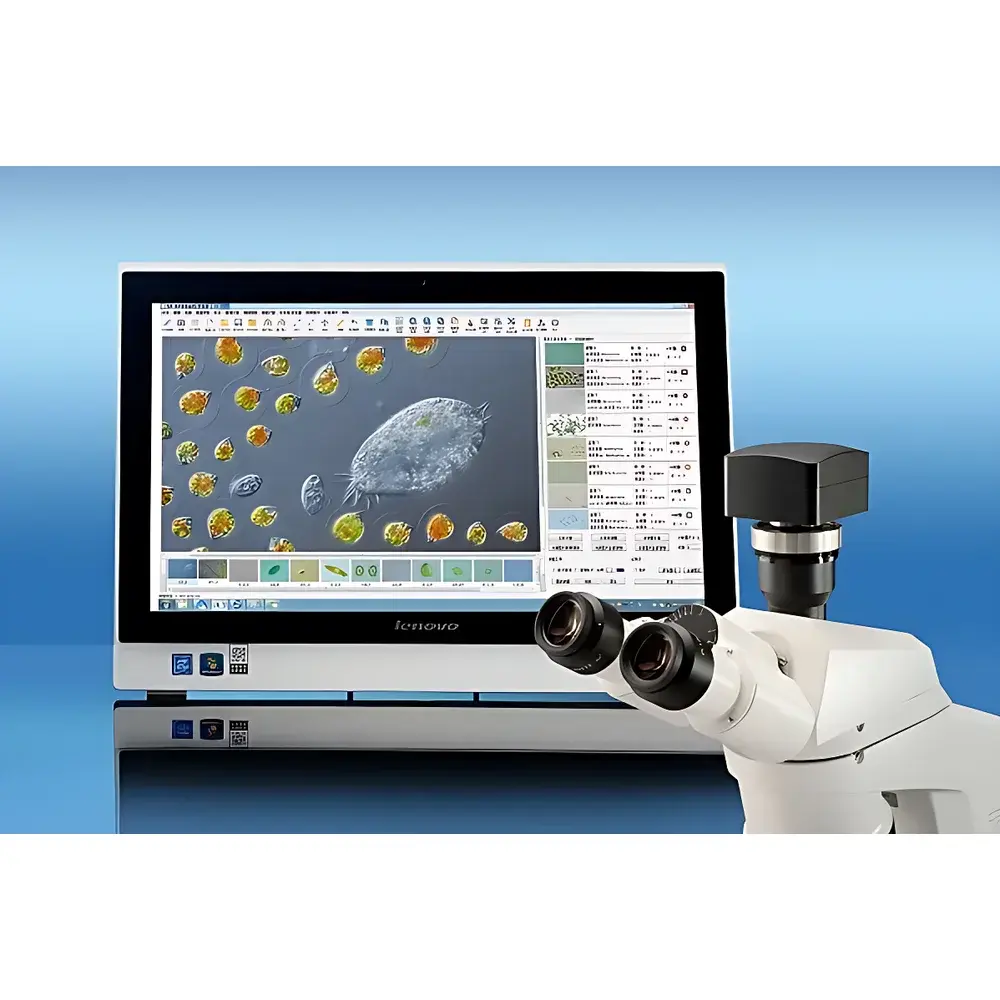
Xunshu Algacount F210 Intelligent Plankton Identification and Enumeration System
| Brand | Xunshu |
|---|---|
| Origin | Zhejiang, China |
| Manufacturer Type | OEM Manufacturer |
| Product Category | Domestic |
| Model | Algacount F210 |
| Instrument Type | Algal and Plankton Counter |
| Camera Resolution | 6.3 MP |
| Objective Magnifications | 4×, 10×, 20×, 40× |
| Identification Methods | Morphological, Taxonomic, Keyword-Based, Similarity-Matching |
Overview
The Xunshu Algacount F210 Intelligent Plankton Identification and Enumeration System is a purpose-built digital image analysis platform engineered for standardized, reproducible phytoplankton and zooplankton assessment in freshwater and marine environmental monitoring laboratories. It operates on the principle of high-resolution brightfield microscopy coupled with advanced computer vision algorithms to automate morphological feature extraction, taxonomic classification, and quantitative enumeration. Designed for compliance with national and regional water quality surveillance protocols—including China’s “Technical Specifications for Monitoring of Phytoplankton in Surface Water (HJ 1081–2019)” and aligned with international best practices for ecological assessment—the Algacount F210 bridges the gap between traditional manual microscopy and modern digital ecology workflows. Its architecture integrates hardware-accelerated image acquisition, multi-layered taxonomic databases, and GLP-aligned data governance—making it suitable for routine monitoring programs, research-grade biodiversity studies, and regulatory reporting where traceability and audit readiness are essential.
Key Features
- Integrated 6.3 MP scientific-grade CMOS camera (SONY IMX178 sensor, 1/1.8″ format) with USB 3.0 interface, supporting real-time imaging at up to 15 fps @ 3072 × 2048 resolution and adjustable exposure (0.244 ms – 2000 ms).
- “XunSao” intelligent algae identification module featuring three proprietary algorithms: Multi-dimensional Progressive Similar Algae Search, Confusable Algae Discrimination, and Typical Morphological Combination Retrieval—enabling rapid, morphology-driven candidate ranking from a curated database of >12,000 validated microphotographs.
- Four-tier taxonomic navigation (Phylum → Order → Genus → Species), structured per modern algal systematics (e.g., AlgaeBase, IOC-UNESCO), with dual-language (Chinese/Latin) nomenclature and peer-reviewed morphological annotations.
- Automated z-stack fusion for extended depth-of-field imaging—critical for resolving vertically stratified planktonic cells across multiple focal planes.
- Seamless mosaic stitching across horizontal and vertical fields of view, enabling full-frame reconstruction of large colonial or filamentous specimens at high magnification (up to 40×).
- Dedicated modules for colonial analysis (e.g., Microcystis colonies), chain-length estimation (e.g., Anabaena, Aphanizomenon filaments), and biovolume calculation using geometric models compliant with Utermöhl and ASTM D5907-20 standards.
- Calibrated digital micrometer with objective-specific scaling—supporting linear, angular, and area measurements under all four magnifications (4×, 10×, 20×, 40×).
Sample Compatibility & Compliance
The Algacount F210 supports standard Utermöhl sedimentation chamber preparations, Lugol’s-fixed phytoplankton samples, and live or preserved zooplankton concentrates mounted on glass slides. Its database comprehensively covers dominant freshwater taxa from China’s seven major river basins and 28 key lakes/reservoirs, as well as marine species from the Bohai Sea, Yellow Sea, East China Sea, and South China Sea. Zooplankton coverage includes 24 taxonomic groups—flagellates, amoebae, ciliates, rotifers, cladocerans, and copepods—with annotated line drawings, micrographs, and bilingual morphological descriptions. The system adheres to ISO 16191:2017 (water quality — guidance on phytoplankton enumeration), supports metadata tagging per EN 16695:2016, and enables electronic record retention meeting ALCOA+ principles (Attributable, Legible, Contemporaneous, Original, Accurate, Complete, Consistent, Enduring, Available).
Software & Data Management
The Algacount F210 software suite runs on Windows 10 and implements role-based access control (RBAC) with administrator and operator accounts. All image captures, annotations, counts, and statistical outputs are stored in an encrypted local SQLite database with immutable timestamps and user attribution. Audit trails log every action—including image acquisition, cell marking, database queries, and report generation—ensuring full traceability for internal QA review or external accreditation (e.g., CNAS, CMA). Statistical outputs include cell density (cells/L), biovolume (mm³/L), Shannon–Wiener diversity index (H′), Pielou evenness (J′), dominance index (Y), carbon/nitrogen biomass estimates, and relative abundance (%) by taxon. Export options include Excel (.xlsx), PDF reports with customizable templates, and batch image archives with embedded EXIF metadata.
Applications
- Routine eutrophication monitoring in reservoirs, rivers, and coastal zones
- Harmful algal bloom (HAB) early warning and species verification (e.g., Microcystis, Alexandrium, Karenia)
- Ecological status assessment under EU WFD or China’s “Blue Sky & Clear Water” initiative
- Research on plankton community dynamics, succession patterns, and climate-driven shifts
- Method validation and inter-laboratory comparison studies requiring standardized enumeration
- Training and capacity building for junior technicians via guided morphological retrieval and side-by-side confusable taxon comparison
FAQ
Does the Algacount F210 support FDA 21 CFR Part 11 compliance?
The system provides electronic signatures, audit trails, and user-level permissions—but does not include cryptographic signature validation or third-party PKI integration required for full Part 11 enforcement. It meets core ALCOA+ data integrity requirements for non-GxP environmental labs.
Can the database be updated with newly observed or region-specific taxa?
Yes—administrators may import new micrographs, taxonomic descriptors, and geometric models via the built-in database editor, maintaining version-controlled backups and change logs.
Is remote operation or network deployment supported?
The current release operates as a standalone workstation application. Networked multi-user access requires local server deployment and IT-administered file-sharing policies; cloud synchronization is not implemented.
What microscope brands and models are compatible?
The system interfaces with any trinocular microscope equipped with a C-mount port. Standard adapters are included for Olympus, Nikon, Leica, Zeiss, and common Chinese OEM models (e.g., Motic, Labomed).
How is measurement accuracy validated?
Each installation includes NIST-traceable stage micrometer calibration; software applies pixel-to-micron conversion factors dynamically based on selected objective magnification and camera binning mode.
Related Products







