
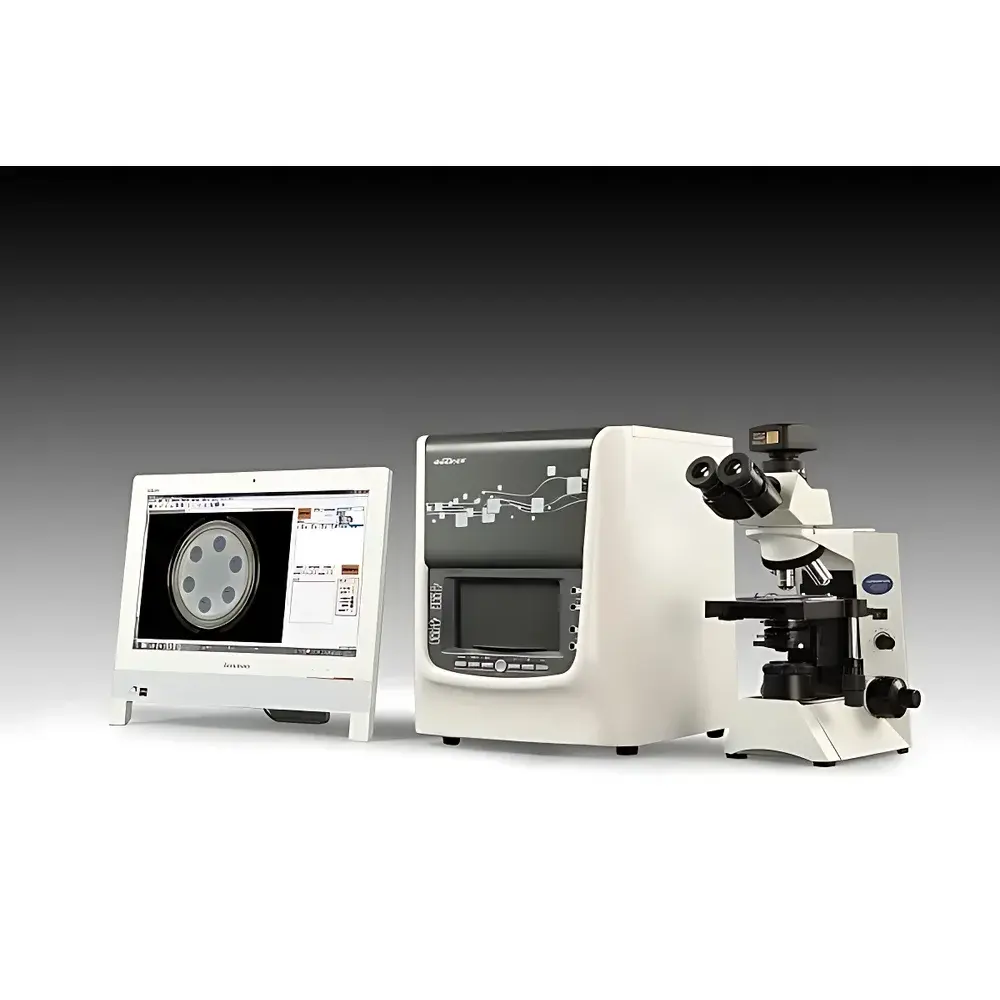
Xunsu MF4 Microbial Colony Counter & Microscopic Cell Analyzer Multi-Function Integrated System
| Brand | Xunsu |
|---|---|
| Origin | Zhejiang, China |
| Manufacturer Type | OEM Manufacturer |
| Instrument Type | Fully Automated Colony Counter & Microscopy Image Analysis System |
| Model | MF4 |
| Price Range | USD 14,000 – 28,000 |
Overview
The Xunsu MF4 Microbial Colony Counter & Microscopic Cell Analyzer Multi-Function Integrated System is a dual-pathway digital imaging platform engineered for regulatory-compliant microbiological analysis in pharmaceutical, food safety, clinical, and academic laboratories. It integrates two independent optical imaging subsystems—(1) a high-fidelity colony/zone imaging module for quantitative microbial enumeration and inhibition zone metrology, and (2) a calibrated microscopy-based cell and spore analysis module—within a single, unified hardware chassis and software architecture. The system operates on the principles of digital image acquisition, morphometric segmentation, and pixel-level intensity modeling to deliver traceable, reproducible, and auditable results. Designed in alignment with China’s NMPA (formerly CFDA) requirements for computerized laboratory systems—and inherently compatible with international data integrity frameworks—the MF4 implements a four-tier user-role architecture, electronic audit trail logging, watermark-enabled report signing, and immutable workflow reconstruction to satisfy GLP, GMP, and FDA 21 CFR Part 11 compliance expectations.
Key Features
- Fully enclosed dark-box imaging chamber with zero ambient light interference, featuring dual-axis illumination: top-mounted 360° flexible diffuse LED lighting (adjustable color temperature: 3500K–8500K) and bottom-mounted crystal-sharp dark-field suspension lighting for precise contour delineation of fungal hyphae, actinomycete aerial vs. substrate mycelia, and irregular colonies.
- High-resolution imaging stack: 20 MP, 1-inch Sony CMOS sensor coupled with Olympus CX33 upright microscope for live-cell observation; 16 MP industrial-grade color CMOS (1/2.33″) with 8 mm fixed-focus lens (150 lp/mm resolution) for colony and inhibition zone capture.
- Multi-algorithm colony segmentation engine incorporating Level Set Active Contour modeling—optimized for low-contrast, overlapping, or morphologically heterogeneous colonies—including spiral plate counting per FDA and SN/T 2098-2008 standards.
- Dual-circle analysis module for simultaneous measurement of outer inhibition zone diameter and inner colony diameter, enabling automatic calculation of area/diameter ratios used in antibiotic screening, enzyme activity assays, and organic acid quantification.
- Automated Aspergillus and filamentous fungus measurement via one-click “Mold Magic Wand” tool—computing area, perimeter, major/minor axis, and circularity without manual caliper placement.
- Multi-region statistical engine supporting OPKA (opsonophagocytic killing assay), SBA (serum bactericidal assay), and multi-well plate analysis with synchronized per-region enumeration and dilution-aware concentration conversion.
- Szone™ multi-mode inhibition zone measurement: auto-edge detection (for sharp boundaries), circle-fitting approximation (for fragmented zones), and three-point manual circle definition (for diffused edges)—all with sub-pixel edge localization accuracy.
Sample Compatibility & Compliance
The MF4 supports a broad spectrum of microbiological sample formats: pour plates, spread plates, membrane filters (including black-grid membranes), 3M Petrifilm™ products (Total Aerobic Count, Staphylococcus aureus, Coliform/E. coli), spiral plates (SBI/IUL compatible), and multi-well microtiter plates. For fungal and actinomycete analysis, it accommodates both surface-grown and embedded agar cultures. All analytical workflows adhere to pharmacopeial standards: Chinese Pharmacopoeia 2015 Edition (two- and three-dose methods for antibiotic potency), USP , and ISO 4833-1:2013 for colony enumeration. Data security architecture conforms to ALCOA+ principles—Attributable, Legible, Contemporaneous, Original, Accurate, Complete, Consistent, Enduring, and Available—with full audit trail retention, role-based access control, and cryptographic watermarking of final reports.
Software & Data Management
The integrated software suite comprises five validated modules: Colony Analysis, Inhibition Zone Measurement, Antibiotic Potency Calculation, β-Lactamase Detection (using sulbactam-sensitive disk diffusion), and Microscopic Cell Analysis. Each module logs every user action—including image acquisition parameters, algorithm selection, threshold adjustments, manual corrections, dilution factor input, and calibration events—into an encrypted relational database. The system enforces a four-tier permission model: System Administrator (account provisioning), Data Manager (database backup/archiving), Operator (test execution), and Reviewer (final report validation). All reports export to PDF or Excel with embedded electronic signatures, timestamped watermarks, and hyperlinked raw image archives. Audit trail reconstruction enables full workflow replay—including original image, applied filters, intermediate segmentation masks, and parameter history—for regulatory inspection readiness.
Applications
The MF4 serves as a centralized digital hub for QC/QA labs performing routine and advanced microbiological testing: enumeration of total viable counts in food and beverage matrices; antimicrobial susceptibility testing (AST) and potency verification of antibiotics per pharmacopeial protocols; rapid β-lactamase screening in dairy samples to detect illegal enzyme adulteration; morphometric characterization of yeast, bacterial, and fungal colonies for strain identification and stability studies; high-content analysis of immune cell phagocytosis (OPKA/SBA); and quantitative microscopy of spores, protozoa, or tissue sections requiring subcellular feature extraction. Its dual-modality design eliminates instrument switching between macro-scale colony assessment and micro-scale cellular morphology—reducing cross-contamination risk and operator variability.
FAQ
Does the MF4 comply with FDA 21 CFR Part 11 requirements?
Yes—the system implements electronic signatures, audit trail logging, role-based access control, and data immutability features aligned with Part 11 Annex A guidance.
Can the MF4 process spiral plates from non-Xunsu inoculators?
Yes—it supports spiral plates generated by SBI (USA) and IUL (Spain) instruments and applies FDA-recommended counting algorithms per SN/T 2098-2008.
What microscopy objectives are compatible with the Olympus CX33 integration?
The system ships with standard 4×, 10×, 40×, and 100× (oil) objectives; additional phase contrast or fluorescence accessories may be added per lab specifications.
Is raw image data export supported for third-party reanalysis?
Yes—original TIFF or PNG images, along with XML metadata containing all processing parameters and calibration values, are fully exportable.
How does the system handle overlapping or chain-forming bacteria?
It employs adaptive watershed segmentation, user-configurable split thresholds, and optional manual intervention tools—including “click-to-split” and “drag-to-enclose”—to resolve clumped colonies while preserving count integrity.





