
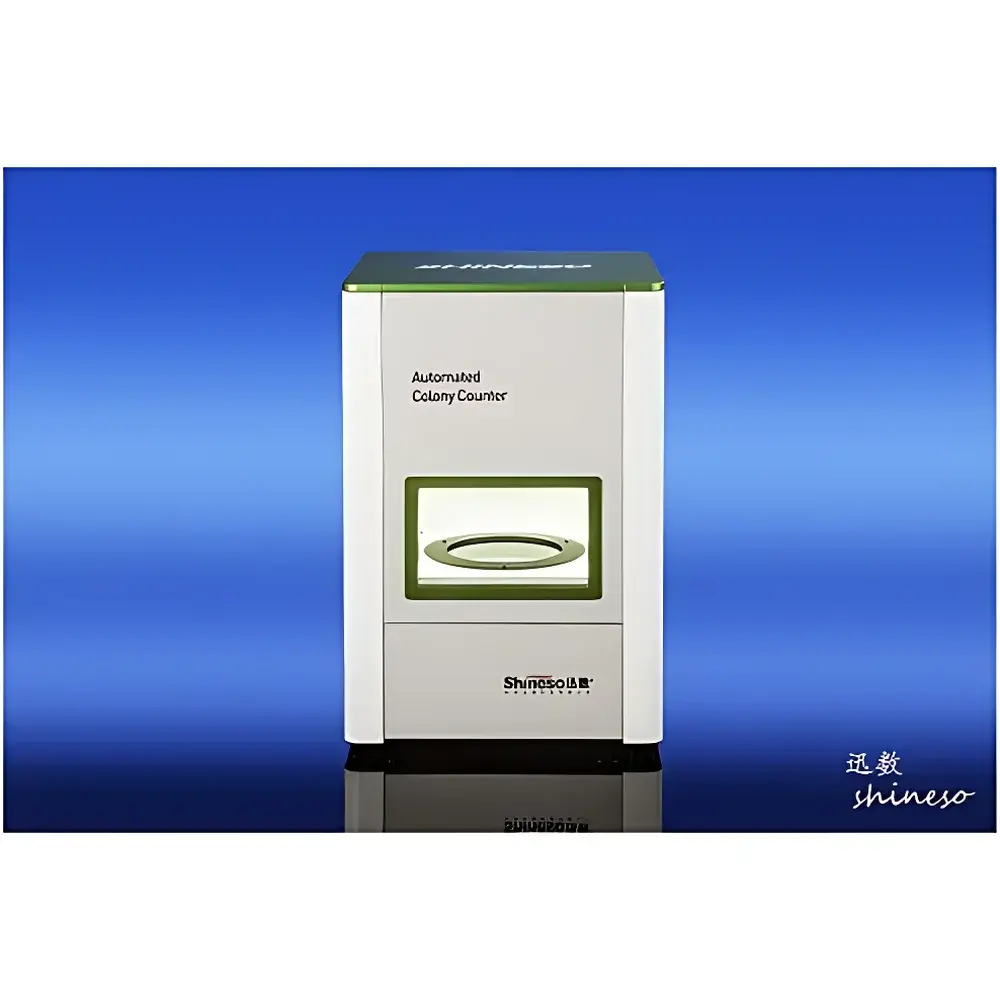
Xunshu iCount 11 Automated Colony Counter
| Brand | Xunshu |
|---|---|
| Origin | Zhejiang, China |
| Manufacturer Type | Direct Manufacturer |
| Product Type | Fully Automated Colony Counter |
| Sample Types | Liquid media, Solid media (pour plate, spread plate) |
| Petri Dish Capacity | 90 mm diameter |
| Counting Speed | 20,000 colonies/sec |
| Detection Resolution | 0.05 mm |
| Imaging System | 8 mm fixed-focus industrial lens, 3.0 MP resolution, 1/2.5″ CMOS sensor, physical pixel count: 5 million |
| Configuration | Main unit + colony analysis software |
Overview
The Xunshu iCount 11 Automated Colony Counter is an entry-level yet technically robust digital imaging system engineered for precise, high-throughput enumeration of microbial colonies on standard 90 mm Petri dishes. It operates on the principle of high-contrast digital image acquisition combined with adaptive threshold segmentation and morphology-based classification algorithms. Unlike manual or semi-automated counters reliant on fixed lighting or basic binary thresholding, the iCount 11 integrates a dual-path optical architecture—featuring both top-mounted diffuse reflectance illumination and bottom-mounted dark-field backlighting—to maximize contrast across diverse colony morphologies (e.g., translucent, pigmented, filamentous, or mucoid) and agar types (e.g., nutrient agar, VRBA, PCA, or membrane filtration filters). Its core design prioritizes reproducibility in regulated environments: the fully enclosed aluminum-alloy chassis (32 × 34 × 46 cm) ensures optical isolation from ambient light, eliminating stray reflections and refractive artifacts commonly observed at Petri dish edges—a critical requirement for GLP-compliant microbiological testing.
Key Features
- Optically isolated enclosure with pull-down aluminum shutter to eliminate environmental light interference during acquisition.
- Dual-mode illumination system: (1) Top-mounted 96-LED array with nano-reflective diffuser (3100–5800 K color temperature, 50–7000 lux adjustable) for uniform, glare-free surface rendering; (2) Bottom-mounted white LED dark-field illumination (100–5500 lux, CRI 74%) for enhanced depth perception of subsurface colonies.
- High-fidelity imaging chain: 8 mm C-mount industrial lens (distortion <1%, f/2.8–f/16 aperture), paired with a 1/2.5″ CMOS sensor (5 MP physical resolution, 2.2 × 2.2 µm pixel pitch) delivering sub-0.05 mm spatial resolution at 90 mm field-of-view.
- Adaptive segmentation engine combining randomized Hough transform circle detection, level-set splitting, and watershed fusion—enabling reliable separation of clustered, chain-forming, or overlapping colonies without over-segmentation.
- Intuitive rapid-statistics interface: seven dedicated controls—three one-click modes (monochrome, mold, inverse) and four scroll-wheel-adjustable presets (homogeneous background, heterogeneous background, microcolonies, colored substrates).
- Comprehensive morphometric analysis: per-colony metrics include equivalent diameter, perimeter, area, circularity, major/minor axis length, and aspect ratio—exportable as structured CSV or Excel datasets.
Sample Compatibility & Compliance
The iCount 11 supports all conventional plating methods: pour plates, spread plates, and membrane filter assays on standard 90 mm Petri dishes. It accommodates both opaque and translucent agar media—including chromogenic formulations—and reliably detects colonies ranging from 0.1 mm to >5 mm in diameter. The system’s illumination flexibility enables consistent performance across diverse microbial species: bacterial colonies (e.g., E. coli, S. aureus), yeasts (e.g., C. albicans), molds (e.g., Aspergillus spp.), and environmental isolates. While not pre-certified to ISO 4833-2:2013 or AOAC Official Method 990.12 out-of-the-box, its traceable calibration protocol (built-in reference grid + user-adjustable scale correction), audit-trail-enabled software logging, and role-based access control (“Manager”, “Operator”, “Reviewer”) align with foundational requirements for data integrity under FDA 21 CFR Part 11 and EU Annex 11 when deployed within validated laboratory workflows.
Software & Data Management
The proprietary colony analysis software provides full lifecycle data handling—from acquisition to regulatory reporting. Each assay session automatically records metadata: sample ID, dilution factor, plate type, illumination settings, segmentation parameters, operator ID, timestamp, and raw + processed images. All modifications—including manual corrections, region-of-interest selections, contamination masking, and grid removal—are versioned and time-stamped. Data exports support PDF reports (with embedded images and statistical summaries), Excel spreadsheets (with morphology matrices), and CSV files compatible with LIMS integration. The software enforces multi-tiered user permissions and maintains an immutable log of all actions—meeting minimum ALCOA+ principles (Attributable, Legible, Contemporaneous, Original, Accurate, Complete, Consistent, Enduring, Available) for QC/QA documentation.
Applications
The iCount 11 serves routine and research-grade applications in food safety laboratories (e.g., total viable count, coliform enumeration per ISO 4833-1), pharmaceutical QC (microbial limits testing per USP ), water quality monitoring (membrane filtration counts per ISO 9308-1), cosmetic challenge testing, and academic microbiology education. Its speed and reproducibility make it suitable for high-volume screening in contract testing labs, while its morphometric output supports comparative studies of growth kinetics, antimicrobial efficacy, or biofilm dispersal. The system does not perform identification or speciation; it is strictly a quantitative enumeration platform compliant with classical culture-based standards.
FAQ
Does the iCount 11 support 150 mm Petri dishes?
No—it is mechanically and optically optimized exclusively for 90 mm diameter Petri dishes.
Can the software export data directly to LIMS?
Yes—structured CSV and Excel outputs are LIMS-compatible; direct API integration requires custom configuration via third-party middleware.
Is the system compliant with 21 CFR Part 11?
It provides foundational capabilities (electronic signatures, audit trails, role-based access); formal compliance requires site-specific validation and procedural controls.
What is the recommended maintenance interval for the LED illumination system?
LED modules are rated for ≥20,000 hours; no scheduled replacement is required under normal laboratory use conditions.
Does the iCount 11 require external calibration standards?
No—the built-in calibration grid allows for on-system verification; NIST-traceable stage micrometers may be used for higher-order validation if required by internal SOPs.



