
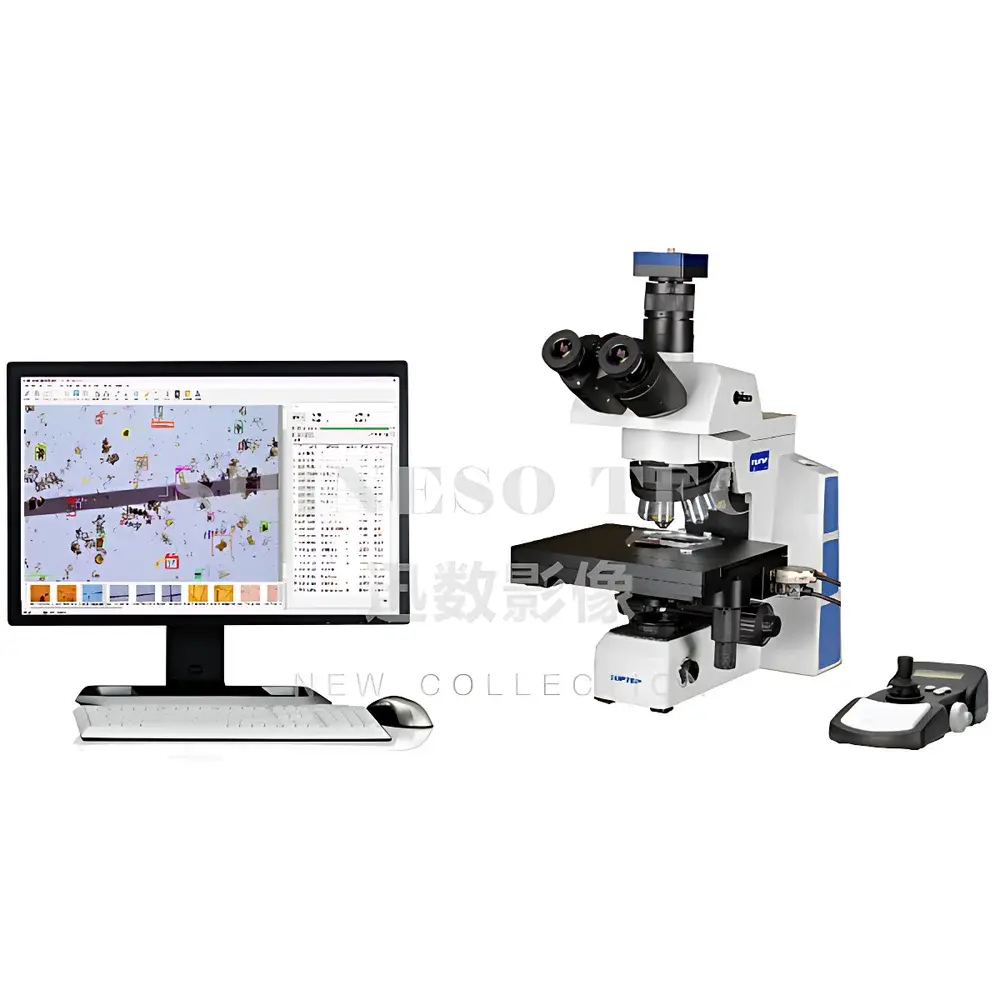
Xunshu AlgaeAI 600 Artificial Intelligence Algal Analyzer
| Brand | Xunshu |
|---|---|
| Origin | Zhejiang, China |
| Manufacturer Type | OEM Manufacturer |
| Country of Origin | China |
| Model | Xunshu AlgaeAI 600 |
| Pricing | Upon Request |
Overview
The Xunshu AlgaeAI 600 Artificial Intelligence Algal Analyzer is a fully integrated, regulatory-compliant digital microscopy platform engineered for standardized quantitative and qualitative analysis of phytoplankton in freshwater and marine environmental monitoring programs. Built upon a research-grade inverted biological microscope, high-resolution global-shutter imaging system, precision XYZ motorized stage, and a domain-optimized deep learning inference engine, the AlgaeAI 600 automates the entire workflow—from slide scanning and multi-plane focus stacking to species-level identification, morphometric measurement, biovolume calculation, and ecological index derivation. Its core analytical principle leverages convolutional neural networks (CNNs) trained on curated, expert-annotated microscopic imagery of >1,700 algal genera across 15 taxonomic phyla, enabling robust classification under real-world imaging conditions—including partial cell occlusion, intercellular overlap, defocus-induced blur, and edge-truncated morphology. Designed to align with internationally referenced water quality standards—including SL 733–2016, HJ 1215–2021, HJ 1216–2021, GB 17378–2007, and the “Methods for Monitoring and Analysis of Water and Wastewater” (4th Edition)—the system delivers auditable, GLP-aligned digital records suitable for regulatory reporting and long-term ecological trend analysis.
Key Features
- Fully automated slide scanning with motorized XYZ stage: supports full-scan, row-grid, or stochastic field-of-view acquisition modes; completes scanning equivalent to 3 hours of manual work in ≤5 minutes
- Optical configuration:舜宇 RX50 research-grade trinocular microscope equipped with Plan Achromat (4×, 10×, 40×) and Plan Apochromat (20×, NA 0.75) objectives; wide-field 10× eyepieces; high-transmission trinocular tube
- Imaging performance: global-shutter CMOS camera with <0.20 µm/pixel resolution; Z-axis closed-loop autofocus with 0.156 µm step resolution and ±0.4 µm repeatability; programmable z-stack acquisition for extended depth-of-field reconstruction
- AI inference engine: optimized CNN architecture trained on >130 common phytoplankton taxa (Chlorophyta, Cyanobacteria, Bacillariophyta, Cryptophyta, Dinophyta, etc.), with ≥92% species-level recognition accuracy in local reference libraries and ≤6% intra-sample analytical repeatability error
- Real-time visualization: dynamic on-screen annotation of detected cells with taxon labels; live-updating statistics panel (phylum, genus, count, relative abundance, cell density); progress bar indicating batch processing status
- Interactive correction interface: mouse-driven addition, deletion, or reclassification of individual cells with immediate recalculation of all downstream metrics—including biovolume, Shannon diversity index, Pielou evenness, dominance index, and average morphometric dimensions (length, width, height, diameter, area, volume)
Sample Compatibility & Compliance
The AlgaeAI 600 accepts standard 22 × 22 mm glass slides prepared via Utermöhl sedimentation or membrane filtration methods per HJ 1215–2021 and HJ 1216–2021. It supports analysis of phytoplankton within the size range of 3–1000 µm and accommodates heterogeneous samples containing mixed densities, overlapping colonies, fragmented filaments, and partially imaged cells at the field boundary. All analytical outputs—including raw image metadata, annotated TIFF stacks, detection confidence scores, and statistical summaries—are stored in timestamped, immutable project files compliant with data integrity principles outlined in ISO/IEC 17025 and EPA Method 1623.2. The system enables full traceability from image capture through AI inference to final report generation, satisfying documentation requirements for GLP audits and regulatory submissions.
Software & Data Management
The proprietary AlgaeAI software suite runs on a dedicated Windows 10 Pro workstation (Intel Core i9-12900, 32 GB DDR4 RAM, 4 GB discrete GPU, dual-storage architecture). It features built-in electronic lab notebook functionality: every analysis session auto-generates an encrypted, version-stamped archive containing original z-stacks, AI-generated bounding boxes with taxonomy labels, morphometric tables, biodiversity indices, and PDF-formatted compliance reports. Export formats include CSV, Excel, and XML for LIMS integration. Audit trails record operator ID, timestamp, parameter adjustments, and manual corrections—ensuring alignment with FDA 21 CFR Part 11 requirements for electronic records and signatures. Optional local model fine-tuning is provided during commissioning to adapt the AI classifier to regional flora or laboratory-specific preparation protocols.
Applications
- Routine phytoplankton monitoring in drinking water reservoirs, wastewater treatment effluents, and natural lakes/rivers per national and provincial water quality assessment frameworks
- Ecological health assessment using biodiversity metrics (Shannon–Wiener, Simpson, Pielou) derived directly from AI-quantified assemblage composition
- Early-warning detection of harmful algal blooms (HABs), including Microcystis, Anabaena, and Pseudo-nitzschia, based on real-time density thresholds and dominance ratios
- Taxonomic support for environmental impact assessments (EIAs), restoration project baselines, and climate-driven phenology studies
- Training and capacity building for technical staff through the integrated Plankton Expert Database—featuring bilingual (Latin/Chinese) taxonomic hierarchy, morphological search tools, and side-by-side comparative modules for morphologically similar taxa
FAQ
Does the AlgaeAI 600 require prior expertise in phycology to operate?
No. The system is designed for routine use by laboratory technicians without formal training in algal taxonomy. Species identification is performed autonomously by the AI engine; users verify or refine results interactively.
Can the AI model be updated or customized for regional species not included in the default library?
Yes. Xunshu provides one complimentary local model adaptation service during installation, leveraging user-submitted reference images and expert validation to extend taxon coverage.
How does the system handle overlapping or out-of-focus algal cells?
It employs three proprietary inference modules: intelligent adhesion separation for clustered cells, morphological inference for partially visible cells, and defocus-tolerant feature extraction for low-contrast or blurred structures.
Is raw image data retained alongside AI annotations?
Yes. All original z-stack images, focus maps, and pixel-level detection masks are preserved in native format with embedded EXIF metadata, enabling retrospective reanalysis and third-party verification.
What regulatory standards does the AlgaeAI 600 support out-of-the-box?
It natively implements workflows compliant with SL 733–2016, HJ 1215–2021, HJ 1216–2021, GB 17378–2007, and the “Methods for Monitoring and Analysis of Water and Wastewater” (4th Edition), including mandatory reporting fields and calculation logic.







