
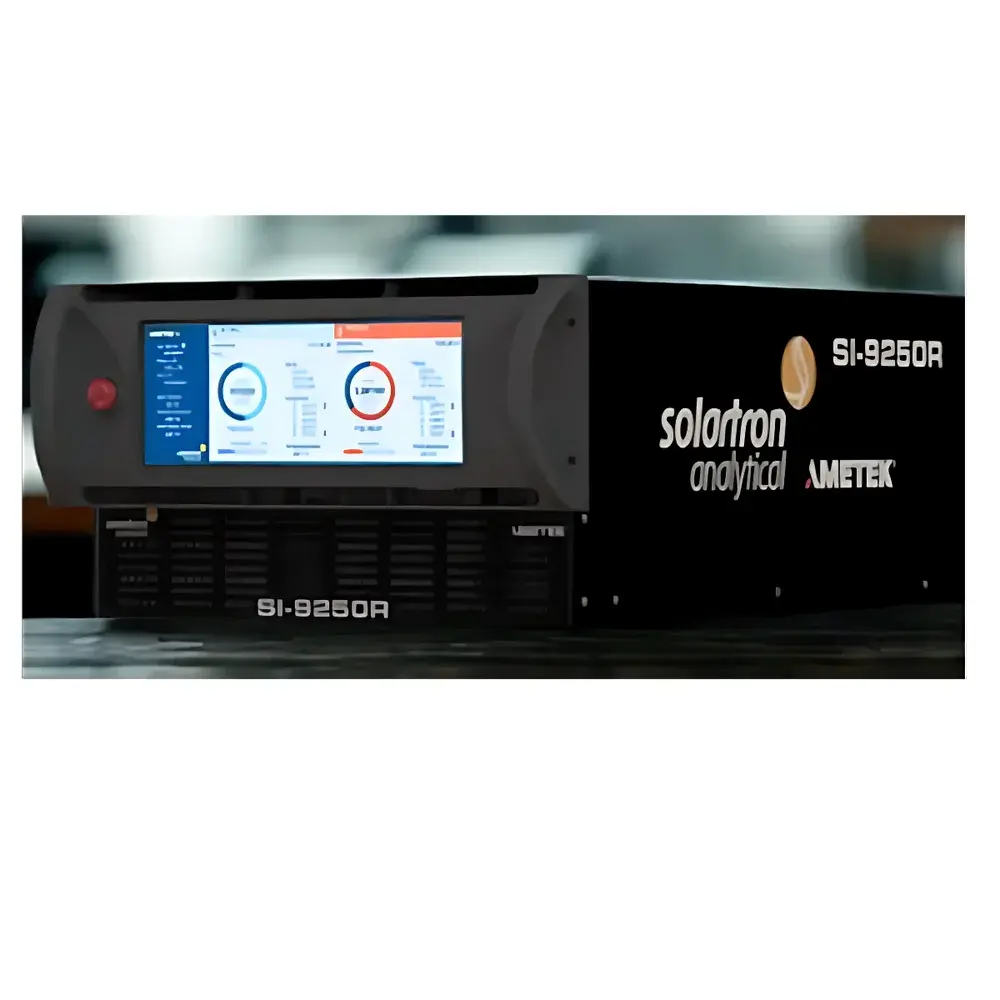
Solartron Analytical HV 9250 High-Voltage, High-Current Integrated AC/DC Electrochemical Workstation
| Brand | Solartron Analytical |
|---|---|
| Origin | UK |
| Model | HV 9250 |
| Channel Configuration | Multi-channel (1 or 2 main channels + up to 5 auxiliary voltage divider channels) |
| Current Range | ±125 A to ±250 A |
| Current Accuracy | ±0.1% |
| Potential Accuracy | ±0.1% |
| Potentiostatic Range | ±60 V, ±120 V, ±240 V |
| EIS Frequency Range | 1 mHz – 10 kHz |
| Maximum Power per Main Channel | 10 kW |
| Data Acquisition Rate | 10 kS/s |
| ADC Resolution | 24-bit (120 µV main channel, 20 µV auxiliary) |
| Input Impedance | 10 MΩ (all voltage inputs) |
| Temperature Inputs | 6 thermistor channels (1 per main + 5 auxiliary), 16 thermocouple channels via external VTI1401 DAQ |
| Digital I/O | 1 input, 1 output (trigger/control) |
| Software Platform | Aspire™ electrochemical control and analysis suite |
Overview
The Solartron Analytical HV 9250 is a high-fidelity, multi-channel electrochemical workstation engineered for demanding high-power battery testing, large-scale electrolyzer characterization, and industrial-scale electrochemical process development. Unlike conventional potentiostats limited to milliampere-level currents and low-voltage operation, the HV 9250 implements a robust, isolated power architecture capable of delivering ±250 A at up to ±240 V DC — enabling direct, real-time evaluation of full-stack cells, flow batteries, and solid-state electrochemical systems under realistic operational loads. Its core measurement principle combines galvanostatic/potentiostatic control with high-resolution impedance spectroscopy (EIS) across a 1 mHz–10 kHz bandwidth, supported by synchronized voltage/current sampling at 10 kS/s and 24-bit analog-to-digital conversion. Designed for integration into automated test benches and controlled environmental chambers, the system complies with fundamental requirements for traceable electrochemical metrology in R&D, quality assurance, and pre-certification validation workflows.
Key Features
- Scalable high-power operation: Configurable main channel output up to ±250 A / ±240 V; parallel/series channel combinations support extended voltage (±240 V) or current (±500 A) ranges while maintaining individual channel isolation and independent control.
- Dual-domain precision: Simultaneous high-accuracy potential control (±0.1% of range) and current measurement (±0.1% of full scale), validated against NIST-traceable reference standards for ISO/IEC 17025-compliant laboratories.
- Modular auxiliary architecture: Five dedicated auxiliary voltage-divider channels per main channel enable precise multi-point potential monitoring across cell stacks, electrode gradients, or distributed reference electrodes — critical for identifying localized degradation or inhomogeneous current distribution.
- Integrated thermal instrumentation: Six onboard thermistor inputs (one per main channel + five auxiliary) and optional 16-channel thermocouple support via VTI1401 external DAQ ensure synchronized electrochemical-thermal correlation without external synchronization hardware.
- Hardware-triggered digital I/O: One TTL-compatible digital input and one output provide deterministic timing for external device coordination — e.g., triggering environmental chamber setpoint changes, safety interlocks, or optical diagnostics synchronized to charge/discharge transitions.
Sample Compatibility & Compliance
The HV 9250 accommodates a broad spectrum of electrochemical configurations, including single-cell Li-ion pouch/prismatic modules, redox flow battery stacks, PEM electrolyzers, molten salt cells, and corrosion test coupons. Its wide voltage compliance range (±60 V to ±240 V) and high-current capability eliminate the need for external power amplifiers or shunt-based current sensing, reducing measurement uncertainty and signal noise. The system meets essential electrical safety standards (IEC 61010-1 CAT III 300 V) and supports audit-ready data integrity through Aspire™ software’s built-in GLP/GMP features: electronic signatures, user-access controls, versioned method templates, and FDA 21 CFR Part 11–compliant audit trails. All firmware and calibration records are stored locally on NAS-capable storage, ensuring long-term reproducibility and regulatory traceability.
Software & Data Management
Aspire™ software serves as the unified control, acquisition, and analysis environment for the HV 9250. It supports over 30 standardized electrochemical techniques — including CC/CV/CP cycling, LSV, pulsed voltammetry, PEIS/GEIS, and arbitrary waveform generation — with real-time Ohmic drop compensation and adaptive parameter optimization. Raw data streams (voltage, current, temperature, auxiliary potentials) are saved in HDF5 format with embedded metadata (timestamps, instrument configuration, calibration IDs), enabling seamless import into MATLAB, Python (via h5py), or third-party analytics platforms. The system provides RESTful API access for integration with LIMS, MES, or custom automation frameworks. Optional NAS direct-write functionality allows continuous streaming to network-attached storage without host PC bottlenecks — essential for multi-week aging studies generating terabytes of time-series data.
Applications
- Large-format battery qualification: Cycle life testing of 48 V–800 V traction battery modules under dynamic load profiles with simultaneous stack voltage segmentation.
- Electrolyzer efficiency mapping: Polarization curve acquisition and EIS-based catalyst layer resistance decomposition across operating temperatures and gas pressures.
- Corrosion kinetics under high-current density: Real-time monitoring of localized anodic dissolution in marine or industrial electrolytes using multi-electrode arrays.
- Electrochemical impedance tomography (EIT): Spatially resolved impedance profiling across planar electrode assemblies via synchronized auxiliary channel acquisition.
- Process validation for electrodeposition: Precise control of current density transients during high-rate metal plating, coupled with in-situ potential feedback from reference microelectrodes.
FAQ
What safety certifications does the HV 9250 meet?
The system conforms to IEC 61010-1 (Edition 3) for measurement, control, and laboratory equipment, including overvoltage category CAT III 300 V and pollution degree 2. Internal isolation barriers exceed 4 kV RMS between main channels and auxiliary inputs.
Can the HV 9250 perform true multi-channel EIS simultaneously?
Yes — all main and auxiliary channels acquire synchronized time-domain data at 10 kS/s, enabling post-acquisition frequency-domain analysis of multiple voltage/current pairs within a single experiment, preserving phase coherence.
Is calibration traceable to national standards?
Factory calibration is performed using Fluke Metrology-grade references traceable to NPL (UK) and includes documented uncertainty budgets per ISO/IEC 17025. On-site recalibration services are available with certified calibration certificates.
How is data integrity ensured during long-duration tests?
Aspire™ enforces write-once archival mode, disables manual file modification, logs all user actions with timestamps and IP addresses, and generates SHA-256 checksums for each dataset — satisfying ALCOA+ principles for regulated environments.
Does the system support third-party environmental chamber integration?
Yes — via analog voltage control signals, Modbus TCP, or custom API endpoints. Pre-configured drivers are available for major chamber vendors (Binder, Weiss, ESPEC) to synchronize temperature ramps with electrochemical protocols.




