Esco Voyager 2.0 Laboratory Monitoring and Data Management Software
| Brand | Esco |
|---|---|
| Origin | Singapore |
| Manufacturer | Esco Lifesciences Group |
| Product Category | Imported LIMS-adjacent Monitoring Software |
| Model | Voyager 2.0 |
| Software Type | Device Integration & Remote Supervisory Platform |
| Connectivity | RS232 / RS485 Serial Interface |
| Deployment | Serverless Local or Hybrid Network Architecture |
| Compliance Context | Supports GLP/GMP-aligned audit trails, ISO/IEC 17025 data integrity principles, and FDA 21 CFR Part 11–ready configuration (with optional digital signature module) |
Overview
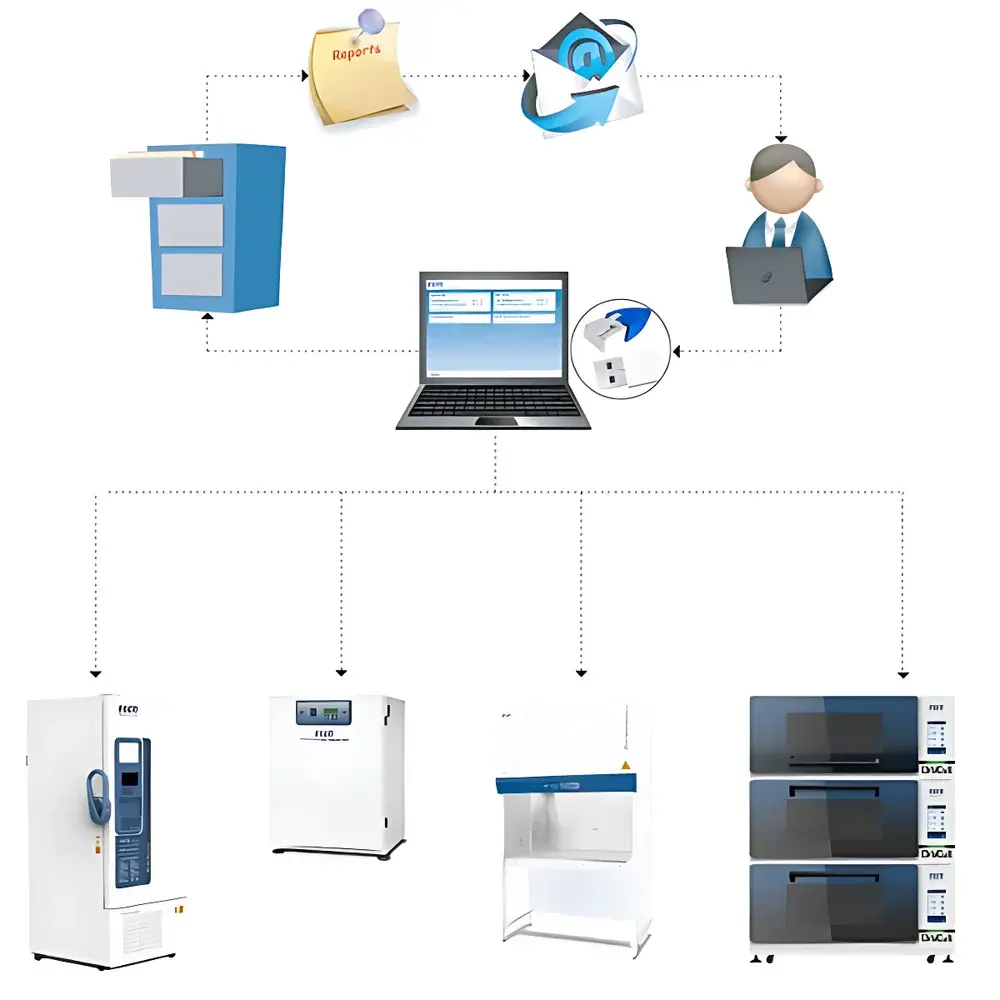
Esco Voyager 2.0 is a purpose-built supervisory software platform engineered to unify remote monitoring, real-time operational logging, and centralized configuration management for Esco laboratory equipment—including biological safety cabinets, CO₂ incubators, ultralow temperature freezers, and controlled-environment workstations. Unlike generic SCADA or enterprise LIMS solutions, Voyager 2.0 operates as a device-native integration layer: it communicates directly with Esco hardware via standardized serial protocols (RS232 and RS485), eliminating the need for third-party gateways, external sensors, or retrofitting. Its architecture is designed for laboratories requiring continuous environmental assurance without infrastructure overhead—supporting both standalone deployment on local workstations and scalable integration into existing institutional IT networks. The system captures time-stamped telemetry (e.g., chamber temperature, airflow velocity, alarm status, door open duration) and stores it in an encrypted local database, enabling retrospective analysis while maintaining full data sovereignty.
Key Features
- Native Device Integration: Direct protocol-level communication with Esco equipment firmware—no middleware, no driver installation, no IP address reconfiguration required.
- Zero-Server Architecture: Runs as a Windows-based desktop application; stores all logs locally in SQLite format with AES-256 encryption—no cloud dependency or external server licensing.
- Multi-Channel Alerting: Configurable escalation rules trigger notifications via SMTP email, SIP-based VoIP call, or SMS gateway (requires third-party SMS provider integration); each alert includes device ID, timestamp, parameter threshold breach, and recommended action code.
- Role-Based Access Control (RBAC): Four predefined permission tiers—Administrator, Lab Manager, Technician, and Viewer—with granular control over device configuration, log export, alarm acknowledgment, and user provisioning.
- Compliance-Ready Logging: All user actions (login/logout, parameter changes, alarm acknowledgments) are recorded with immutable timestamps and operator IDs—enabling traceability for internal audits or regulatory inspections under ISO/IEC 17025, CLIA, or GxP frameworks.
- Export-Optimized Reporting: Generates PDF or CSV reports compliant with laboratory quality documentation standards—including daily operational summaries, alarm frequency histograms, and device uptime/downtime analytics.
Sample Compatibility & Compliance
Voyager 2.0 does not interface with sample containers or biological specimens directly; rather, it monitors the physical integrity of the environments in which samples are housed. It is validated for use with Esco’s Class II A2 and B2 biosafety cabinets (per NSF/ANSI 49), CO₂ incubators (per ISO 13408-2), and ultra-low temperature freezers (per IEC 61000-4-3). All data capture adheres to ALCOA+ principles (Attributable, Legible, Contemporaneous, Original, Accurate, Complete, Consistent, Enduring, Available) when deployed with enabled audit trail settings. While Voyager 2.0 itself is not FDA-cleared as a medical device, its configuration supports 21 CFR Part 11 compliance when paired with Esco’s optional digital certificate module and institutional identity management systems.
Software & Data Management
The software employs a lightweight, single-executable installer compatible with Windows 10/11 (64-bit) and .NET Framework 4.8. Data retention policies are configurable per installation: users may define automatic local backup intervals (daily/weekly/monthly), compression settings, and external storage paths (NAS, USB drive, or mapped network share). Raw telemetry is stored in structured, human-readable JSON metadata alongside binary sensor logs—facilitating third-party import into ELN or LIMS platforms via documented RESTful API endpoints (available under Esco Developer License Agreement). Version-controlled firmware updates for connected devices can be initiated and logged directly from the Voyager interface, with rollback capability and SHA-256 hash verification.
Applications
- Quality Assurance Units: Continuous validation of environmental parameters across multiple labs to support ISO 17025 accreditation evidence packages.
- Biobanking Facilities: Long-term monitoring of freezer stability and alarm response latency—critical for sample viability assurance per ISBER Best Practices.
- Academic Core Facilities: Centralized oversight of shared equipment usage, maintenance scheduling, and cost-allocation reporting based on actual runtime metrics.
- Clinical Trial Labs: Audit-ready documentation of incubator CO₂ concentration excursions during cell culture processing—aligned with ICH-GCP Annex 11 expectations.
- Pharmaceutical R&D: Correlation of cabinet airflow deviations with particulate counts (when integrated with Esco’s optional particle counters) to support root cause analysis in contamination investigations.
FAQ
Does Voyager 2.0 require an internet connection to operate?
No. Core monitoring, logging, and alerting functions operate fully offline. Internet access is only needed for optional features such as remote access via Esco Cloud Bridge (separate subscription), firmware updates, or SMTP/SMS gateway configuration.
Can Voyager 2.0 integrate with our existing LIMS or ELN?
Yes—via its documented JSON-based API and scheduled CSV export scheduler. Esco provides integration guides for common platforms including LabVantage, Thermo Fisher SampleManager, and Benchling (custom adapter development may be required).
Is historical data migration supported from Voyager 1.x?
Yes. Voyager 2.0 includes a built-in converter that imports legacy SQLite databases from Voyager 1.5+ installations, preserving all timestamps, user IDs, and alarm classifications.
How frequently is telemetry data sampled and logged?
Default sampling interval is 10 seconds per monitored parameter; this is adjustable per device type within defined firmware limits (e.g., temperature: 1–60 sec; airflow: 5–30 sec).
What cybersecurity certifications apply to Voyager 2.0?
The software complies with NIST SP 800-53 Rev. 4 controls for medium-impact systems, including secure boot verification, TLS 1.2+ for outbound communications, and FIPS 140-2 validated cryptographic modules (when enabled).
Related Products