
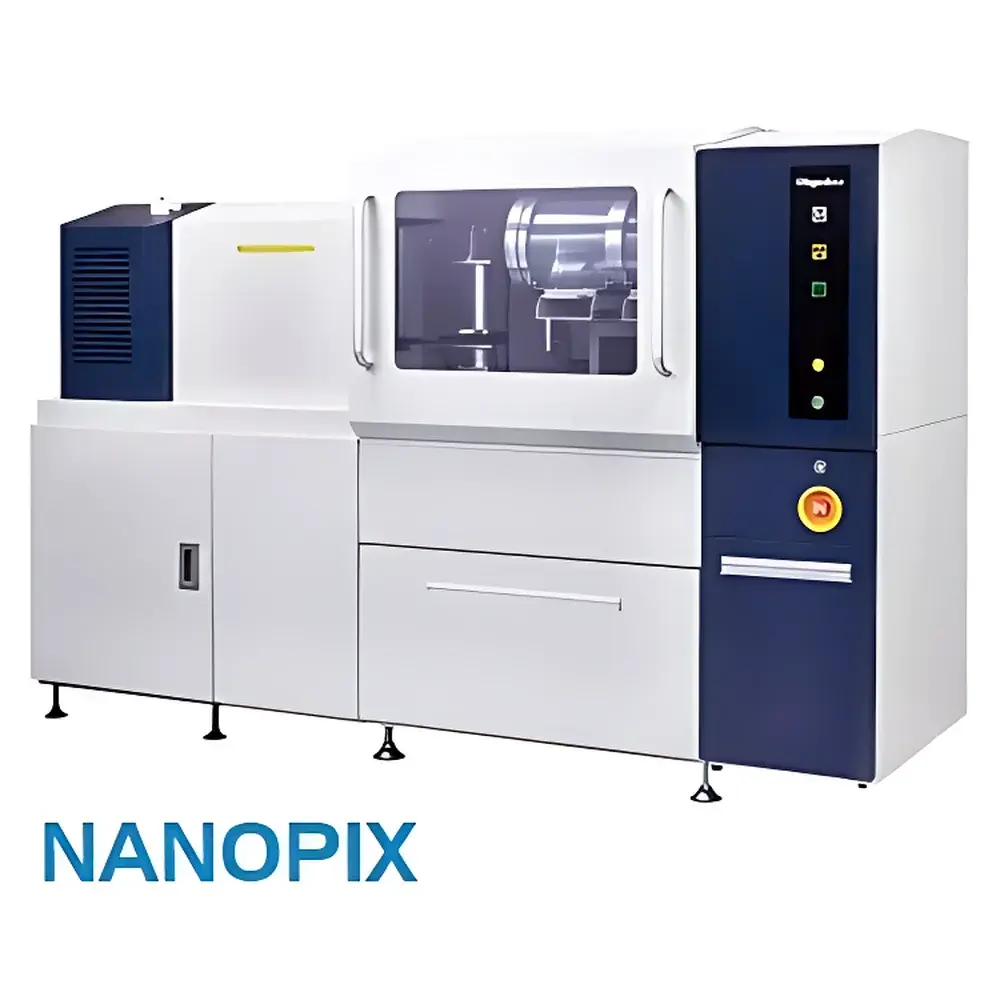
Rigaku NANOPIX SAXS/WAXS System
| Brand | Rigaku |
|---|---|
| Origin | Japan |
| Model | NANOPIX |
| Instrument Type | Integrated SAXS/WAXS Scattering System |
| Measurement Range (q) | 0.02 – 5.0 nm⁻¹ (corresponding to real-space d-spacing: 0.16 – 288 nm) |
| Beam Size | Ø70 µm |
| Sample Requirement | ≥ few mg (solid), ≥ few µL (liquid) |
| Data Acquisition Time | As low as <60 s per frame (depending on flux, sample scattering power, and detector integration time) |
| X-ray Source | MM007HF microfocus rotating anode or FR-X sealed-tube source |
| Beam Conditioning | Selectable pinhole collimation (1-, 2-, or 3-pinhole configurations) |
| Sample Stages | GI-SAXS/WAXS stage, cryo/variable-temperature stage (−150 °C to +400 °C), vacuum-compatible stage, tensile stage, multi-axis goniometer |
| Detector | HyPix-3000 or HyPix-6000 hybrid pixel array detector (2D) |
Overview
The Rigaku NANOPIX is a fully integrated laboratory-scale small-angle and wide-angle X-ray scattering (SAXS/WAXS) system engineered for high-resolution structural characterization of nanoscale and mesoscale materials. Based on the principles of coherent X-ray scattering, the NANOPIX enables quantitative analysis of electron density fluctuations across length scales from ~0.16 nm to 288 nm — bridging atomic-level crystallographic information (via WAXS) and nanoscale morphology (via SAXS) in a single instrument. Its design centers on high-brilliance microfocus X-ray generation, precision beam conditioning, and noise-optimized 2D detection, allowing robust measurement of weak scattering signals from dilute solutions, thin films, polymers, colloids, proteins, and functional nanomaterials. The system operates under vacuum or controlled atmosphere environments and supports simultaneous thermal, mechanical, or environmental stimuli — making it suitable for time-resolved, in situ, and operando studies aligned with modern materials science workflows.
Key Features
- High angular resolution down to qmin = 0.02 nm⁻¹ — enabling access to structures up to ~314 nm in real space (d = 2π/q)
- Dual-mode operation: seamless switching between SAXS (q ≈ 0.02–0.5 nm⁻¹) and WAXS (q ≈ 0.5–5.0 nm⁻¹) without hardware reconfiguration
- Modular collimation options: selectable 1-, 2-, or 3-pinhole systems for optimized resolution vs. intensity trade-offs
- High-flux X-ray sources: MM007HF rotating anode (Cu Kα, 9 kW) or FR-X sealed tube (Cu Kα, 2.2 kW), both with automatic power control and long-term stability
- HyPix-3000/6000 hybrid pixel array detectors featuring zero readout noise, high dynamic range (>10⁶), and frame rates up to 100 Hz — essential for kinetic and pump-probe experiments
- Intelligent automation: motorized stages, beam alignment routines, and auto-exposure optimization driven by Rigaku’s SmartLab Studio II software platform
Sample Compatibility & Compliance
The NANOPIX accommodates diverse sample forms including powders, thin films, fibers, gels, liquid dispersions, and bulk solids. Minimal sample requirements — as little as a few milligrams for solids or microliters for solutions — reduce material consumption and support high-throughput screening. Optional accessories expand experimental flexibility: grazing-incidence (GI-SAXS/WAXS) geometry for surface-sensitive measurements; cryogenic and variable-temperature stages compliant with ASTM E1113 and ISO 11357 standards; vacuum chambers meeting ISO 27497 vacuum integrity specifications; and uniaxial tensile modules for stress-induced structural evolution studies. All hardware and software components are designed to support GLP-compliant data acquisition, with audit-trail logging, electronic signatures, and metadata embedding in accordance with FDA 21 CFR Part 11 requirements where configured.
Software & Data Management
Data acquisition, reduction, and modeling are unified within Rigaku’s SmartLab Studio II environment — a modular, scriptable platform supporting automated batch processing, real-time q-space calibration, background subtraction, radial integration, and primary data correction (e.g., polarization, absorption, detector response). Integrated tools include Fit2D-compatible SAXS/WAXS analysis modules, Irena (NIH) plugin support for advanced modeling, and direct export to industry-standard formats (ASC, DAT, CBF, HDF5). Raw and processed datasets are stored with embedded experimental metadata (source settings, sample ID, temperature history, stage positions), ensuring full traceability and reproducibility. For regulated environments, optional validation packages provide IQ/OQ documentation, performance qualification protocols, and software configuration control aligned with ISO/IEC 17025 and GMP Annex 11 expectations.
Applications
- Nanoparticle size distribution and shape analysis (e.g., metallic, polymeric, lipid-based NPs)
- Protein folding/unfolding, oligomerization, and complex formation in solution
- Morphology evolution in block copolymers, polymer blends, and phase-separated systems
- Crystal structure refinement and lattice parameter tracking during thermal cycling (WAXS)
- In situ monitoring of sol-gel transitions, crystallization kinetics, and electrochemical processes
- Thin-film nanostructure characterization via GI-SAXS/WAXS — including lamellar spacing, domain orientation, and interfacial roughness
- Structure–property correlation in battery electrode materials, MOFs, and soft matter actuators under mechanical or thermal load
FAQ
What is the minimum q-value achievable with the NANOPIX system?
The system achieves qmin = 0.02 nm⁻¹ using the longest sample-to-detector distance configuration and optimal beam collimation.
Can the NANOPIX perform simultaneous SAXS and WAXS measurements?
Yes — the HyPix detector captures both low-q and high-q scattering in a single exposure; data are separated post-acquisition via radial integration over defined q-ranges.
Is the system compatible with third-party environmental chambers?
Yes — standardized flange interfaces (CF-63, CF-100) and programmable I/O ports enable integration with external furnaces, humidity cells, or electrochemical cells.
Does Rigaku provide data analysis training and method development support?
Yes — application scientists offer on-site and remote training, custom macro development, and collaborative method optimization for academic and industrial users.
What maintenance intervals are recommended for the X-ray source and detector?
Rotating anode tubes require annual refurbishment; sealed tubes are rated for >10,000 hours; HyPix detectors feature solid-state reliability with no routine recalibration needed beyond initial commissioning.



