
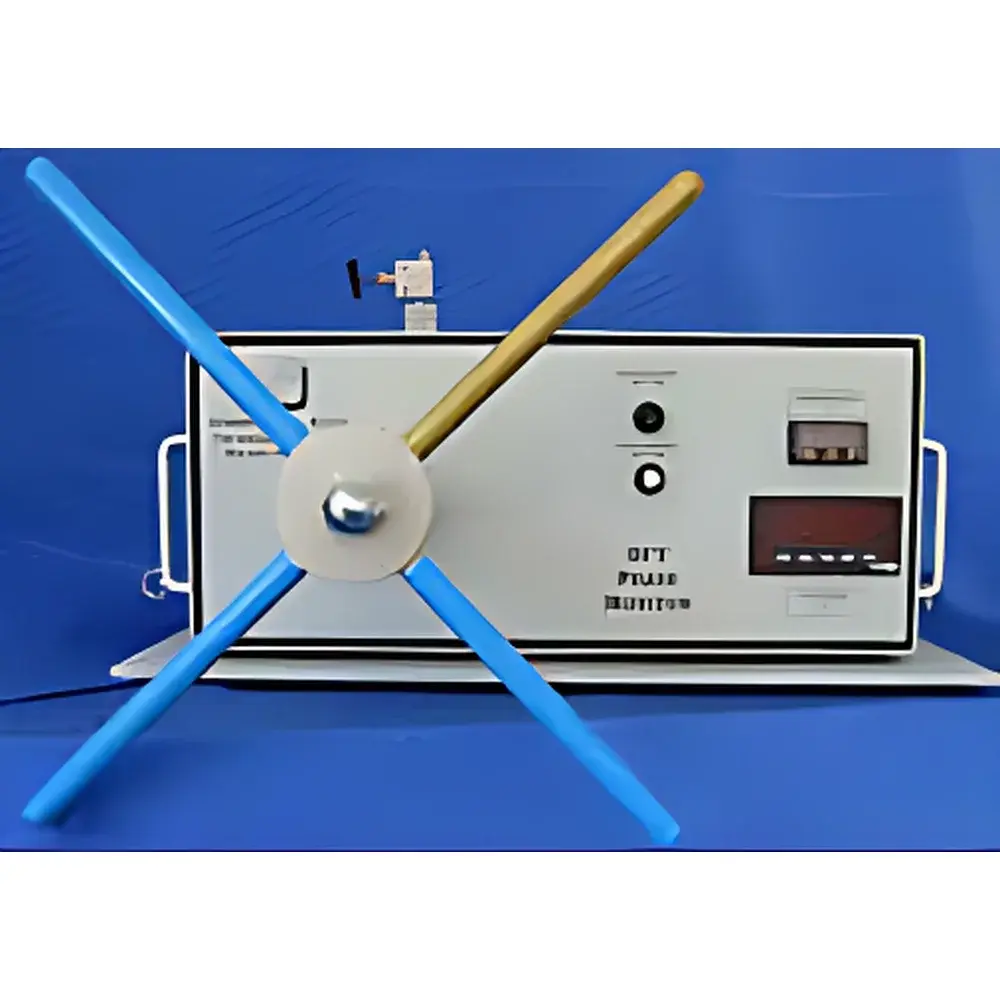
SFT PM-II Supercritical Phase Equilibrium Apparatus
| Brand | SFT |
|---|---|
| Origin | USA |
| Model | PM-II |
| Maximum Temperature | 150 °C |
| Number of Channels | 1 |
| Extraction Volume | 3–30 mL |
| Maximum Pressure | 10,000 psi (69 MPa) |
| Maximum Flow Rate | 0–24 mL/min |
| Extraction Capacity | 3–30 mL/h |
| Pressure Accuracy | ±2 psi |
| Temperature Accuracy | ±0.5 °C |
| Sample Cell Material | 316 Stainless Steel |
| View Window | 3/8″ Fused Quartz |
| Burst Disc Rating | 11,500 psi (79 MPa) |
| Compression Ratio | 10:1 |
| Heating Power | 500 W |
| Control | Fuzzy Logic Temperature Controller with RTD Feedback |
| Imaging System | 1/3″ Color CCD Camera with Variable-Focus Lens, Fiber-Optic Illumination, NTSC-Compatible Monitor & VCR Recording |
Overview
The SFT PM-II Supercritical Phase Equilibrium Apparatus is a precision-engineered benchtop instrument designed for quantitative thermodynamic characterization of fluid-phase behavior under subcritical and supercritical conditions. It operates on the principle of direct visual observation coupled with high-fidelity pressure–temperature–composition (P–T–x) monitoring to determine solubility limits, critical points, phase boundaries, cloud points, swelling behavior, and precipitation thresholds in dense-gas systems—particularly carbon dioxide, ethane, propane, and other liquefied gases. Unlike conventional static equilibrium cells or indirect analytical methods, the PM-II enables real-time, in situ visualization of phase transitions—including liquid–vapor, liquid–supercritical, solid–supercritical, and ternary immiscibility—with simultaneous recording of thermodynamic state variables. Its robust 316 stainless steel sample cell, rated to 10,000 psi (69 MPa) and 150 °C, features dual quartz viewports and magnetically driven internal stirring, ensuring homogeneous mixing and minimizing thermal gradients during extended isothermal or isobaric experiments.
Key Features
- High-pressure, high-temperature sample cell (3–30 mL adjustable volume) constructed from ASTM A240 316 stainless steel with 3/8″ fused quartz optical windows for unobstructed visualization.
- Fully integrated fuzzy logic temperature controller with embedded RTD sensor, enabling precise thermal regulation from ambient to 150 °C (±0.5 °C accuracy) and programmable ramp/soak profiles.
- Pressure control system calibrated to ±2 psi accuracy across the full 10,000 psi range; includes certified burst disc (11,500 psi) and redundant safety interlocks compliant with ASME BPVC Section VIII Division 1.
- Dual-position sample cell mounting: horizontal orientation for liquid-phase studies and vertical orientation for solid dissolution, crystallization, or polymer swelling experiments.
- Real-time imaging subsystem comprising a 1/3″ color CCD camera with manual 12× zoom lens, auto-iris (5 lux sensitivity), fiber-optic cold-light illumination, and NTSC-compatible 14″ color monitor with synchronized VCR recording.
- Video-archived data logging captures timestamped pressure, temperature, elapsed time, user annotations, and live video—supporting traceability requirements aligned with GLP and FDA 21 CFR Part 11 when paired with validated software protocols.
Sample Compatibility & Compliance
The PM-II accommodates a broad spectrum of sample types: pure compounds, binary and multicomponent mixtures, polymers, pharmaceutical actives, natural product extracts, and functionalized nanoparticles. It supports both solvent-free and cosolvent-assisted studies—enabling investigation of modifier effects on solubility enhancement, selectivity reversal, or antisolvent-induced precipitation. The apparatus meets key international standards for laboratory-scale high-pressure equipment, including ISO 14855 (biodegradability in CO₂ media), ASTM D7687 (critical point determination), and USP (container closure integrity testing under pressurized gas environments). All wetted components comply with FDA 21 CFR 177.2400 (food-contact polymers) and EU Regulation (EC) No. 1935/2004 where applicable. Electrical design conforms to UL 61010-1 and IEC 61000-6-3 for electromagnetic compatibility.
Software & Data Management
While the base PM-II configuration utilizes analog video archiving via VCR, optional digital data acquisition modules integrate with third-party LabVIEW™ or MATLAB® environments for automated P–T–x mapping. Time-stamped analog outputs (0–5 V or 4–20 mA) are available for pressure and temperature signals, compatible with most industrial DAQ systems. Video recordings include embedded telemetry overlays (pressure, temperature, date/time), supporting audit-ready documentation per ISO/IEC 17025 and GMP Annex 11 requirements. When used with validated metadata tagging and electronic signature workflows, the system satisfies ALCOA+ principles (Attributable, Legible, Contemporaneous, Original, Accurate, Complete, Consistent, Enduring, Available) for regulated research.
Applications
- Determination of binary and ternary critical endpoints for process design of supercritical extraction, fractionation, and purification.
- Quantification of solute solubility isotherms in scCO₂ and alternative solvents as a function of pressure, temperature, and cosolvent concentration.
- Investigation of polymer–scCO₂ interactions: swelling kinetics, glass transition depression, and morphology evolution via in situ optical tracking.
- Antisolvent crystallization studies (e.g., SAS, GAS, PGSS) to optimize particle size distribution and polymorphic form selection.
- Thermodynamic modeling validation—providing experimental benchmarks for equations of state (Peng–Robinson, SAFT) and activity coefficient models.
- Reaction engineering support: measuring reactant/product solubilities to define mass-transfer limitations and optimal operating windows for supercritical-phase reactions.
FAQ
What is the maximum allowable working pressure and temperature of the PM-II sample cell?
The sample cell is rated for continuous operation up to 10,000 psi (69 MPa) and 150 °C, with a certified burst disc set at 11,500 psi (79 MPa).
Can the PM-II be used for kinetic studies, such as dissolution rate or swelling dynamics?
Yes—the real-time video capability combined with synchronized pressure/temperature logging enables quantitative analysis of time-dependent phenomena including dissolution onset, nucleation lag, and interfacial migration.
Is the system compatible with corrosive solvents beyond CO₂, such as ammonia or hydrogen sulfide?
Standard configuration uses 316 stainless steel and quartz; compatibility with aggressive fluids requires material verification per NACE MR0175/ISO 15156 and may necessitate optional Hastelloy C-276 wetted parts.
Does the PM-II support automated data export for thermodynamic modeling software?
Analog signal outputs allow integration with external DAQ systems; digital data acquisition and CSV export are supported via optional interface modules compatible with Aspen Properties, CHEMCAD, and REFPROP.
How is temperature uniformity maintained across the sample volume during high-pressure experiments?
A 500 W band heater with fuzzy logic control and direct RTD feedback ensures axial and radial thermal stability within ±0.5 °C; magnetic stirring further mitigates thermal stratification.



