
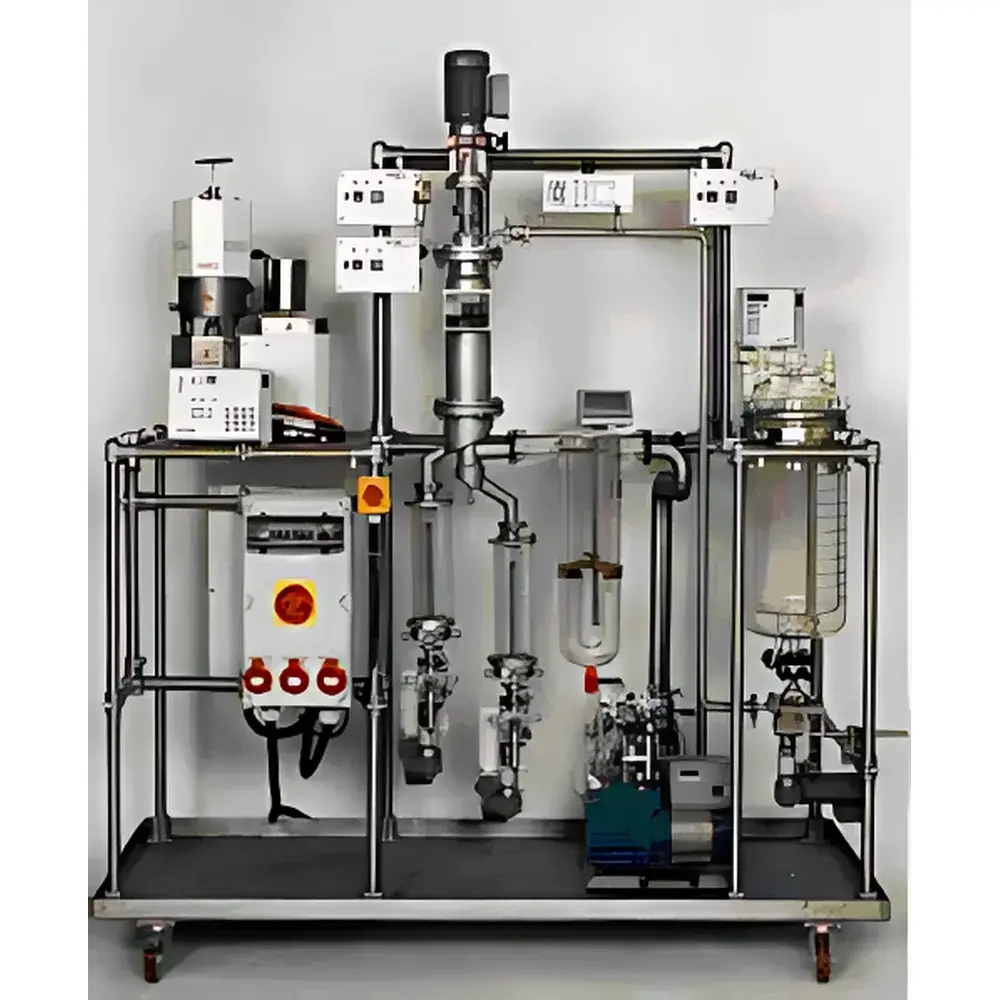
UIC KD 6 Stainless Steel Short-Path (Molecular) Distillation System
| Brand | UIC GmbH |
|---|---|
| Origin | Germany |
| Model | KD 6 |
| Feed Rate | 3–9 kg/h |
| Effective Evaporation Area | 0.06 m² |
| Evaporator Inner Diameter | 180 mm |
| Condenser Area | 0.088 m² |
| Collecting Flasks | 3 |
| Operating Pressure Range | down to 0.001 mbar |
| Max Evaporation Temperature | 350 °C |
| Condenser/Cold Trap Temperature Range | –25 to 200 °C |
| Heating Method | Thermostatic Oil Circulation |
| Film Formation | Self-Cleaning Roller-Type Wiper System |
| Construction Material | AISI 316L Stainless Steel (optional: Hastelloy® variants) |
Overview
The UIC KD 6 is a modular, stainless steel short-path distillation system engineered for laboratory-scale process validation, pilot-scale parameter acquisition, and small-batch production of high-value thermolabile compounds. Unlike glass-based benchtop molecular stills, the KD 6 employs a robust AISI 316L stainless steel evaporator—mirroring the thermal and mechanical behavior of full-scale industrial metal distillation units. Its design is grounded in true short-path molecular distillation principles: under ultra-high vacuum (down to 0.001 mbar), vapor molecules travel a path shorter than their mean free path, minimizing intermolecular collisions and enabling separation at significantly reduced temperatures. This physical regime preserves structural integrity of heat-sensitive actives—including vitamins, polyunsaturated fatty acids (PUFAs), cannabinoids, natural flavors, pharmaceutical intermediates, and specialty polymers—while delivering reproducible mass transfer data directly scalable to industrial equipment.
Key Features
- Stainless steel construction (AISI 316L standard; optional Hastelloy® C-276 or B-2 for aggressive feedstocks) ensures compatibility with GMP-compliant environments and long-term corrosion resistance under vacuum and elevated temperature.
- Self-cleaning roller-type wiper system dynamically forms a uniform, thin film (< 0.1 mm) on the heated evaporator surface (Ø180 mm, 0.06 m² effective area), maximizing heat transfer efficiency and minimizing residence time to ≤ 5 seconds.
- Independent thermostatic oil circulation circuits precisely control temperature across five critical zones: feed preheater, evaporator wall, condenser surface, distillate collector, and residue outlet—enabling stable operation from –25 °C (cold trap) to 350 °C (evaporator).
- Modular architecture supports configuration flexibility: three interchangeable collection flasks accommodate multi-fraction collection; optional PLC-based automation with HMI interface enables recipe-driven operation, real-time parameter logging, and audit-ready event history.
- Integrated vacuum-compatible design includes calibrated capacitance manometer, dual-stage vacuum pumping interface (diffusion + scroll or turbo), and leak-tight quick-connect flanges compliant with ISO-KF and CF standards.
Sample Compatibility & Compliance
The KD 6 handles feedstocks ranging from low-viscosity oils to highly viscous, waxy, or crystalline materials (e.g., fish oil deodorizer distillate, crude tocopherol mixtures, polymer oligomers). Its heated feed line and residue discharge system prevent solidification during processing. The system meets fundamental requirements for GLP and GMP-aligned laboratories: all wetted surfaces are electropolished (Ra ≤ 0.4 µm), traceable calibration certificates available for temperature and pressure sensors, and optional 21 CFR Part 11-compliant software packages support electronic signatures, audit trails, and data integrity per ALCOA+ principles. While not certified as a medical device, its construction and documentation align with ASTM E2656 (Standard Guide for Validation of Molecular Distillation Processes) and ISO 17025 traceability frameworks.
Software & Data Management
Base operation is managed via an integrated touch-panel HMI with programmable setpoints for temperature ramping, vacuum profiling, and feed rate modulation. Optional UIC ControlSuite software provides PC-based supervision, including real-time trend visualization of evaporator wall temperature, condenser delta-T, absolute pressure, and feed flow (when paired with Coriolis or mass flow meter). All operational parameters—including timestamps, operator IDs, alarm events, and manual overrides—are stored in encrypted SQLite databases with configurable retention policies. Export formats include CSV and PDF reports compatible with LIMS integration. For regulated environments, the validated software package includes user role management, electronic signature workflows, and immutable audit logs meeting FDA 21 CFR Part 11 Annex 11 expectations.
Applications
- Purification of omega-3 concentrates (EPA/DHA) from fish oil hydrolysates with minimal cis-trans isomerization.
- Deacidification and deodorization of vegetable oil distillates without thermal degradation of phytosterols.
- Isolation of natural astaxanthin, lutein, and β-carotene from algal biomass extracts.
- Removal of residual monomers and catalysts from silicone prepolymers and epoxy resins.
- Recovery of fragrance compounds (e.g., ionones, damascones) from natural essential oil fractions.
- Process development for continuous short-path distillation trains, providing validated kv, hfg, and mass transfer coefficients for scale-up modeling.
FAQ
What vacuum level is required for optimal performance of the KD 6?
The system is designed for operation down to 0.001 mbar (1 × 10⁻³ mbar), achievable using a two-stage vacuum configuration (e.g., scroll pump + turbomolecular pump). Stable operation below 0.01 mbar is recommended for most thermolabile separations.
Can the KD 6 handle feed materials with melting points above 80 °C?
Yes—integrated heating of the feed line, evaporator jacket, and residue discharge path maintains material fluidity throughout the process train, eliminating blockage risks common in non-heated systems.
Is the evaporator surface area fixed or configurable?
The standard KD 6 evaporator provides 0.06 m² effective surface area. Larger-area modules (e.g., KD 12, KD 20) are available within the same platform; however, the KD 6 chassis does not support field retrofitting of alternate evaporators.
How is film thickness controlled during operation?
Film thickness is governed by the rotational speed and geometry of the self-cleaning roller wiper assembly, which dynamically adjusts to feed viscosity changes. No manual adjustment is required—thickness remains consistent across the 0.06 m² surface at steady-state conditions.
Does UIC provide validation documentation for IQ/OQ/PQ protocols?
UIC supplies factory-verified calibration data, material certifications (EN 10204 3.1), and a comprehensive User Requirements Specification (URS) template. Site-specific IQ/OQ execution is supported by UIC Field Engineers upon request, with PQ protocol development guided by client-defined product specifications.



