
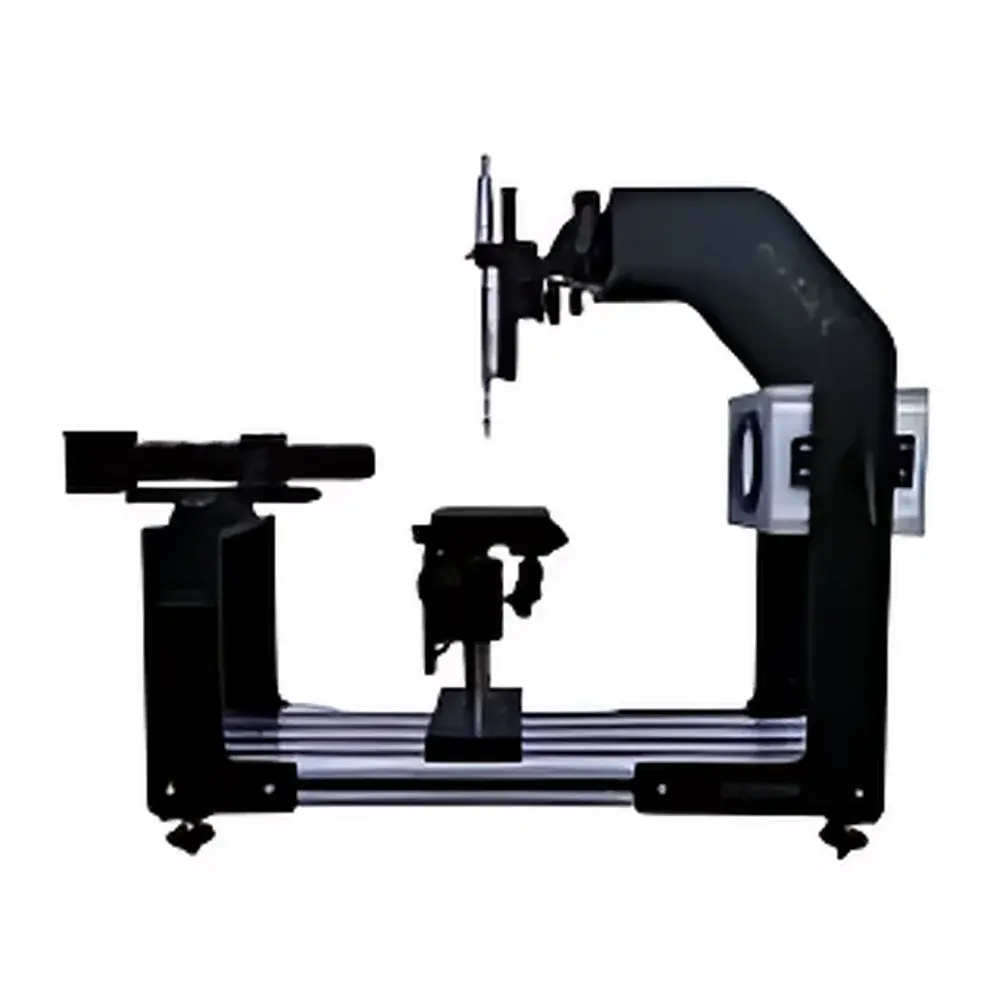
HARKE HK-EVN-SPCA Optical Contact Angle Analyzer for Hydrophobic Contaminant Detection on Glass Surfaces
| Brand | HARKE |
|---|---|
| Model | HK-EVN-SPCA |
| Origin | Beijing, China |
| Manufacturer Type | Direct Manufacturer |
| Country of Origin | China |
| Pricing | Available Upon Request |
| Sample Stage Dimensions | 100 mm × 120 mm |
| Contact Angle Measurement Range | 0–180° |
| Contact Angle Accuracy | ±0.1° |
| Contact Angle Resolution | ±0.01° |
| Surface/Interfacial Tension Method | Pendant Drop |
| Surface/Interfacial Tension Range | 0–1000 mN/m |
| Optical System | ZF-180 High-Resolution Stepping Zoom Lens |
| Imaging System | USB 2.0 Camera + PC Software Control, 30 fps (optional: 100/300/1000+ fps) |
| Instrument Footprint | 260 mm × 700 mm |
| Lens Vertical Travel | 120 mm |
| Weight | ~30 kg |
| Software | HARKE-SPCA v1.0 |
| Power Supply | 220 V / 3 A / 50 Hz |
| Operating Temperature | Ambient |
| Surface Energy Calculation Method | Equation of State (EOS) |
| Fitting Algorithms | Circle, Ellipse, Young-Laplace (Sessile & Pendant Drop), Spherical Cap |
| Measurement Modes | Static Contact Angle (Sessile Drop), Advancing/Receding Angle, Contact Angle Hysteresis, Roll-off Angle, Dynamic Wetting Kinetics, Immersion (Underliquid) Contact Angle, Time-Resolved Contact Angle Profiles, Powder Wettability (via Washburn), Curved & Microstructured Surface Analysis |
Overview
The HARKE HK-EVN-SPCA Optical Contact Angle Analyzer is a precision-engineered instrument designed for quantitative surface characterization of solid substrates—particularly glass and optically transparent materials—through contact angle and interfacial tension analysis. It operates on the principle of optical contour analysis: high-resolution imaging of liquid droplet profiles on solid surfaces enables pixel-accurate geometric fitting to determine contact angles via Young–Laplace-based algorithms. This non-destructive, label-free methodology provides direct insight into surface energy distribution, hydrophobic/hydrophilic character, and contaminant-induced wettability shifts—critical parameters in quality control of display glass, photomasks, optical lenses, and cleanroom-compatible components. The system integrates automated liquid dispensing, motorized stage positioning, and real-time image acquisition to support both static and dynamic wetting assessments under ambient laboratory conditions.
Key Features
- Full-automation capability with programmable syringe pump for precise, repeatable droplet deposition (volume range: 0.1–10 µL, resolution: 0.01 µL)
- ZF-180 stepping zoom lens with calibrated magnification (0.7–4.5×) and parfocal design ensures consistent focus across measurement sequences
- High-speed imaging options up to 1000 fps enable kinetic analysis of rapid wetting, absorption, or droplet rebound phenomena
- Multi-algorithm fitting engine supporting circle, ellipse, conic section, and Young–Laplace models—optimized for low-volume drops (<2 µL), asymmetric interfaces, and rough or heterogeneous surfaces
- Integrated environmental enclosure option (not standard) allows controlled humidity (10–90% RH) and temperature (15–40°C) operation for GLP-compliant studies
- Modular hardware architecture supports future upgrades including heated/cooled stages, goniometric tilting units, and vapor-phase exposure modules
Sample Compatibility & Compliance
The HK-EVN-SPCA accommodates flat, curved, microstructured, and porous substrates—including float glass, fused silica, ITO-coated wafers, polymer films, and sintered metal filters—within its 100 mm × 120 mm translation stage. Sample thickness up to 30 mm is supported via adjustable lens travel (120 mm vertical range). All measurements adhere to ASTM D7334–22 (“Standard Practice for Surface Wettability of Coatings by Contact Angle Measurement”) and ISO 19403-2:2017 (“Paints and Varnishes — Wettability — Part 2: Determination of Contact Angle”). Surface energy calculations follow the Equation of State (EOS) method per Owens–Wendt–Rabel–Kaelble theory, with optional integration of van Oss–Chaudhury–Good (vOCG) model for polar/dispersive component decomposition. Data audit trails, user access controls, and electronic signature support are configurable to align with FDA 21 CFR Part 11 requirements when used in regulated QC environments.
Software & Data Management
HARKE-SPCA v1.0 software provides a unified interface for instrument control, image acquisition, real-time analysis, and report generation. It features batch processing for multi-sample workflows, time-lapse sequence stitching, and export of raw images (TIFF/AVI), numerical datasets (CSV/XLSX), and annotated PDF reports. Calibration routines include pixel-to-length mapping verification using NIST-traceable stage micrometers and reference contact angle standards (e.g., PTFE, silicon wafer). All measurement metadata—including timestamp, operator ID, environmental conditions, and algorithm parameters—is embedded in output files to ensure full traceability. Raw data files are stored in vendor-neutral formats compatible with third-party statistical packages (e.g., MATLAB, Python pandas) for advanced multivariate surface analysis.
Applications
- Quantitative assessment of hydrophobic organic contamination on TFT-LCD and OLED glass substrates prior to coating or bonding
- Verification of plasma or UV-ozone cleaning efficacy through contact angle reduction trends (e.g., from >90° to <10°)
- Surface energy mapping of functionalized biomedical glass slides for antibody immobilization optimization
- Dynamic contact angle hysteresis analysis to evaluate microscale heterogeneity in anti-fingerprint coatings
- Interfacial tension determination of aqueous surfactant solutions used in semiconductor rinse processes
- Time-resolved Washburn analysis of powder compacts (e.g., SiO₂, TiO₂) for porosity and surface chemistry correlation
- Roll-off angle quantification for self-cleaning architectural glazing R&D
FAQ
What types of liquids are compatible with the pendant drop method for interfacial tension measurement?
Deionized water, alcohols (ethanol, isopropanol), hydrocarbons (hexadecane, decane), and low-viscosity surfactant solutions (≤50 cP) are routinely measured. Highly volatile or corrosive liquids require custom syringe materials and sealed chamber configurations.
Can the system measure contact angles on vertically oriented samples?
Yes—using the optional tilting stage accessory, samples can be positioned at angles up to ±90° relative to horizontal for gravity-compensated sessile or captive bubble measurements.
Is HARKE-SPCA software validated for GMP/GLP environments?
The base software meets ALCOA+ data integrity principles; full 21 CFR Part 11 compliance requires installation of validated configuration packages, role-based access logs, and periodic IQ/OQ documentation—available upon request for regulated users.
How is calibration verified between routine use?
Daily verification uses certified reference surfaces (e.g., polished silicon wafers with known 72.8° water contact angle) and stage micrometer checks; annual recalibration includes lens distortion mapping and pump volume delivery validation.
Does the system support ISO 10422-compliant surface energy reporting?
Yes—surface free energy values, including dispersive (γd) and polar (γp) components, are calculated per ISO 10422:2021 Annex B using user-selected models (Owens–Wendt, Wu, vOCG) with uncertainty propagation reporting.



