
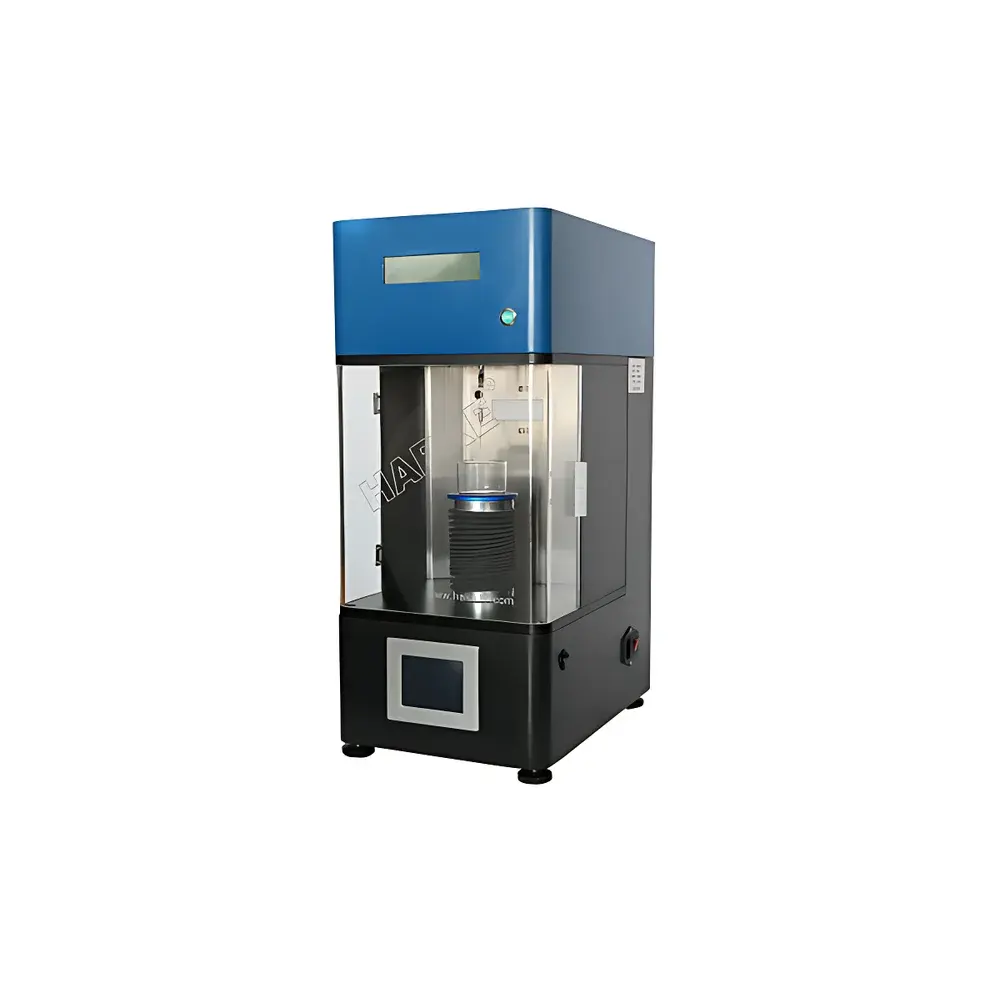
HARKE SFT-C1 Advanced Surface Tensiometer
| Brand | HARKE |
|---|---|
| Model | SFT-C1 |
| Measurement Principle | Du Noüy Ring Method (ISO 1409, ASTM D971, DIN 53914) |
| Measurement Range | 0–400 mN/m |
| Resolution | 0.01 mN/m |
| Accuracy | ±0.1 mN/m |
| Temperature Control | Ambient (optional heated jacket & recirculating bath support) |
| Sensor Type | Electromagnetic Force Compensation Balance |
| Sample Stage Travel | 0–80 mm (adjustable at 0.1 mm increments) |
| Stage Speed | 0–10 mm/sec (programmable) |
| Sample Vessel Diameter | Φ50 mm |
| Dimensions (W×D×H) | 260 × 350 × 500 mm |
| Weight | 15 kg |
| Software | SFT-C1 v3.x (GLP-compliant, audit-trail enabled) |
| Compliance | ISO/IEC 17025-ready, supports 21 CFR Part 11 electronic signatures (with optional configuration) |
Overview
The HARKE SFT-C1 Advanced Surface Tensiometer is a benchtop electromechanical instrument engineered for high-reproducibility measurement of surface and interfacial tension using the standardized Du Noüy ring method. Based on the principle of force balance—where the maximum pull force required to detach a platinum-iridium ring from a liquid–air or liquid–liquid interface is quantified—the SFT-C1 delivers traceable, thermodynamically grounded tension values in millinewtons per meter (mN/m). Its electromagnetic force compensation transducer eliminates mechanical drift inherent in torsion-wire systems, ensuring long-term zero stability and minimal operator-induced error. Designed for laboratories requiring regulatory-grade data integrity, the system operates within ambient temperature conditions by default, with optional integration of Peltier-based heating modules or external thermostatic circulation units to maintain isothermal test environments per ISO 1409 and ASTM D971 protocols.
Key Features
- Electromagnetic force compensation sensor with 0–120 g dynamic load range and <0.1 µN resolution—enabling stable, low-noise acquisition across the full 0–400 mN/m measurement span.
- Programmable sample stage with bidirectional motion control (0–10 mm/sec, ±0.1 mm positional accuracy), supporting customizable immersion depth, dwell time, and withdrawal speed—critical for studying dynamic interfacial relaxation behavior.
- Dual-display architecture: real-time force curve visualization synchronized with numeric surface tension output, allowing direct correlation between raw sensor response and calculated values via Young–Laplace correction algorithms.
- Integrated precision microbalance functionality (up to 120 g, 0.1 mg readability) enables concurrent density determination and mass calibration—eliminating need for separate analytical balances in routine QC workflows.
- Pre-calibrated, ISO-conforming platinum-iridium rings and Wilhelmy plates (A3, A4, A5 geometries per DIN 53914), fabricated via vacuum-brazing to ensure geometric consistency and oxide-free surface integrity.
- Embedded Linux-based controller replaces external PC dependency; all operations—including method setup, data acquisition, export, and report generation—are executed locally with deterministic timing and no OS-level latency.
Sample Compatibility & Compliance
The SFT-C1 accommodates aqueous solutions, organic solvents, polymer melts, surfactant formulations, emulsions, and low-viscosity oils in standard Φ50 mm glass or quartz cuvettes. Its modular design permits rapid transition between ring and plate geometries without recalibration. All measurement procedures align with internationally recognized standards: ISO 1409 (plastics), ASTM D971 (petroleum products), DIN 53914 (surfactants), and USP for analytical instrument qualification. The system supports GLP/GMP documentation requirements through timestamped, user-authenticated audit trails, electronic signature capability (21 CFR Part 11 compliant when configured with PKI authentication), and CSV/PDF export with embedded metadata (operator ID, method version, environmental logs).
Software & Data Management
SFT-C1 v3.x software provides a scalable, role-based interface optimized for both novice operators and advanced researchers. It includes preloaded method templates for static/dynamic surface tension, critical micelle concentration (CMC) profiling, and interfacial aging studies. Raw force-time datasets are stored in HDF5 format with embedded calibration coefficients and environmental metadata. Reporting modules generate IQ/OQ-ready validation reports, trend charts with statistical overlays (mean ± SD, RSD%), and comparative analysis across historical batches. Data export conforms to ASTM E1461 and ISO/IEC 17025 traceability requirements—including uncertainty budgeting per GUM (JCGM 100:2008).
Applications
- Quality control of surfactants, detergents, and wetting agents in chemical manufacturing.
- Formulation development of pharmaceutical emulsions, liposomal drug carriers, and topical suspensions.
- Surface energy assessment of polymer films and coatings prior to adhesion or printing processes.
- Interfacial rheology screening of crude oil–brine systems in enhanced oil recovery (EOR) research.
- Academic investigation of Langmuir monolayers, nanoparticle–interface interactions, and temperature-dependent tension isotherms.
- Density determination of volatile or corrosive liquids where traditional pycnometers pose handling risks.
FAQ
What standards does the SFT-C1 comply with for surface tension measurement?
It fully supports ISO 1409, ASTM D971, DIN 53914, and EN 14370 methodologies for both surface and interfacial tension testing.
Can the instrument perform measurements at controlled temperatures?
Yes—while baseline operation is ambient-temperature only, optional accessories include a Peltier-heated sample stage (±0.1 °C stability) and compatibility with external recirculating chillers/heaters (e.g., Julabo F25) for precise thermal control from 5 °C to 80 °C.
Is the software validated for regulated environments?
SFT-C1 v3.x includes configurable 21 CFR Part 11 compliance features—electronic signatures, audit trail review tools, and password-protected user roles—validated per GAMP 5 guidelines upon installation.
How is calibration verified and maintained?
The system ships with NIST-traceable calibration certificates for force and geometry. Users may perform daily verification using certified reference liquids (e.g., ultra-pure water at 20 °C = 72.75 mN/m, diiodomethane = 50.8 mN/m) and automated zero/balance checks.
Does the instrument support interfacial tension between two immiscible liquids?
Yes—by replacing the air–liquid interface with a second liquid phase (e.g., oil–water), the SFT-C1 measures interfacial tension using identical ring geometry and correction algorithms, per ASTM D1331.
Related Products



