
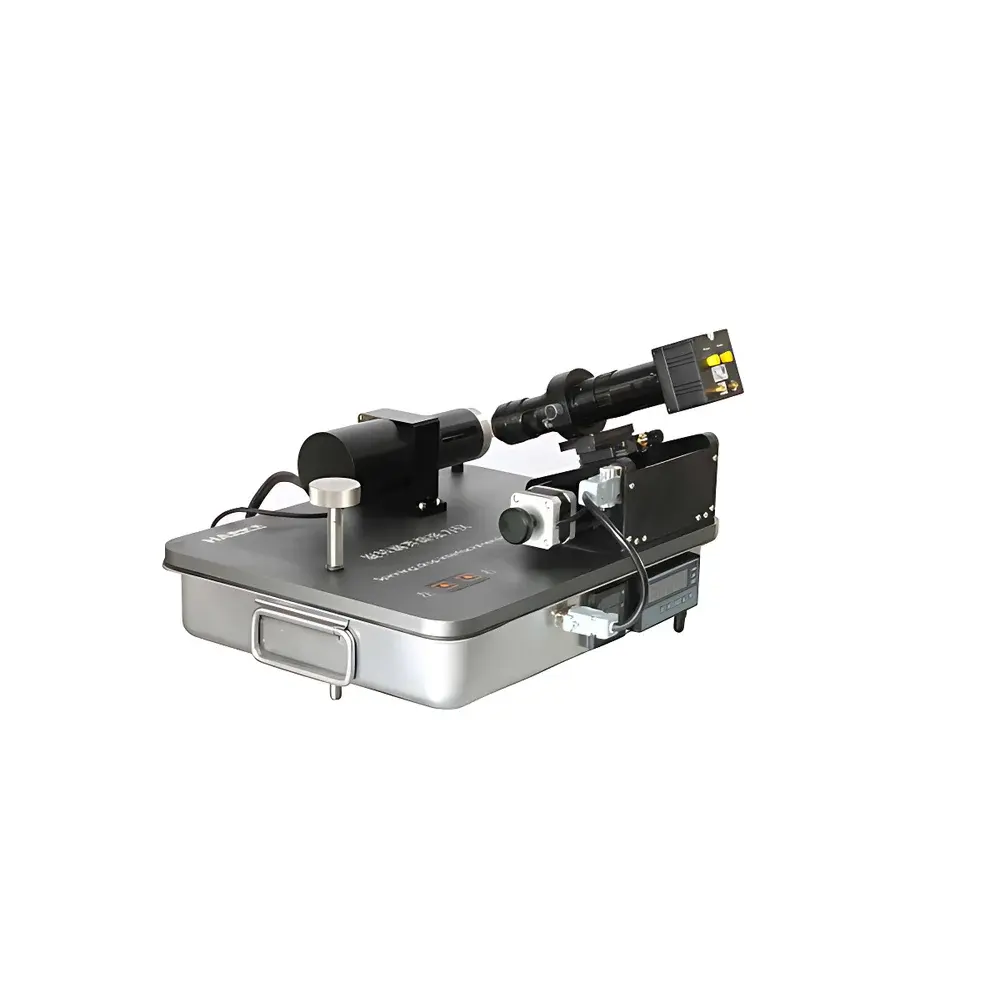
HARKE SDT-5 Rotating Drop Ultra-Low Interfacial Tensile Analyzer
| Brand | HARKE |
|---|---|
| Origin | Beijing, China |
| Manufacturer Type | Direct Manufacturer |
| Country of Origin | China |
| Model | SDT-5 |
| Quotation | Upon Request |
| Sample Tube Inner Diameter | Φ2 mm / Φ6 mm |
| Interfacial Tension Measurement Range | 10⁰ to 10⁻⁵ mN/m |
| Measurement Accuracy | ±1% F.S. |
| Optical System | 25× Measuring Microscope |
| Video System | 25× Measuring Microscope |
| Instrument Dimensions (W×D×H) | 420 × 320 × 260 mm |
| Lens Travel Stroke | 0–100 mm |
| Net Weight | 15 kg |
| Measurement Software | Excel-based Custom Interface |
| Power Supply | 220 V / 3 A / 50 Hz |
| Temperature Control Range | Ambient to 70 °C |
| Measurement Method | Rotating Drop Method |
| Primary Measurement Parameter | Interfacial Tension |
| Core Functionality | Manual Microscopic Measurement with Electric Heating Temperature Control |
Overview
The HARKE SDT-5 Rotating Drop Ultra-Low Interfacial Tensile Analyzer is a precision laboratory instrument engineered for the quantitative determination of interfacial tension (IFT) between immiscible fluid phases—particularly oil/water, surfactant/water, and polymer solution interfaces—at values as low as 10⁻⁵ mN/m. It operates on the rotating drop principle, a well-established hydrodynamic method grounded in Laplace’s equation and rotational equilibrium mechanics. In this configuration, a denser droplet of one phase is suspended within a less-dense continuous phase inside a horizontally rotating cylindrical capillary tube. Under centrifugal force, the droplet deforms into a prolate spheroid; its axial ratio is optically captured and related to interfacial tension via theoretical calibration curves derived from Young–Laplace modeling. The SDT-5 is specifically optimized for applications demanding high reproducibility at ultra-low IFT regimes—such as enhanced oil recovery (EOR) formulation screening, microemulsion phase behavior mapping, and evaluation of ultralow-foaming surfactants used in pharmaceutical or semiconductor cleaning processes.
Key Features
- Rotating drop measurement platform with dual-capillary compatibility (Φ2 mm and Φ6 mm inner diameter sample tubes), enabling flexible selection based on viscosity, density contrast, and required sensitivity range.
- Integrated electric heating system with PID-controlled temperature regulation (ambient to 70 °C), supporting thermally dependent interfacial studies under stable isothermal conditions.
- Dual-function optical path: a fixed 25× measuring microscope coupled with synchronized video capture capability for real-time droplet shape monitoring and frame-by-frame deformation analysis.
- Manual micrometric lens positioning (0–100 mm vertical travel) ensures precise focus adjustment across varying droplet sizes and tube wall thicknesses.
- Robust mechanical architecture with vibration-damped base and precision-balanced rotor assembly minimizes mechanical noise-induced measurement drift.
- Excel-based data acquisition interface provides direct export of raw pixel measurements, calculated axial ratios, and final IFT values—compatible with downstream statistical analysis and GLP-compliant reporting workflows.
Sample Compatibility & Compliance
The SDT-5 accommodates a broad spectrum of liquid–liquid systems, including but not limited to: hydrocarbon–aqueous surfactant solutions, silicone oil–water dispersions, fluorinated solvent–brine interfaces, and biopolymer–lipid emulsions. Its design conforms to fundamental physical principles referenced in ASTM D971 (Standard Test Method for Interfacial Tension of Oil Against Water by the Ring Method—used here as a comparative validation benchmark), ISO 6295 (Petroleum products — Determination of interfacial tension — Du Noüy ring method), and supplementary guidance in ISO/IEC 17025:2017 for method validation in accredited testing laboratories. While the instrument itself does not embed full 21 CFR Part 11 compliance features (e.g., electronic signatures, audit trails), its Excel-based output structure supports integration into validated LIMS environments where manual documentation and reviewer sign-off meet internal QA/QC requirements.
Software & Data Management
Data acquisition is performed through a purpose-built Excel macro-enabled workbook that accepts calibrated pixel measurements from microscope eyepiece reticles or digital video frames. Users input tube geometry, rotational speed (RPM), density difference (Δρ), and temperature to compute interfacial tension using the rotating drop equation: γ = Δρ·ω²·R³/(4·k), where ω is angular velocity, R is droplet equatorial radius, and k is a shape-dependent correction factor pre-tabulated for standard aspect ratios. All calculation parameters are logged per test run. Exported CSV files retain timestamps, operator ID fields, and metadata tags—enabling traceability in GxP-aligned workflows when paired with controlled document management practices.
Applications
- Enhanced oil recovery (EOR) research: Screening alkali-surfactant-polymer (ASP) formulations for ultralow IFT targets (<10⁻³ mN/m) critical to capillary number optimization.
- Surfactant development: Quantifying synergistic effects in mixed anionic/nonionic systems and assessing temperature-dependent IFT hysteresis.
- Fuel and lubricant stability: Evaluating additive performance at fuel–water interfaces relevant to corrosion inhibition and phase separation resistance.
- Coating and ink formulation: Characterizing pigment dispersion stability via oil–water IFT modulation during emulsification.
- Agrochemical delivery systems: Optimizing nanoemulsion carriers for active ingredient solubilization and membrane permeability enhancement.
- Biomedical interface science: Studying protein–lipid monolayer interactions and surfactant replacement therapy analogs.
FAQ
What is the minimum measurable interfacial tension value achievable with the SDT-5?
The instrument is validated for reliable measurements down to 1 × 10⁻⁵ mN/m under optimal conditions—i.e., high-density contrast, low-viscosity dispersed phase, and precise rotational speed control.
Can the SDT-5 be used for surface tension measurements?
No—the rotating drop method is intrinsically designed for liquid–liquid interfacial systems. Surface tension of pure liquids requires Wilhelmy plate, du Noüy ring, or pendant drop methods.
Is automated image analysis included with the system?
The base configuration relies on manual reticle-based measurement; however, third-party machine vision plugins compatible with OpenCV or MATLAB can be integrated via exported video streams.
Does the SDT-5 support pressure-controlled environments?
Not natively—the current design operates at ambient pressure. High-pressure adaptations require custom pressure-rated sample cells and are outside standard scope.
How is temperature uniformity maintained across the sample tube during heating?
A thermostatically regulated aluminum heating block envelops the central 20 mm segment of the capillary, minimizing axial thermal gradients while permitting optical access at both ends.



