
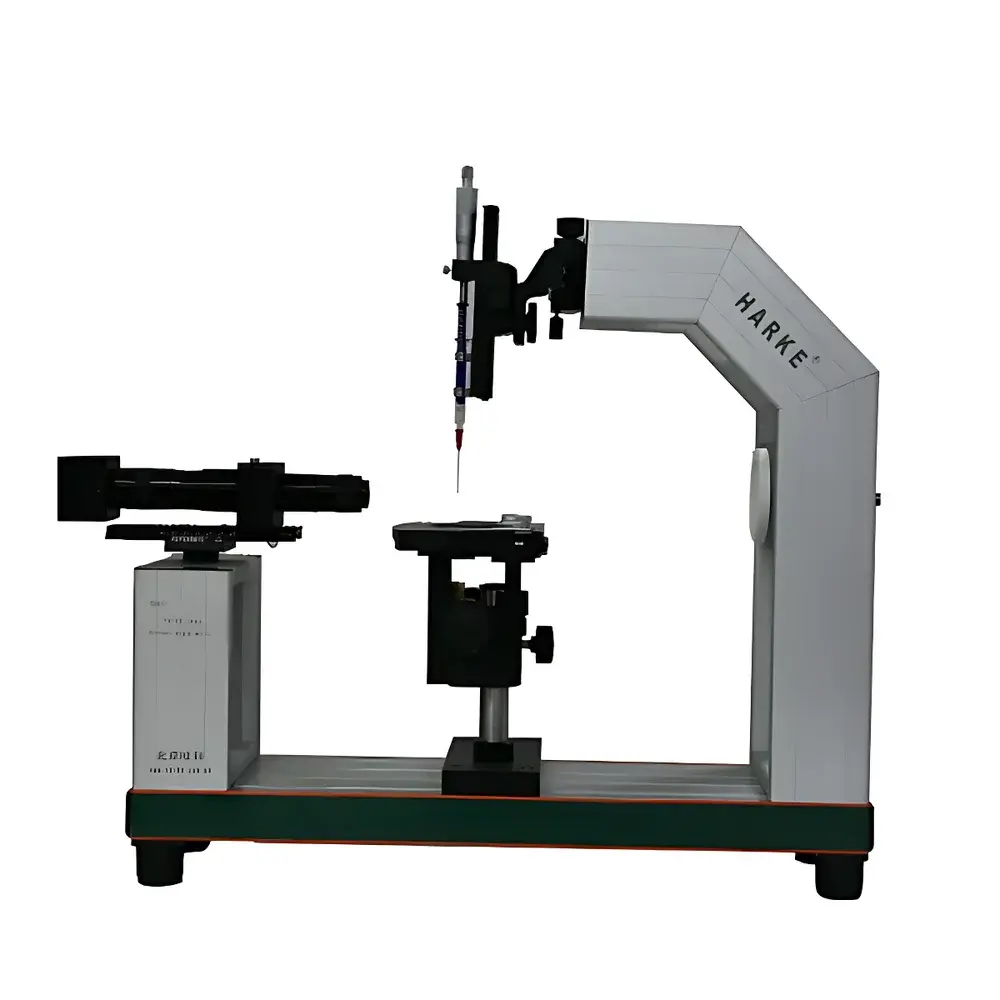
HARKE SPCA Video-Based Optical Contact Angle Analyzer
| Brand | HARKE |
|---|---|
| Model | SPCA |
| Type | Benchtop Video Optical Contact Angle Analyzer |
| Origin | Beijing, China |
| Manufacturer | HARKE (Domestic Producer) |
| Measurement Range | 0–180° |
| Accuracy | ±0.1° |
| Droplet Formation Methods | Sessile Drop, Captive Bubble |
| Analysis Algorithms | Automated Circle Fitting, Ellipse Fitting, Full-Profile Tangent, Local-Profile Tangent, Height/Width Method, Young–Laplace Fitting, Curve Ruler Method |
| Surface Adaptability | Convex/Concave Surfaces, Tilted Substrates, Curvature Correction |
| Dynamic Contact Angle Capability | Advancing/Receding/Average |
| Image Processing | Manual & Fully Automated |
| Syringe Dispensing | Computer-Controlled (0–100 μL), Manual (1 mL) |
| Dispensing Precision | ±0.1 μL |
| Surface Energy Models | Zisman Plot, Fowkes, Owens–Wendt–Rabel–Kaelble (OWRK) |
| Microscope | HARKE-Optimized Precision Zoom Lens (0.75×–4.5×, Parfocal) |
| Camera | High-Resolution Digital CMOS |
| Video Capture | Real-Time Recording, Frame-by-Frame Playback, Timed Auto-Capture, Single-Frame Export from Video |
| Stage Dimensions | 100 mm × 120 mm |
| Stage Travel | Vertical 50 mm, Horizontal (X/Y) 70 mm / 40 mm |
| Stage Extension | 30 mm |
| Fixed Base Translation | 150 mm (Z-axis) |
| Dispenser Translation | 100 mm (X/Y) |
| Microscope Translation | 100 mm (Z-axis) |
| Max Sample Size | 100 mm (W) × 80 mm (D) × Unlimited Height |
| Overall Dimensions | 240 mm (W) × 640 mm (D) × 630 mm (H) |
Overview
The HARKE SPCA is a benchtop video-based optical contact angle analyzer engineered for high-precision interfacial characterization of solid–liquid systems. It operates on the principle of digital image capture and geometric contour analysis of sessile or captive droplets under controlled environmental conditions. By combining parfocal zoom optics, sub-microliter dispensing accuracy, and multi-algorithm image processing, the SPCA delivers reproducible contact angle measurements across flat, curved, tilted, and topographically complex surfaces. Designed for routine QC labs and advanced surface science research, it supports static, advancing/receding, and dynamic contact angle acquisition — enabling comprehensive wettability profiling essential for materials development, coating formulation, biomedical device evaluation, and quality assurance in semiconductor and packaging industries.
Key Features
- High-resolution digital CMOS imaging system synchronized with real-time video capture and frame-accurate export for temporal analysis of wetting dynamics.
- Parfocal precision zoom microscope (0.75×–4.5×) optimized for consistent focus across magnification ranges — eliminating refocusing during multi-scale droplet analysis.
- Computer-controlled microdispensing unit with ±0.1 μL volumetric accuracy over 0–100 μL range, supporting automated sequential dosing for hysteresis and absorption studies.
- Multi-modal contact angle computation: automated circle, ellipse, full/local tangent, height-width, Young–Laplace, and curve-ruler algorithms — each validated against ISO 19403-2 and ASTM D7334 standards.
- Integrated stage mobility: vertical (50 mm), lateral (70 mm X, 40 mm Y), extended base translation (150 mm), and independent dispenser/microscope Z-travel (100 mm each) — accommodating irregularly shaped or thick substrates up to 80 mm depth.
- Comprehensive surface energy quantification using Zisman, Fowkes, and OWRK models; calculation of adhesion work, spreading coefficient, and interfacial tension components per IUPAC guidelines.
Sample Compatibility & Compliance
The SPCA accommodates samples ranging from standard silicon wafers and polymer films to porous membranes, textured metals, and biological tissues. Its modular stage design enables measurement on convex, concave, and inclined surfaces — with curvature correction and tilt-angle compensation embedded in firmware. All analytical outputs comply with GLP documentation requirements: timestamped image metadata, audit-trail-enabled parameter logging, and exportable CSV/PDF reports traceable to instrument ID and operator credentials. The system supports validation protocols aligned with ISO 27448 (photocatalytic activity), ASTM D5725 (coating wettability), and USP (pharmaceutical surface characterization), facilitating regulatory submissions and cross-laboratory method transfer.
Software & Data Management
HARKE’s proprietary SPCA Control Suite provides intuitive workflow-driven operation — from droplet deposition setup and lighting calibration to batch-mode analysis and statistical reporting. Software features include ROI-based auto-thresholding, dynamic baseline detection for non-planar substrates, and real-time contact angle vs. time curves with configurable hysteresis windows. All raw images, processed contours, and numerical results are stored in a structured SQLite database with SHA-256 hash integrity verification. Export options include TIFF (lossless), MP4 (H.264), and Excel-compatible data tables with column headers conforming to MIAME/MIAPE metadata standards. Optional 21 CFR Part 11 compliance package available — including electronic signatures, role-based access control, and immutable audit logs.
Applications
- Quality control of hydrophobic/hydrophilic coatings in automotive, aerospace, and medical device manufacturing.
- Surface modification validation following plasma treatment, corona discharge, or chemical grafting.
- Characterization of self-cleaning, anti-fog, and anti-icing functional surfaces.
- Formulation screening of surfactants, emulsifiers, and inkjet inks via dynamic contact angle and surface energy mapping.
- Biocompatibility assessment of implant materials through protein adsorption and cell adhesion correlation studies.
- Research into capillary-driven flow in microfluidic channels and porous media using time-resolved contact angle kinetics.
FAQ
What droplet formation methods does the SPCA support?
Sessile drop and captive bubble configurations — both fully programmable via software-defined dispensing sequences and environmental chamber integration.
Can the system measure contact angles on curved or tilted surfaces?
Yes — built-in curvature compensation and tilt-angle input allow accurate contact angle determination on convex, concave, and inclined substrates without manual correction.
Is surface energy calculation automated?
Yes — the software includes integrated modules for Zisman plot generation, Fowkes two-component analysis, and OWRK polar/dispersive decomposition with confidence interval estimation.
Does the SPCA meet regulatory requirements for pharmaceutical or medical device testing?
When configured with the optional 21 CFR Part 11 module, it satisfies FDA and EMA data integrity mandates for GxP environments, including electronic records retention and operator accountability.
What is the maximum sample thickness the stage can accommodate?
The fixed base translation (150 mm) combined with 30 mm stage extension allows vertical clearance up to 180 mm — sufficient for most industrial substrates and custom fixtures.



