
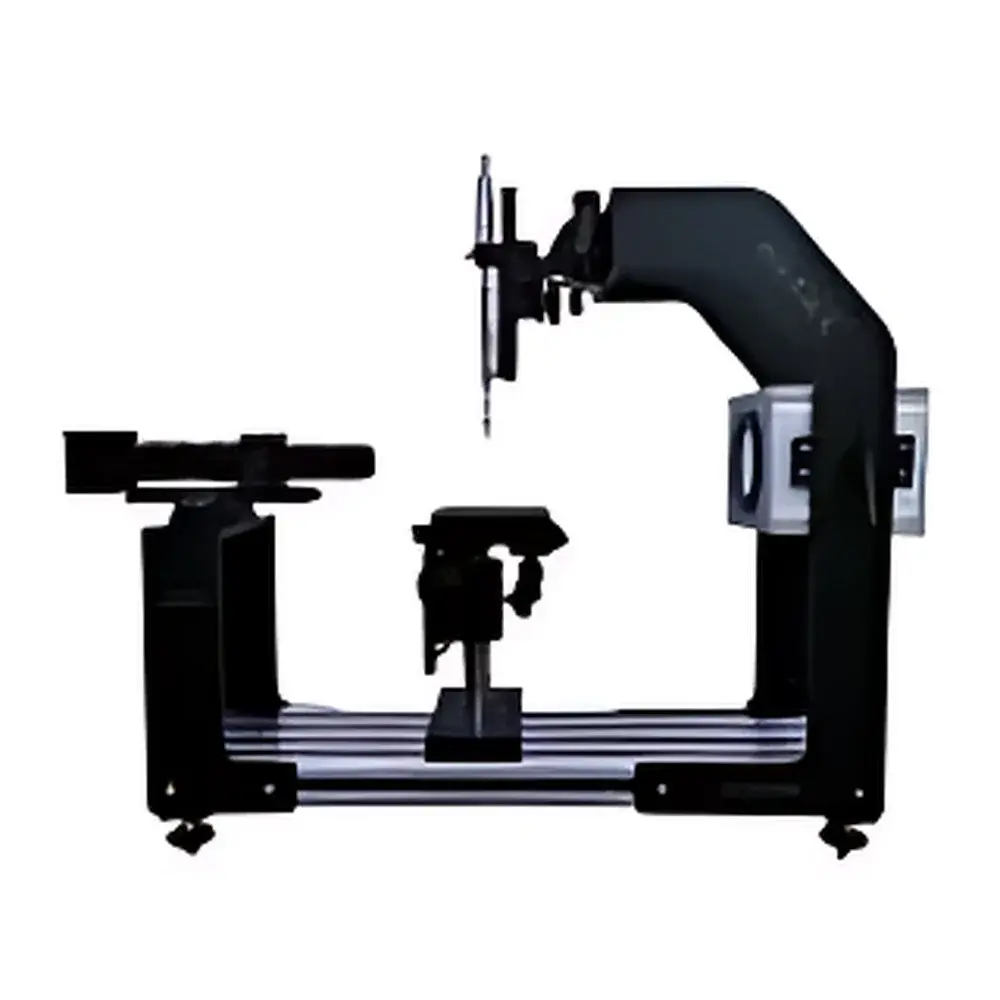
HARKE HK-SPCA1 Video-Based Optical Contact Angle Analyzer
| Brand | HARKE |
|---|---|
| Model | HK-SPCA1 |
| Instrument Type | Benchtop Video Optical Contact Angle Analyzer |
| Contact Angle Range | 0–180° |
| Contact Angle Accuracy | ±0.1° |
| Contact Angle Resolution | 0.01° |
| Stage Dimensions | 400 × 400 mm |
| Optical Magnification | 0.7×–4.5× |
| Surface/Interfacial Tension Range | 0–100 mN/m |
| Surface/Interfacial Tension Accuracy | ±0.01 mN/m |
| Imaging Speed | Up to 1000 fps (optional) |
| Imaging Interface | USB 2.0 |
| Lens Travel | 120 mm |
| Power Supply | 220 V / 3 A / 50 Hz |
| Weight | ~30 kg |
| Software | HARKE-SPCA1.0 |
| Temperature Control | Ambient (optional electrically heated stage & motorized tilt platform) |
Overview
The HARKE HK-SPCA1 is a precision benchtop video-based optical contact angle analyzer engineered for quantitative characterization of solid-liquid-gas interfacial behavior. It operates on the principle of shape image analysis—capturing high-resolution silhouettes of sessile or pendant liquid droplets deposited on solid substrates, then applying geometric and curve-fitting algorithms (e.g., circle, ellipse, Young-Laplace fitting) to determine contact angle, surface free energy, and interfacial tension. Designed for rigorous laboratory environments, the system supports static, dynamic (advancing/receding), and tilting-angle (roll-off/slide-off) measurements—enabling comprehensive assessment of wettability, hydrophobicity/hydrophilicity, coating uniformity, and surface heterogeneity. Its modular architecture accommodates optional thermal control and automated sample positioning, making it suitable for both routine QC testing and advanced materials research in fields such as thin-film development, biomedical device validation, and functional surface engineering.
Key Features
- Benchtop design with robust aluminum-alloy frame and vibration-damped optical baseplate for stable imaging under ambient lab conditions
- High-fidelity optical path: ZF-180 fixed-position zoom lens (0.7×–4.5× magnification) coupled with a USB 2.0 monochrome CMOS camera delivering up to 30 fps standard; optional ultra-high-speed modules support 100, 300, or 1000 fps for dynamic wetting kinetics
- Precision XYZ manual micrometer stage (400 × 400 mm travel range) with fine-focus lens carriage (120 mm vertical travel) for optimal droplet focus and reproducible sample alignment
- HARKE-SPCA1.0 software suite featuring real-time droplet contour detection, multi-method contact angle calculation (circle, ellipse, Young-Laplace, conic section), and automated sequential measurement across multiple sample locations
- Integrated surface energy analysis using the Owens-Wendt-Rabel-Kaelble (OWRK) and Wu harmonic mean methods, based on contact angle data from at least two probe liquids (e.g., water, diiodomethane)
- Interfacial tension quantification via pendant drop analysis, compliant with ISO 19403-3 and ASTM D7490 guidelines for liquid-liquid and liquid-air systems
Sample Compatibility & Compliance
The HK-SPCA1 accommodates rigid and flexible planar substrates—including glass slides, silicon wafers, polymer films, metal foils, and ceramic tiles—up to 400 × 400 mm in dimension and ≤25 mm in thickness. Its open-stage configuration permits integration with external environmental chambers or electrochemical cells. All measurement protocols adhere to internationally recognized standards: contact angle repeatability meets ISO 19403-2 (2017) requirements for static angle determination; surface energy calculations follow ISO 19403-4; and interfacial tension results align with ISO 19403-3 for pendant drop methodology. The system supports GLP-compliant operation through audit-trail-enabled software logging (user actions, timestamped raw images, parameter settings, and result exports), and is compatible with 21 CFR Part 11-ready configurations when deployed in regulated pharmaceutical or medical device manufacturing environments.
Software & Data Management
HARKE-SPCA1.0 is a Windows-native application built for scientific traceability and workflow efficiency. It provides synchronized video capture, frame-by-frame droplet annotation, batch processing of multi-point datasets, and export of calibrated images (TIFF/PNG), numerical results (CSV/XLSX), and summary reports (PDF). All raw image sequences and metadata are stored with embedded instrument configuration, operator ID, date/time stamps, and environmental notes. The software includes built-in calibration routines for pixel-to-micron conversion using certified stage micrometers, and supports user-defined measurement templates for standardized SOP execution. Exported data files retain full traceability for internal QA review or external regulatory submission.
Applications
- Quality control of anti-reflective, hydrophobic, or oleophobic coatings on optical lenses and display panels
- Surface energy mapping of plasma-treated polymers prior to adhesive bonding or printing
- Characterization of biofunctionalized surfaces for cell adhesion studies and diagnostic microfluidic channel fabrication
- Evaluation of cleaning efficacy on semiconductor wafers via post-process contact angle shift analysis
- Development and validation of superhydrophobic textiles, self-cleaning façades, and corrosion-resistant metal finishes
- Research into nanocomposite film formation kinetics using time-resolved advancing/receding angle tracking
FAQ
What contact angle measurement methods does the HK-SPCA1 support?
It supports static sessile drop, dynamic advancing/receding angles via syringe-controlled volume modulation, and roll-off angle determination using an optional motorized tilt platform.
Is the system compatible with non-aqueous or volatile solvents?
Yes—provided appropriate fume extraction and sealed chamber accessories are used; the pendant drop module enables interfacial tension measurement for low-volatility organic systems.
Can surface energy be calculated without proprietary probe liquids?
No—surface energy decomposition requires contact angle data from at least two reference liquids with known polar and dispersive components (e.g., water and diiodomethane); HARKE-SPCA1.0 includes a built-in database of 20+ validated probe liquids.
Does the software support automated reporting for ISO/ASTM compliance?
Yes—customizable report templates include instrument ID, calibration status, operator signature field, uncertainty estimates, and direct embedding of annotated images per ISO 19403 annexes.
What is the minimum detectable contact angle resolution?
The system resolves angle changes down to 0.01°, with measurement accuracy specified at ±0.1° under controlled lighting and substrate flatness conditions.



