
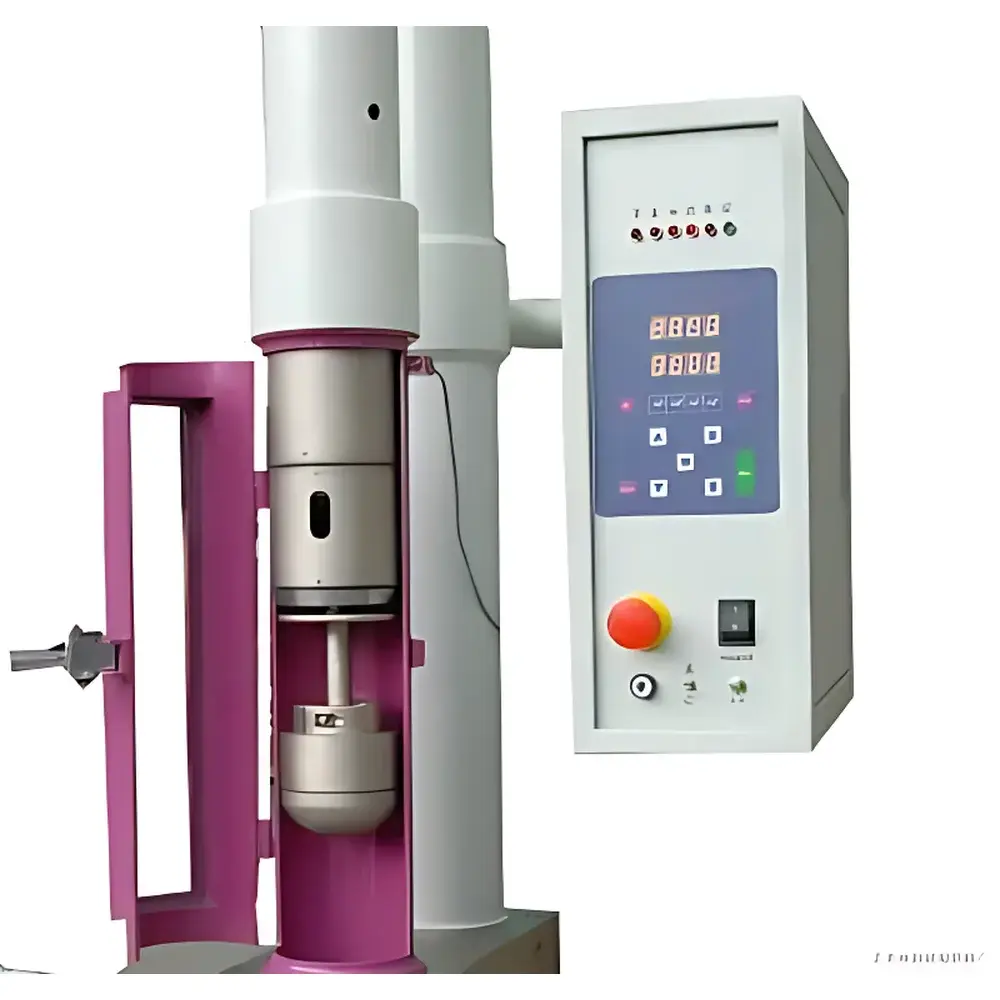
XJL-300C Pipe Drop Weight Impact Tester
| Origin | Beijing |
|---|---|
| Manufacturer Type | Distributor |
| Origin Category | Domestic (China) |
| Model | XJL-300C |
| Quotation | Upon Request |
| Ambient Temperature Range | 10–35 °C |
| Hammer Mass Range | 0.250–15.00 kg (increments of 0.100 kg and 0.250 kg |
| certified masses | 1.000 kg and 2.000 kg with ±0.1% accuracy) |
| Hammer Nose Radii | R5 mm, R10 mm, R12.5 mm, R30 mm, R50 mm |
| Impact Height Range | 50–2000 mm (height indication error ≤ ±2 mm) |
| Specimen Diameter Capacity | Φ10–Φ630 mm |
| Power Supply | 220 V AC ±10%, 50 Hz, 500 W (single-phase, three-wire) |
| Lifting Speed | 12 m/min |
| Overall Dimensions | 850 mm × 950 mm × 3350 mm |
Overview
The XJL-300C Pipe Drop Weight Impact Tester is a precision-engineered mechanical testing system designed for standardized evaluation of impact resistance in thermoplastic, thermosetting, and composite pipes used in municipal water supply, gas distribution, geothermal systems, and industrial fluid conveyance. It operates on the principle of controlled gravitational impact—where a calibrated hammer mass is elevated to a defined height and released to strike a specimen under specified boundary conditions. The test conforms to core international standards including ISO 3127 (plastics pipes—determination of resistance to external blow), ASTM D2444 (standard test method for determination of impact resistance of thermoplastic pipe and fittings), and GB/T 14152 (Chinese national standard for impact testing of plastic pipes). Its modular hammer assembly, repeatable height control, and wide specimen diameter range enable consistent assessment of ductile-to-brittle transition behavior, crack initiation energy, and failure mode classification across diverse pipe geometries and wall thicknesses.
Key Features
- High-precision hammer mass configuration: Interchangeable hammer bodies (0.250–15.00 kg) with traceable calibration certificates; certified reference masses (1.000 kg and 2.000 kg) certified to ±0.1% uncertainty for metrological traceability.
- Multi-radius hammer nose set: Five standardized impact surfaces (R5, R10, R12.5, R30, R50 mm) compliant with ISO and ASTM requirements for varying pipe stiffness and surface contact area.
- Digitally indexed drop height control: Linear encoder-based vertical positioning system ensures impact height repeatability within ±2 mm across the full 50–2000 mm range, critical for energy-level consistency (E = m·g·h).
- Wide-diameter specimen support frame: Adjustable cradle mechanism accommodates pipes from Φ10 mm to Φ630 mm, supporting both unsupported and guided (three-point bending) configurations per test standard requirements.
- Robust electromechanical lifting system: Constant-speed hoist (12 m/min) with overload protection and emergency stop circuitry, integrated into a rigid steel frame (850 × 950 × 3350 mm) for vibration isolation and operator safety.
- Compliance-ready electrical architecture: 220 V AC ±10%, 50 Hz, 500 W single-phase supply with EMI-filtered input and grounded three-wire configuration meeting IEC 61000-6-2/6-4 immunity and emission requirements.
Sample Compatibility & Compliance
The XJL-300C supports standardized impact testing of rigid and semi-rigid polymer pipes—including PVC-U, PE 80/100, PP-R, PVDF, and GRP—as well as metallic-lined composites where outer polymer layers govern impact performance. Specimens may be conditioned per ISO 291 (23 °C/50% RH) or low-temperature protocols (e.g., −10 °C or −20 °C per ISO 3127 Annex B). All test configurations align with mandatory clauses of ISO 3127:2021, ASTM D2444–22, and GB/T 14152–2001. The system’s mechanical design satisfies CE Machinery Directive 2006/42/EC essential health and safety requirements, and its operational documentation supports GLP-compliant laboratory audits when paired with validated test procedures and equipment logs.
Software & Data Management
While the XJL-300C operates as a manually initiated, hardware-controlled tester, it is fully compatible with third-party laboratory information management systems (LIMS) and electronic lab notebooks (ELN) via RS-232 or optional USB-to-serial interface. Users may record test parameters—including hammer mass, drop height, nose radius, specimen ID, ambient temperature, and pass/fail outcome—in structured CSV or XML formats. For regulated environments, integration with 21 CFR Part 11–compliant software platforms enables audit-trail generation, user access controls, and electronic signature capture. Calibration records, maintenance logs, and verification reports (e.g., height repeatability checks, mass verification) are maintained externally per ISO/IEC 17025 clause 6.4.10.
Applications
- Quality assurance of extruded plastic pipes during production line release testing.
- Comparative impact performance evaluation across material grades (e.g., PE80 vs. PE100, carbon-black stabilized vs. UV-inhibited formulations).
- Validation of pipe design compliance for pressure class certification (e.g., PN10, PN16, PN25).
- Failure analysis investigations following field service incidents involving mechanical damage.
- Research studies on temperature-dependent toughness transitions in polyolefin-based piping systems.
- Third-party certification testing for ISO 4427, ISO 4437, and EN 1555 series approvals.
FAQ
What standards does the XJL-300C support out-of-the-box?
It is mechanically configured to execute all test conditions specified in ISO 3127, ASTM D2444, and GB/T 14152 without modification.
Can the system be upgraded for automated data capture?
Yes—optional digital height sensor output and relay-triggered camera synchronization enable integration with PC-based acquisition software for timestamped impact event logging.
Is operator training included with installation?
Standard commissioning includes on-site mechanical verification, safety briefing, and hands-on operation training for up to two designated personnel.
How often must the hammer mass be recalibrated?
Per ISO/IEC 17025 and internal QA policy, certified masses require annual recalibration by an accredited metrology laboratory; routine in-house verification using certified reference weights is recommended before each test batch.
Does the machine meet CE marking requirements?
Yes—the structural frame, lifting mechanism, and electrical enclosure comply with the essential safety requirements of the EU Machinery Directive 2006/42/EC, supported by technical file documentation and risk assessment reports.





