
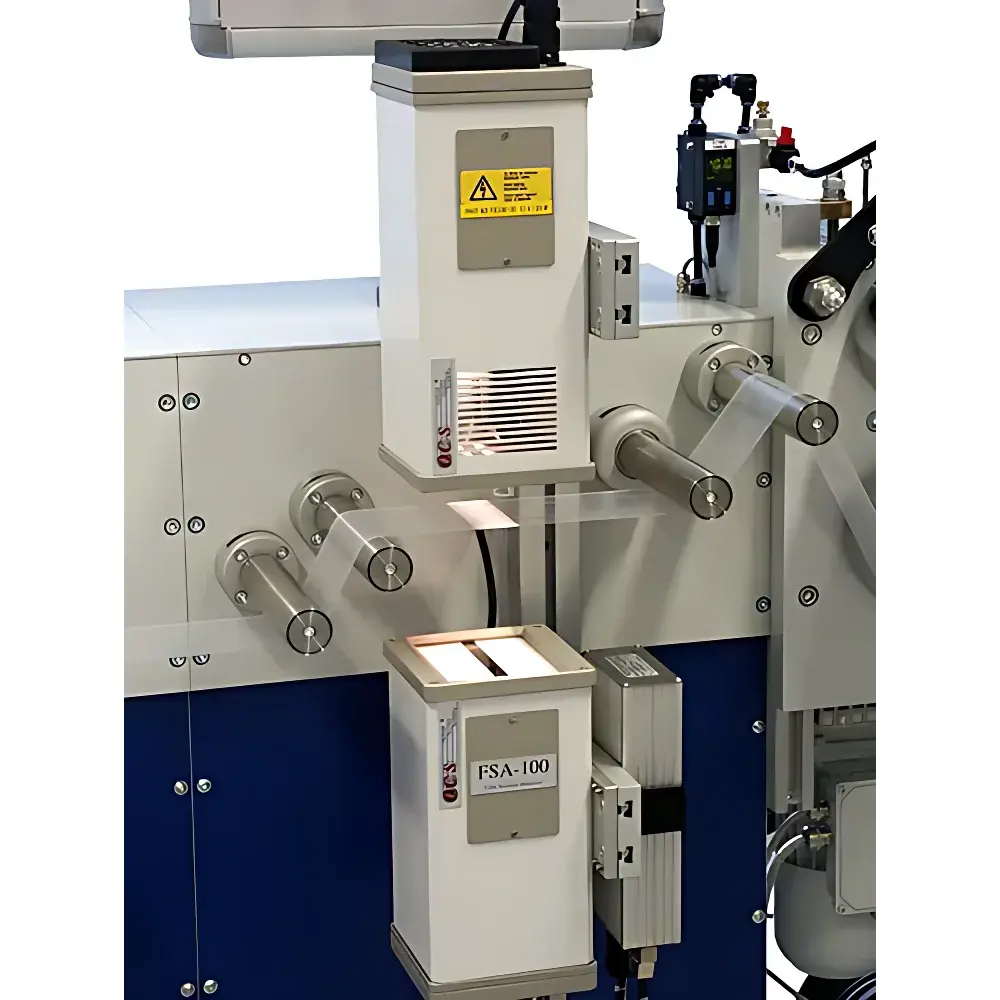
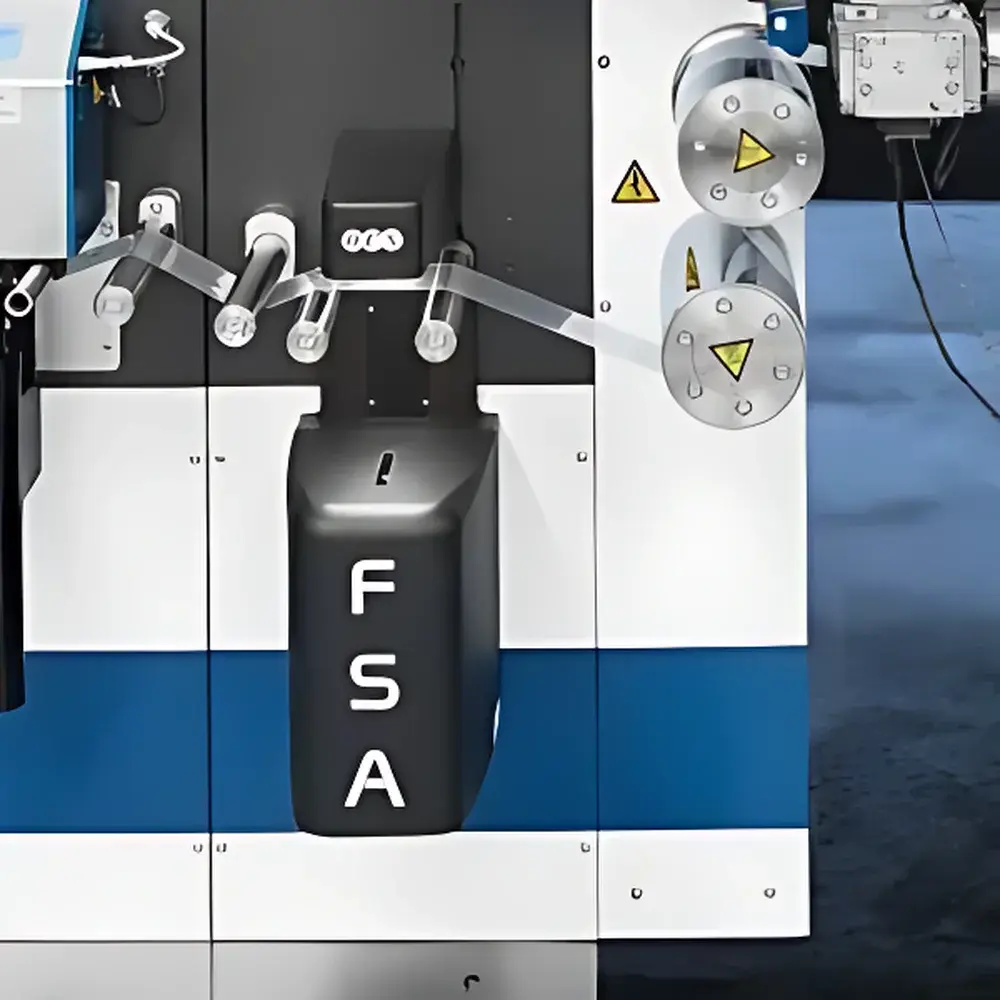
OCS FSA-100 Film & Gel Defect Inspection System
| Brand | OCS |
|---|---|
| Origin | Germany |
| Model | FSA-100 |
| Detection Resolution | down to 5 µm |
| Defect Classification Levels | 10 user-defined grades |
| Line Speed Independence | Yes (via roller-mounted encoder) |
| Imaging Sensor | High-speed line-scan camera |
| Light Source | Integrated uniform illumination module |
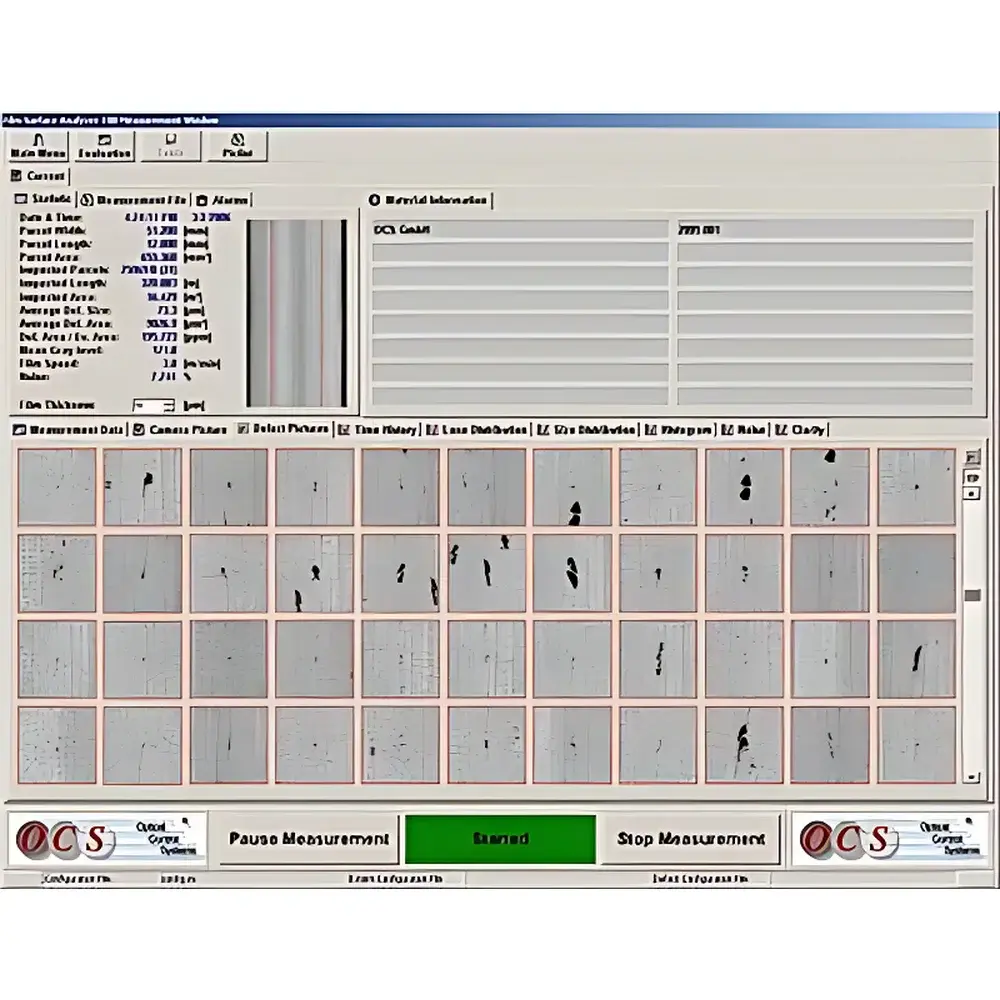
| Software Interface | Menu-driven, SAA-compliant GUI |
| Data Output | Real-time display, HDD storage, customizable PDF/printed reports (tabular & color bar chart formats) |
| User Access Control | Password-protected parameter profiles |
| Material Compatibility | Transparent (films, glass) and opaque (paper, aluminum foil, stainless steel, nonwovens) |
Overview
The OCS FSA-100 Film & Gel Defect Inspection System is an industrial-grade, vision-based surface quality analyzer engineered for inline or offline inspection of polyolefin films, cast sheets, and related polymer-based substrates. It operates on the principle of high-resolution, calibrated optical contrast imaging: a precisely collimated light source illuminates the moving web, while a synchronized high-speed line-scan camera captures pixel-accurate grayscale frames at rates up to 20 kHz—fully decoupled from production line velocity. Defect detection relies on real-time image subtraction, threshold-based segmentation, and morphological analysis algorithms compliant with ISO 12233 spatial frequency response calibration standards. Designed specifically for rubber and plastic manufacturing environments, the FSA-100 quantifies gel particles, fisheyes, pinholes, black specks, gels, and surface contaminants in accordance with ASTM D2497 (Standard Test Method for Gel Content of Ethylene-Propylene-Diene Terpolymers) and ISO 4618 (Plastics — Vocabulary — Terms relating to pigments and extenders), supporting traceability and process validation in polyolefin extrusion and blown-film lines.
Key Features
- Sub-5 µm defect resolution enabled by diffraction-limited optics and 12-bit dynamic range line-scan sensor
- Velocity-independent acquisition via mechanical encoder mounted on a load-compensated idler roller—no slip, no recalibration required across speed ranges from 5 to 500 m/min
- 10-tier hierarchical defect classification engine: users define size, contrast, aspect ratio, and edge gradient thresholds per grade for statistical process control (SPC)
- SAA-compliant software architecture ensuring ergonomic workflow design, consistent with IEC 62366-1 usability engineering requirements for medical device adjacent applications
- Role-based access control: administrator, operator, and QA reviewer profiles with password-protected parameter libraries and audit trail logging
- Real-time visualization of defect maps overlaid on live web preview; configurable alarm triggers (e.g., >3 defects/m² over 10 s window)
Sample Compatibility & Compliance
The FSA-100 accommodates both transparent and opaque substrates without hardware reconfiguration. For polyolefin films (LDPE, LLDPE, PP), it detects thermally induced gels and crosslinked agglomerates via backlit transmission mode; for aluminum foil, stainless steel strips, paper, and spunbonded nonwovens, front-lit reflective mode provides optimal contrast for surface topology anomalies. All measurement protocols adhere to GLP principles: system suitability tests (SST) verify illumination uniformity and camera linearity prior to each shift; calibration certificates traceable to PTB (Physikalisch-Technische Bundesanstalt) standards are provided. The system supports 21 CFR Part 11-compliant electronic records when paired with validated network storage configurations.
Software & Data Management
The embedded Linux-based imaging workstation runs OCS VisionSuite v4.2, featuring intuitive tabbed navigation, drag-and-drop report template builder, and native export to CSV, XML, and PDF/A-2u formats. All raw frame buffers, processed defect coordinates, and classification metadata are timestamped and stored with SHA-256 hash integrity verification. Historical data is indexed by material lot ID, shift, operator, and machine ID—enabling root cause analysis via Pareto charts and time-series trend plots. Optional integration with MES platforms (Siemens Opcenter, Rockwell FactoryTalk) is supported via OPC UA 1.04 interface.
Applications
- Quality gate inspection of blown and cast polyolefin films prior to slitting or packaging
- Gel content quantification for ASTM D2497 compliance reporting in EPDM and TPO compound production
- Root cause analysis of die lip contamination in extrusion lines through longitudinal defect clustering patterns
- Validation of melt filtration efficiency by tracking upstream-to-downstream defect density reduction
- Supplier qualification audits requiring objective, repeatable surface defect metrics (per ISO 9001:2015 Clause 8.6)
- Nonwoven web uniformity assessment in hygiene and medical-grade spunbond production
FAQ
Does the FSA-100 require recalibration when switching between film and metal foil?
No—optical path compensation is automatic via dual-mode illumination control and real-time gain adjustment; only material-specific threshold profiles need loading.
Can defect data be exported to statistical process control (SPC) software such as Minitab or JMP?
Yes—CSV exports include all geometric descriptors (area, perimeter, Feret diameter, circularity), enabling direct import into industry-standard SPC packages.
Is the system suitable for Class 10,000 cleanroom environments?
The FSA-100 enclosure meets IP54 ingress protection; optional stainless-steel housing and HEPA-filtered internal airflow kits are available for ISO 14644-1 Class 7 (10,000) compliance.
How is traceability ensured for regulatory submissions?
All measurements include embedded digital signatures, immutable timestamps, and full audit logs—including user login/logout events, parameter changes, and report generation history—satisfying FDA and EMA expectations for ALCOA+ data integrity.






