
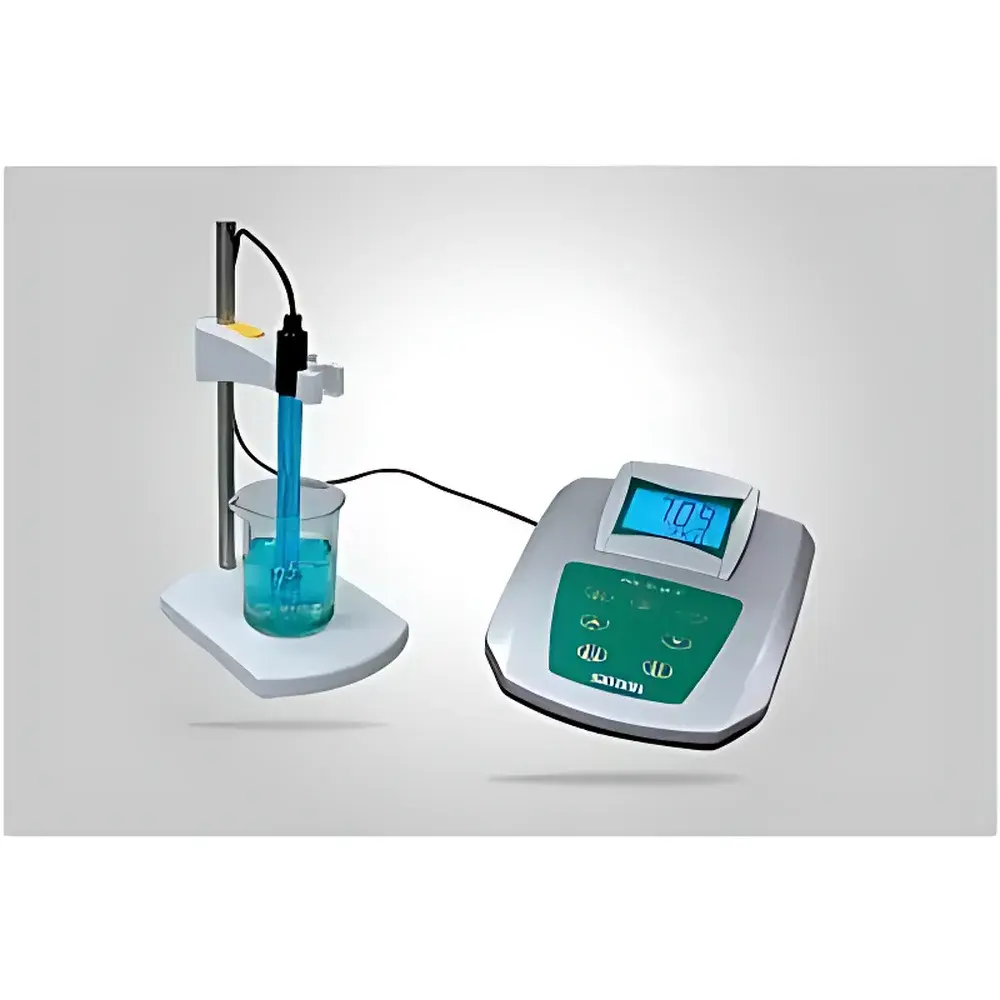
Sanxin PHS-3C Benchtop pH Meter
| Brand | Sanxin |
|---|---|
| Model | PHS-3C |
| Type | Benchtop Electrochemical pH Meter |
| Measurement Principle | Potentiometric pH Determination via Glass Electrode |
| pH Range | 0.00–14.00 pH |
| Resolution | 0.01 pH (selectable 0.1/0.01) |
| Accuracy | ±0.01 pH |
| mV Range | ±1999 mV |
| mV Accuracy | ±0.1% FS ±1 digit |
| Temperature Compensation | Manual or Automatic (0–100 °C) |
| Calibration Points | Up to 3-point with built-in buffer standards (pH 4.00, 6.86, 9.18) |
| Electrode Slope Display | % theoretical (Nernstian) slope shown post-calibration |
| Data Storage | 25 measurement records |
| Display | Backlit LCD showing dual parameters (e.g., pH + °C or mV + °C) |
| Power Supply | DC 9 V adapter |
| Dimensions | 160 × 190 × 70 mm |
| Weight | 750 g |
| Compliance | Designed for GLP-compliant laboratory environments |
Overview
The Sanxin PHS-3C is a benchtop potentiometric pH meter engineered for routine and teaching laboratories requiring reliable, repeatable acid-base measurements in aqueous solutions. It operates on the fundamental Nernst equation principle—measuring the potential difference between a pH-sensitive glass electrode and a stable reference electrode to determine hydrogen ion activity. Its dual-mode configuration (economy and basic operation modes) allows flexible deployment across diverse institutional settings, including university chemistry labs, pharmaceutical quality control units, environmental monitoring stations, and industrial process support facilities. The instrument integrates a microprocessor-controlled analog-to-digital conversion system, ensuring stable readings under variable ambient conditions. While not designed for ultra-high-precision metrology (e.g., primary standard certification), it meets ISO 8655-4 and ASTM E70 requirements for routine pH instrumentation used in non-regulated or semi-regulated workflows.
Key Features
- Microprocessor-based architecture with embedded firmware supporting automatic electrode diagnostics and real-time slope calculation
- Backlit blue LCD display enabling simultaneous readout of pH/mV values and temperature (°C or °F selectable)
- Three-point calibration capability with auto-recognition of standard buffers (pH 4.00, 6.86, 9.18) and immediate % theoretical slope feedback
- Manual and ATC-compatible temperature compensation—supports optional Sanxin PHT-series temperature electrodes or 201B-F triple-junction pH/ATC combination electrodes
- 25-entry internal memory with timestamp-free storage; data retrieval via front-panel navigation without external software
- Dual measurement modes: pH mode (0.00–14.00, resolution 0.01/0.1) and mV mode (±1999 mV, ±0.1% FS accuracy)
- Robust mechanical design: compact footprint (160 × 190 × 70 mm), lightweight (750 g), and housed in chemically resistant ABS casing
Sample Compatibility & Compliance
The PHS-3C is validated for use with standard aqueous electrolyte solutions, buffer standards, and low-ionic-strength samples typical in academic instruction and QC screening. It accommodates common glass-body pH electrodes (e.g., Sanxin 201 series), ORP electrodes (for redox potential assessment), and ion-selective electrodes (ISEs) when configured with appropriate reference junctions. While not certified to IEC 61000-4 electromagnetic immunity standards, its analog signal path is optimized for noise rejection in shared lab environments. For GLP/GMP-aligned operations, users must maintain calibration logs, electrode maintenance records, and environmental condition notes per internal SOPs—no built-in audit trail or 21 CFR Part 11 compliance features are included.
Software & Data Management
Data handling is fully standalone: no proprietary PC software or USB connectivity is provided. All 25 stored entries are retained during power cycling and recalled via intuitive keypad navigation. Export functionality is not supported; manual transcription remains the default method for recordkeeping. Users implementing electronic lab notebooks (ELNs) or LIMS integration must rely on manual entry or third-party OCR tools. Calibration history is not archived—only the most recent calibration parameters (slope, offset, buffer IDs) persist until next calibration.
Applications
- Undergraduate and graduate teaching labs: demonstration of acid-base equilibria, titration endpoint detection, and electrode theory
- Environmental testing: pH monitoring of surface water, wastewater effluents, and soil leachates per EPA Method 150.1
- Pharmaceutical pre-formulation studies: solution stability screening and excipient compatibility assessments
- Power plant water chemistry: boiler feedwater and condensate pH verification (ASTM D1066)
- Chemical manufacturing QA: batch release testing of reagents, catalyst slurries, and cleaning solutions
- Food & beverage R&D: preliminary acidity profiling of beverages, dairy products, and fermentation broths
FAQ
Does the PHS-3C support automatic temperature compensation (ATC) out of the box?
No—ATC requires an optional temperature probe (e.g., Sanxin PHT series) or a combined pH/ATC electrode such as the 201B-F.
Can I calibrate using non-standard buffer solutions (e.g., pH 7.41 or 10.01)?
Yes—the instrument allows user-defined calibration points, though only three buffers may be selected per session.
Is the device suitable for measuring pH in non-aqueous or high-viscosity samples?
It is not recommended; the PHS-3C is validated exclusively for aqueous systems per manufacturer specifications.
What is the expected lifetime of the glass pH electrode when used with this meter?
Typical service life ranges from 12–24 months depending on storage conditions, cleaning frequency, and sample matrix aggressiveness.
Does the PHS-3C comply with FDA 21 CFR Part 11 for electronic records?
No—it lacks electronic signature capability, audit trail generation, and secure user authentication required for regulated submissions.





