
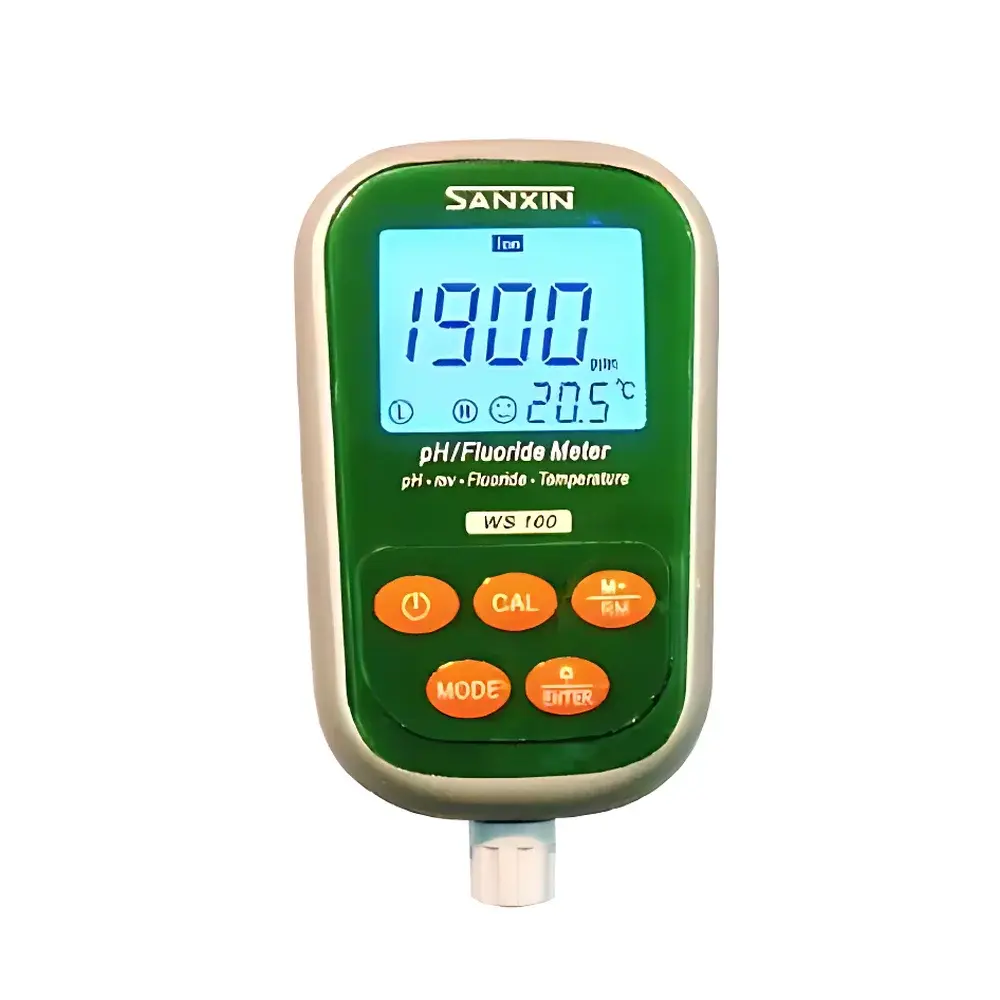
SANXIN WS100 Portable pH / Fluoride Ion Concentration Meter
| Brand | SANXIN |
|---|---|
| Origin | Shanghai, China |
| Manufacturer Type | Direct Manufacturer |
| Instrument Type | Portable |
| Fluoride Measurement Range | 1.00–6.00 pF |
| Detection Limit | 1.00–6.00 pF |
| Response Time | 5 s |
| Fluoride Accuracy | ±0.01 pF |
| Temperature Range | 0–80 °C |
| pH Range | 0.00–14.00 |
| pH Accuracy | ±0.01 |
| ORP Range | ±1999 mV |
| ORP Accuracy | ±0.1% FS |
| Data Storage | 200 sets |
| Power | 2 × AA batteries (1.5 V) |
| Dimensions (meter) | 65 × 120 × 31 mm |
| Weight (meter) | 180 g |
| IP Rating | IP57 |
Overview
The SANXIN WS100 Portable pH / Fluoride Ion Concentration Meter is a field-deployable electrochemical analyzer engineered for precise, real-time quantification of fluoride ion activity (expressed as pF), hydrogen ion activity (pH), oxidation-reduction potential (ORP), and temperature in aqueous environmental samples. It operates on the principle of potentiometric ion-selective electrode (ISE) measurement, where a solid-state fluoride-selective membrane generates a Nernstian response proportional to the logarithm of fluoride ion activity in solution. Coupled with a high-stability Ag/AgCl reference system and integrated thermistor-based temperature sensing, the instrument delivers automatic temperature compensation across 0–80 °C—critical for maintaining accuracy in variable field conditions. Designed for compliance with standard water quality monitoring protocols—including those referenced in ISO 10523 (pH of water), ISO 10304-1 (ion chromatography for anions), and EPA Method 300.0 (fluoride by ISE)—the WS100 serves as a primary screening tool for regulatory field surveys, source water assessment, and point-of-use verification.
Key Features
- Triple-composite fluoride ISE probe integrating fluoride-sensitive membrane, Ag/AgCl reference junction, and embedded NTC thermistor—eliminates need for separate temperature probes or manual calibration offsets.
- Simultaneous dual-parameter display: real-time concurrent readout of pF and corresponding fluoride concentration in ppm (mg/L), with automatic unit conversion based on sample temperature and ionic strength assumptions.
- Microprocessor-controlled auto-calibration sequence supporting two-point pF calibration (e.g., 2.00 pF and 4.00 pF standards) and three-point pH calibration (4.01, 7.00, 10.01 buffers), with slope validation and diagnostic feedback.
- IP57-rated enclosure ensures dust resistance and immersion protection up to 1 m for 30 minutes—validated for use in humid field environments, riverbanks, wellheads, and wastewater outfalls.
- Low-power architecture enabling >200 hours of continuous operation on two AA alkaline cells; includes under-voltage warning and auto-shutdown after 10 minutes of inactivity.
- Onboard diagnostics report electrode impedance, calibration slope (%Nernst), offset voltage, and memory integrity—supporting GLP-compliant field documentation.
Sample Compatibility & Compliance
The WS100 is validated for direct measurement in natural waters (surface water, groundwater, drinking water), treated effluents, and low-TDS municipal supplies. It accommodates samples with total dissolved solids (TDS) up to 5,000 mg/L and turbidity <10 NTU without filtration. For fluoride analysis, it complies with the operational principles outlined in ASTM D1179 (Standard Test Method for Fluoride in Water) and supports method verification per US EPA Region 8 QA/G-5 guidance for field ISE use. The instrument’s ±0.01 pF accuracy and 5-second stable response meet minimum performance criteria for Tier 2 field screening under ISO 5667-3. Electrode compatibility extends to common matrix modifiers (e.g., TISAB II buffer addition for high-carbonate or aluminum-rich samples), though such reagent use is external to the meter’s hardware.
Software & Data Management
Data logging is performed autonomously without PC connectivity: 200 measurement records are stored internally, each containing timestamp (user-settable), pF/pH/ORP value, temperature reading, unit designation, and calibration status flag. Export is achieved via manual transcription or optional IR-enabled data transfer module (sold separately). All stored entries include audit-trail metadata—no editing or deletion capability post-recording—to uphold data integrity requirements under ISO/IEC 17025 and FDA 21 CFR Part 11 (when used in regulated environmental laboratories with documented SOPs). Firmware supports language-independent numeric display and configurable auto-hold trigger thresholds.
Applications
- Routine surveillance of fluoride levels in community water systems to verify compliance with WHO guideline values (1.5 mg/L) and national standards (e.g., GB/T 5750.5–2023 in China, EPA MCL 4.0 mg/L).
- Field validation of defluoridation treatment efficiency at point-of-entry (POE) and point-of-use (POU) devices, including activated alumina and bone char filters.
- Baseline characterization of fluoride geochemistry in spring-fed aquifers and volcanic rock leachates during hydrogeological surveys.
- Emergency response testing following industrial spills involving fluorosilicic acid or cryolite, where rapid pF screening informs immediate risk categorization.
- Educational deployment in university environmental science labs for teaching ISE theory, Nernst equation application, and field method validation protocols.
FAQ
What fluoride standards are required for calibration?
Two certified fluoride standard solutions covering the 1.00–6.00 pF range (e.g., 10 mg/L and 0.1 mg/L NaF in TISAB II buffer) are recommended. Calibration must be performed at ambient sample temperature.
Can the WS100 measure fluoride in seawater or high-salinity brines?
No. Elevated chloride and competing anions cause significant interference and non-Nernstian response. Use only in freshwater matrices with ionic strength <0.1 mol/L.
Is the triple-composite electrode replaceable as a single unit?
Yes. The integrated sensor assembly (fluoride ISE + reference + temperature) is a field-swappable consumable (SANXIN part no. WS-EF100), with guaranteed minimum service life of 12 months under typical field use.
Does the instrument support GLP audit trails?
While the base unit lacks electronic signature or user authentication, its immutable storage, timestamping, and calibration diagnostics fulfill core GLP data recording requirements when paired with laboratory SOPs and manual logbook cross-referencing.
How often should the electrode be cleaned and conditioned?
Rinse with deionized water after each measurement. Soak in 0.1 mol/L NaF solution for 2 hours before first use or after prolonged dry storage. Routine cleaning with mild detergent and soft brush is advised weekly in high-fouling environments.
Related Products







