
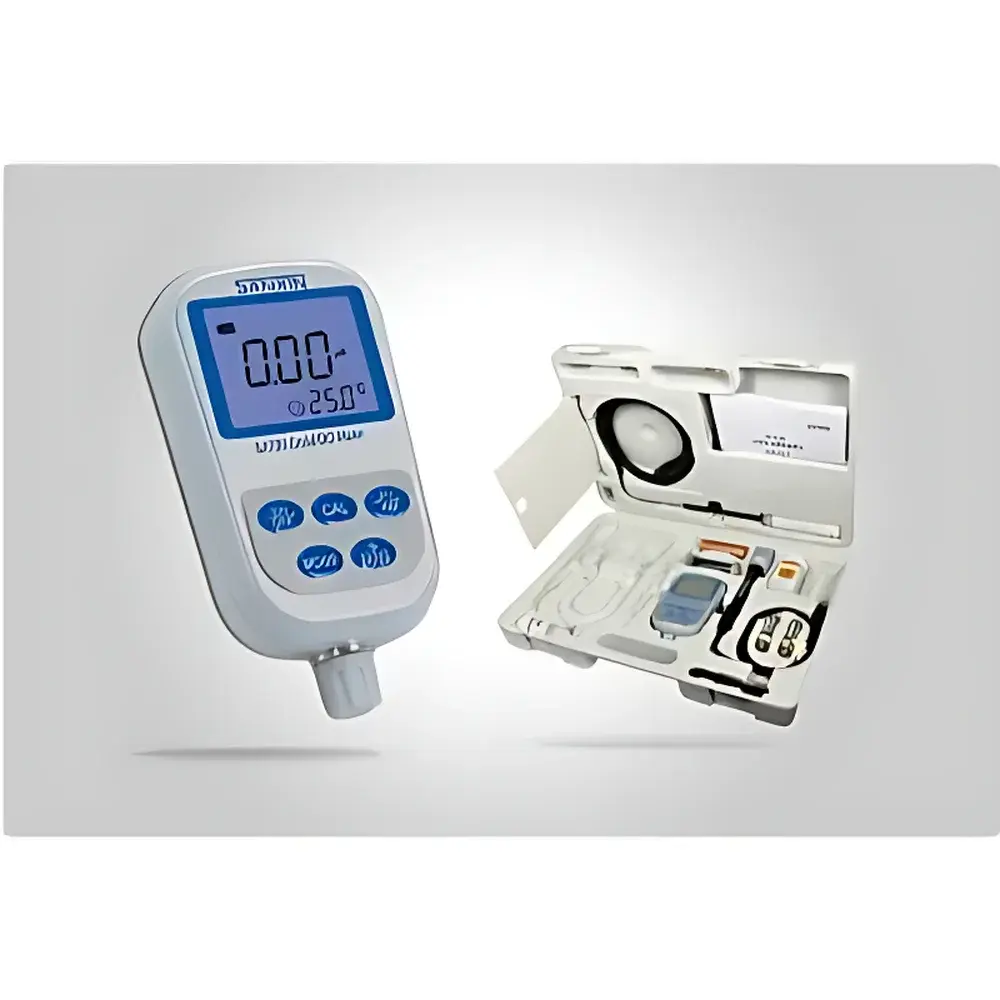
SANXIN SX726 Portable Conductivity & Dissolved Oxygen Meter
| Brand | SANXIN |
|---|---|
| Origin | Shanghai, China |
| Manufacturer | SANXIN Precision Instruments Co., Ltd. |
| Model | SX726 |
| Instrument Type | Portable/Handheld Water Quality Analyzer |
| Measured Parameters | Conductivity, Dissolved Oxygen (DO), Temperature, TDS, Salinity, Resistivity |
| Measurement Principle | Four-electrode conductivity cell (for conductivity/resistivity/TDS/salinity) |
| Accuracy | ±1.0% FS (conductivity) |
| Temperature Compensation | Automatic (0–50 °C for conductivity |
| Salinity Compensation | Automatic (0–45 ppt) |
| Barometric Pressure Compensation | Manual (66–200 kPa) |
| Data Storage | 200 sets |
| Power Supply | 2 × AA batteries (1.5 V each) |
| Dimensions (meter) | 65 × 120 × 31 mm |
| Weight (meter) | 180 g |
| Enclosure Rating | IP57 |
| Electrode Interface | 8-pin waterproof connector with automatic electrode recognition |
Overview
The SANXIN SX726 Portable Conductivity & Dissolved Oxygen Meter is an integrated, field-deployable water quality analyzer engineered for precision, reliability, and operational simplicity in demanding environmental and industrial settings. It combines dual-sensor measurement architecture—utilizing a four-electrode conductivity cell and a polarographic Clark-type dissolved oxygen sensor—to deliver simultaneous, real-time quantification of key aqueous parameters including conductivity, dissolved oxygen (DO), temperature, total dissolved solids (TDS), salinity, and resistivity. Designed to meet the practical requirements of on-site monitoring, the SX726 operates without external power sources and maintains metrological integrity across variable ambient conditions through automatic temperature compensation and configurable salinity/barometric corrections. Its measurement methodology adheres to foundational electrochemical principles defined in ASTM D1125 (Standard Test Methods for Electrical Conductivity and Resistivity of Water) and ASTM D888 (Standard Test Methods for Dissolved Oxygen in Water), ensuring traceability and comparability with laboratory-grade reference methods.
Key Features
- IP57-rated rugged enclosure—dust-protected and submersible up to 1 m for 30 minutes—enabling safe operation in rain, splashing, or shallow immersion scenarios.
- Intelligent 8-pin waterproof electrode interface that auto-detects connected sensor types (e.g., 2301-S conductivity probe, DO500 dissolved oxygen probe), eliminating manual configuration errors.
- Backlit, high-contrast LCD display with transparent acrylic window—optimized for readability under low-light or outdoor conditions.
- Integrated data logging capability storing up to 200 measurement records with timestamp, parameter values, and calibration metadata.
- Modular accessory system housed within a dedicated carrying case—including calibrated standard solutions (1408 µS/cm KCl), spare DO membranes (DO503), electrolyte refills (DO502), and field-ready electrodes—ensuring continuity of measurement without logistical delays.
Sample Compatibility & Compliance
The SX726 is validated for use with natural waters (freshwater, estuarine, wastewater effluents), process streams, cooling tower fluids, aquaculture systems, and potable water distribution networks. Its sensor design complies with ISO 7888 (Water quality — Determination of electrical conductivity) and ISO 5814 (Water quality — Determination of dissolved oxygen — Electrochemical probe method). The instrument supports GLP-compliant workflows through persistent calibration history storage and user-accessible calibration verification logs. While not certified to FDA 21 CFR Part 11 out-of-the-box, its audit-trail-capable firmware architecture permits integration into regulated environments when deployed with documented SOPs and periodic performance verification per ISO/IEC 17025 requirements.
Software & Data Management
Data export is supported via manual transcription or optional infrared (IR) interface (accessory-dependent). All stored measurements include date/time stamps, sensor identification codes, and environmental correction parameters (temperature, salinity, pressure). Calibration events are time-stamped and retain slope, offset, and reference value metadata—facilitating retrospective QA/QC review. Firmware updates are delivered via USB-to-serial adapter (sold separately), ensuring long-term compatibility with evolving regulatory expectations and analytical best practices.
Applications
- Field-based environmental monitoring programs tracking eutrophication indicators and aquatic ecosystem health.
- Routine QC checks in municipal wastewater treatment plants—monitoring influent/effluent conductivity and DO saturation levels.
- Industrial process water surveillance in power generation (cooling loops), semiconductor manufacturing (ultrapure rinse water), and food & beverage production (sanitation validation).
- Educational laboratories requiring robust, multi-parameter instrumentation for undergraduate water chemistry curricula.
- Emergency response teams assessing post-event water safety following floods or chemical spills.
FAQ
Does the SX726 support automatic barometric pressure compensation?
No—barometric pressure compensation is manual, requiring user input within the 66–200 kPa range prior to DO measurement.
Can the instrument store calibration coefficients for multiple electrodes?
Yes—each recognized electrode type retains its own calibration profile, enabling rapid switching between conductivity and DO sensors without reconfiguration.
Is the DO500 electrode compatible with BOD incubation protocols?
The DO500 is rated for continuous immersion and stable operation at 20 °C; however, extended BOD5 incubation (5 days at 20 °C) requires verification of membrane integrity and electrolyte saturation before and after testing.
What is the minimum sample volume required for accurate measurement?
A minimum depth of 5 cm is recommended for both conductivity and DO measurements to ensure full electrode immersion and avoid surface film interference.
How often should the conductivity cell be cleaned and recalibrated?
Cleaning with deionized water and mild detergent is advised after exposure to turbid or organic-laden samples; calibration verification should occur before each field deployment or at least daily during continuous use.
Related Products







