
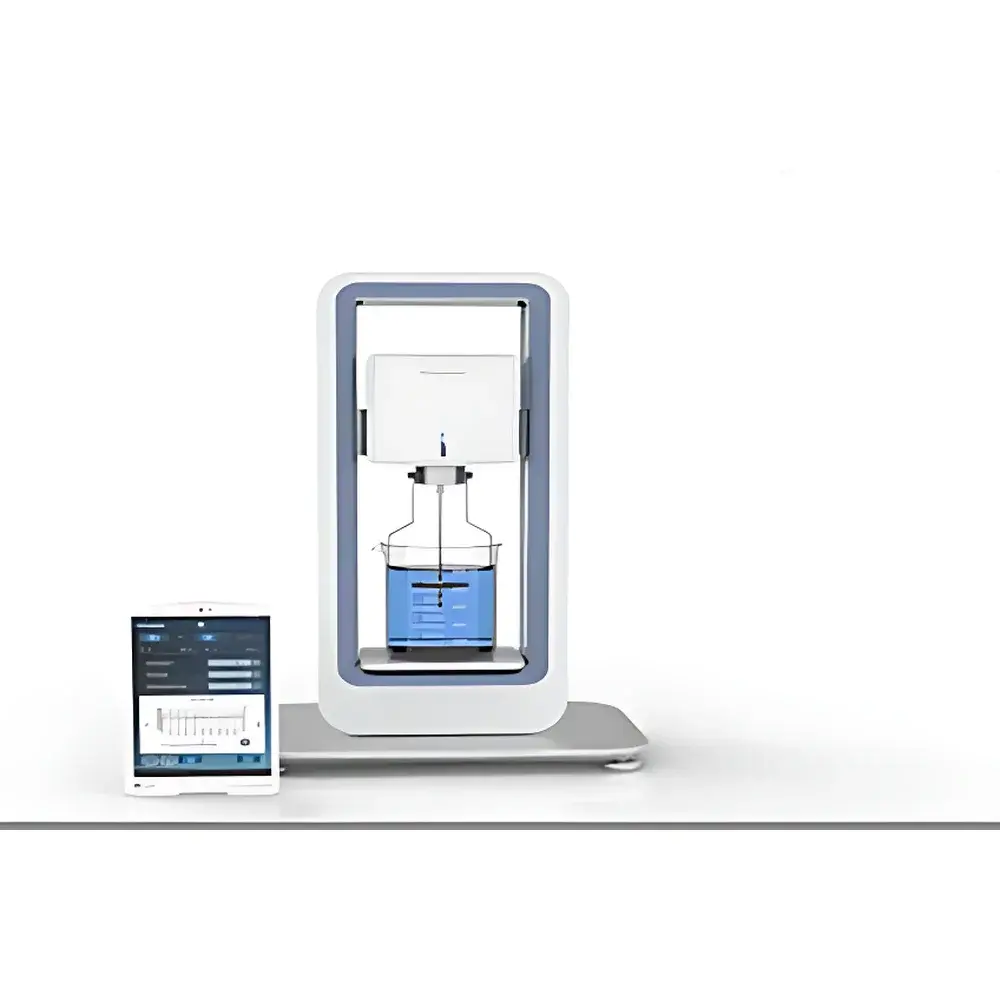
Fungilab V-COMPACT Advanced Portable Rotational Viscometer
| Brand | Fungilab |
|---|---|
| Origin | Spain |
| Model | V-COMPACT |
| Instrument Type | Portable Rotational Viscometer |
| Viscosity Range | 1–320,000 cP |
| Temperature Range | –40 °C to +300 °C |
| Temperature Accuracy | ±0.3 °C |
| Temperature Resolution | 0.1 °C |
| Repeatability | ±0.2% |
| Accuracy | ±1% of full scale |
| Speed Range | 0.01–250 rpm |
| Power Supply | 90–240 VAC, 50/60 Hz |
| Transducer | PT100 Class A |
| Rotor Material | AISI 316 Stainless Steel |
| Compliance | ASTM D2196, ISO 2555, ISO 3219, USP <911> |
Overview
The Fungilab V-COMPACT is an advanced portable rotational viscometer engineered for high-precision dynamic viscosity measurement across research laboratories, QC/QA environments, and field applications. It operates on the principle of controlled-shear rotational rheometry—applying a defined torque to a rotating spindle immersed in a sample, measuring the resulting angular velocity to calculate viscosity according to Newton’s law of viscosity (η = τ/γ̇). Unlike traditional benchtop viscometers with integrated displays, the V-COMPACT adopts a screenless architecture, relying exclusively on wireless communication with a dedicated 8-inch Android tablet preloaded with Fungilab’s ViscoLab™ application. This design eliminates mechanical display components, enhancing long-term reliability while enabling intuitive parameter configuration, real-time data visualization, and seamless report generation—all within a GLP-compliant digital workflow.
Key Features
- Screenless main unit with fully wireless operation via ViscoLab™ mobile application
- Automated motorized lift system for precise, repeatable immersion depth control
- Heldal™ spiral measurement mode—exclusive to V-COMPACT—for stable characterization of shear-thinning and yield-stress non-Newtonian fluids
- Multi-step programmable measurement routines with customizable TTT (Torque Threshold Termination) and TTS (Time Threshold Stop) logic
- Real-time graphical display of viscosity vs. time, shear rate, or shear stress—including dual-axis customization
- User-configurable QCL (Quality Control Limit) alarms with adjustable thresholds and over-range detection
- On-device calibration verification for viscosity and temperature sensors (traceable to NIST-traceable standards)
- Integrated PT100 Class A temperature probe with ±0.3 °C accuracy and 0.1 °C resolution
- Modular rotor system supporting L-, R-, and H-series geometries; all rotors fabricated from corrosion-resistant AISI 316 stainless steel
- Optional accessories: Low-viscosity adapter (LCP), small-sample adapter (APM), and quick-release PPR rotor mounting system
Sample Compatibility & Compliance
The V-COMPACT accommodates a broad range of liquid and semi-liquid samples—from low-viscosity solvents (1 cP) to highly structured gels and pastes (up to 320,000 cP)—with appropriate rotor selection and speed optimization. Its compliance framework supports routine adherence to international testing standards including ASTM D2196 (non-Newtonian fluids), ISO 2555 (resin solutions), ISO 3219 (polymer solutions), and USP (viscosity of pharmaceutical preparations). The device logs all measurement metadata—including operator ID, timestamp, environmental temperature, rotor ID, speed profile, and calibration status—enabling full audit trails required under FDA 21 CFR Part 11 and GMP/GLP environments. Temperature-controlled measurements are supported via external circulators (not included), leveraging the built-in PT100 interface for closed-loop feedback.
Software & Data Management
ViscoLab™ software provides a secure, role-based interface for method development, execution, and reporting. All measurement protocols—including multi-step ramp sequences, slope analysis, and time-sweep profiles—are stored locally on the tablet and exportable as encrypted SQLite databases. Raw datasets are exportable in CSV format for third-party statistical analysis, while finalized reports generate PDF documents containing instrument ID, calibration certificates, traceable timestamps, and annotated graphs with user-defined axis labels. Audit logging captures every parameter change, calibration event, and alarm activation. Optional cloud synchronization enables centralized data backup and cross-laboratory method sharing—fully compliant with ISO/IEC 17025 documentation requirements.
Applications
The V-COMPACT serves critical roles in formulation development and quality assurance across multiple sectors: polymer processing labs use Heldal™ mode to assess extrudability and die swell behavior; paint and coatings manufacturers validate sag resistance and leveling performance under controlled shear; pharmaceutical R&D teams characterize suspension stability and injectability of biologics; food technologists evaluate mouthfeel and pumpability of sauces and dairy emulsions; and adhesives producers monitor open-time and green strength evolution during cure. Its portability and battery-independent operation make it suitable for on-site viscosity verification in pilot plants and manufacturing cleanrooms where space and EMI constraints limit conventional instrumentation.
FAQ
Does the V-COMPACT require factory recalibration after firmware updates?
No—user-performed viscosity and temperature calibrations remain intact unless explicitly reset. Firmware updates preserve all stored methods, calibration offsets, and audit logs.
Can the V-COMPACT operate without the tablet?
No—the device has no local display or physical controls; all configuration, execution, and monitoring depend entirely on the ViscoLab™ application running on the supplied tablet.
What is the minimum sample volume required with the LCP adapter?
As low as 0.5 mL when using the Low-Viscosity Adapter (LCP) with L-series rotors—ideal for precious or hazardous materials.
Is ASTM D1200 cone-and-plate compliance supported?
Not natively—the V-COMPACT uses coaxial cylinder (CC) and spindle geometries per ISO 3219. Cone-and-plate measurements require optional third-party accessories not covered under standard warranty.
How is traceability maintained for regulatory submissions?
Each test record includes embedded digital signatures, instrument serial number, calibration certificate reference, and timestamped environmental data—exportable in PDF/A-1b format for archival submission to regulatory authorities.



