
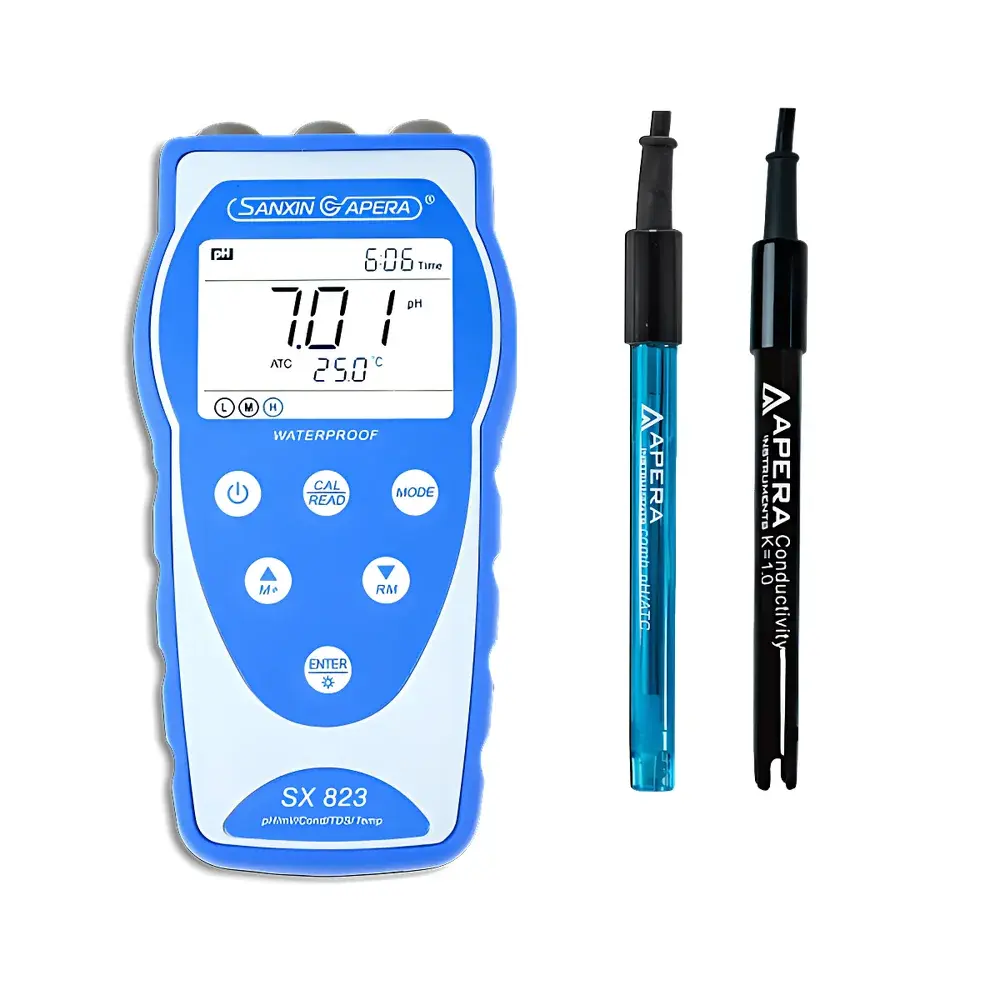
SANXIN SX823 Portable pH/Conductivity Water Quality Analyzer
| Brand | SANXIN |
|---|---|
| Origin | Shanghai, China |
| Manufacturer Type | Direct Manufacturer |
| Model | SX823 |
| Instrument Type | Portable/Handheld Water Quality Analyzer |
| Measurement Principle | Electrochemical Method |
| Measured Parameters | pH, Conductivity, TDS, Salinity, Resistivity |
| pH Range | (−2.00 to 19.99) pH |
| Conductivity Range | 0 to 200 mS/cm (5-range auto-scaling) |
| Temperature Compensation | Automatic or Manual (0–100 °C for pH |
| Electrode Constants | 0.1 / 1.0 / 10 cm⁻¹ |
| Data Storage | 1000 GLP-compliant records |
| IP Rating | IP57 |
| Power | 3 × AA batteries (1.5 V) or DC 5 V via USB |
| Dimensions (Instrument) | 88 × 170 × 33 mm |
| Weight (Instrument) | 313 g |
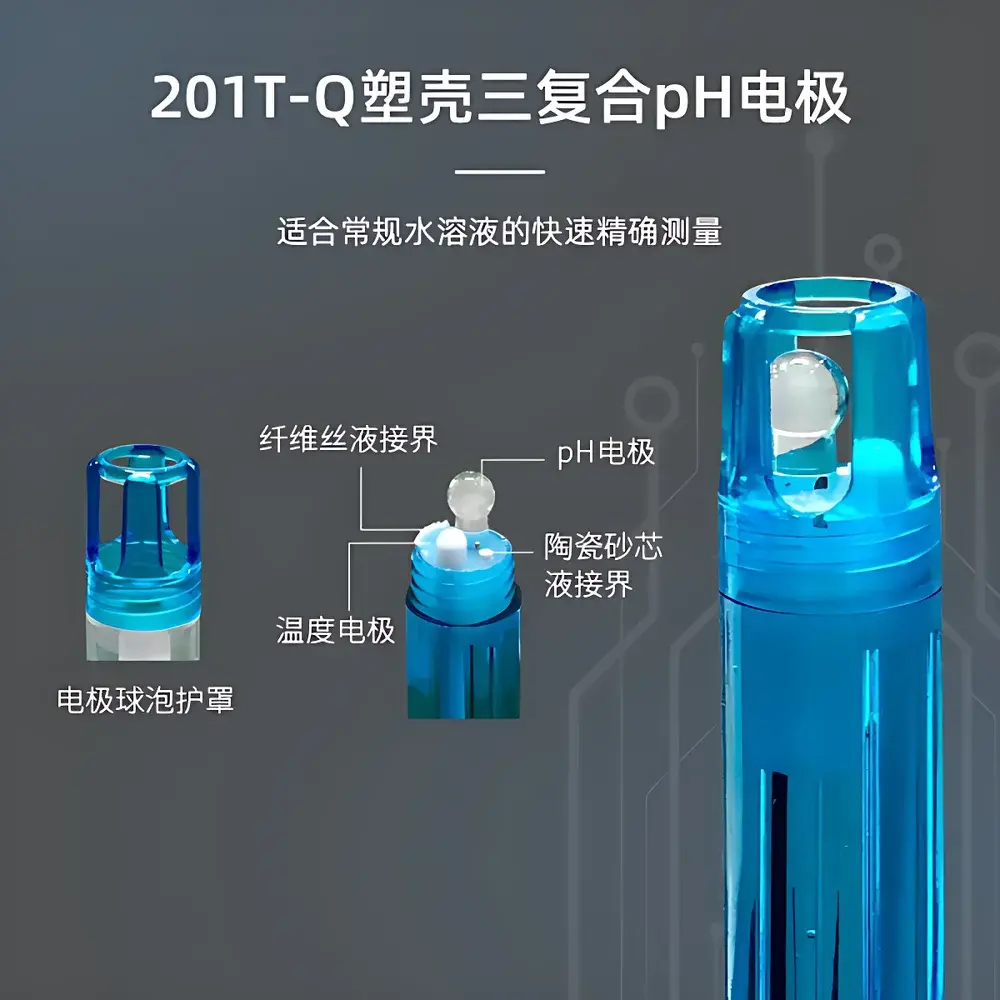
| Standard Electrodes | 201T-Q Tri-combination pH electrode (Li-glass membrane, integrated temperature sensor) |
Overview
The SANXIN SX823 Portable pH/Conductivity Water Quality Analyzer is an electrochemical field instrument engineered for high-reliability, multi-parameter water analysis in demanding environmental, industrial, and regulatory settings. It operates on standardized potentiometric (pH/mV) and conductimetric (conductivity/TDS/salinity/resistivity) principles compliant with ASTM D1125, ISO 7888, and USP . Designed for on-site deployment—whether at wastewater treatment outfalls, power plant cooling loops, pharmaceutical clean utilities, or municipal distribution networks—the SX823 delivers laboratory-grade measurement integrity without benchtop constraints. Its dual-sensor architecture enables simultaneous, traceable acquisition of pH and conductivity-related parameters under variable thermal conditions, supported by rigorous temperature compensation algorithms validated per NIST-traceable calibration protocols.
Key Features
- Triple-parameter electrochemical sensing: Integrated pH, conductivity, and temperature measurement with automatic parameter switching and real-time unit conversion (μS/cm, mS/cm, TDS g/L, salinity ppt, resistivity MΩ·cm).
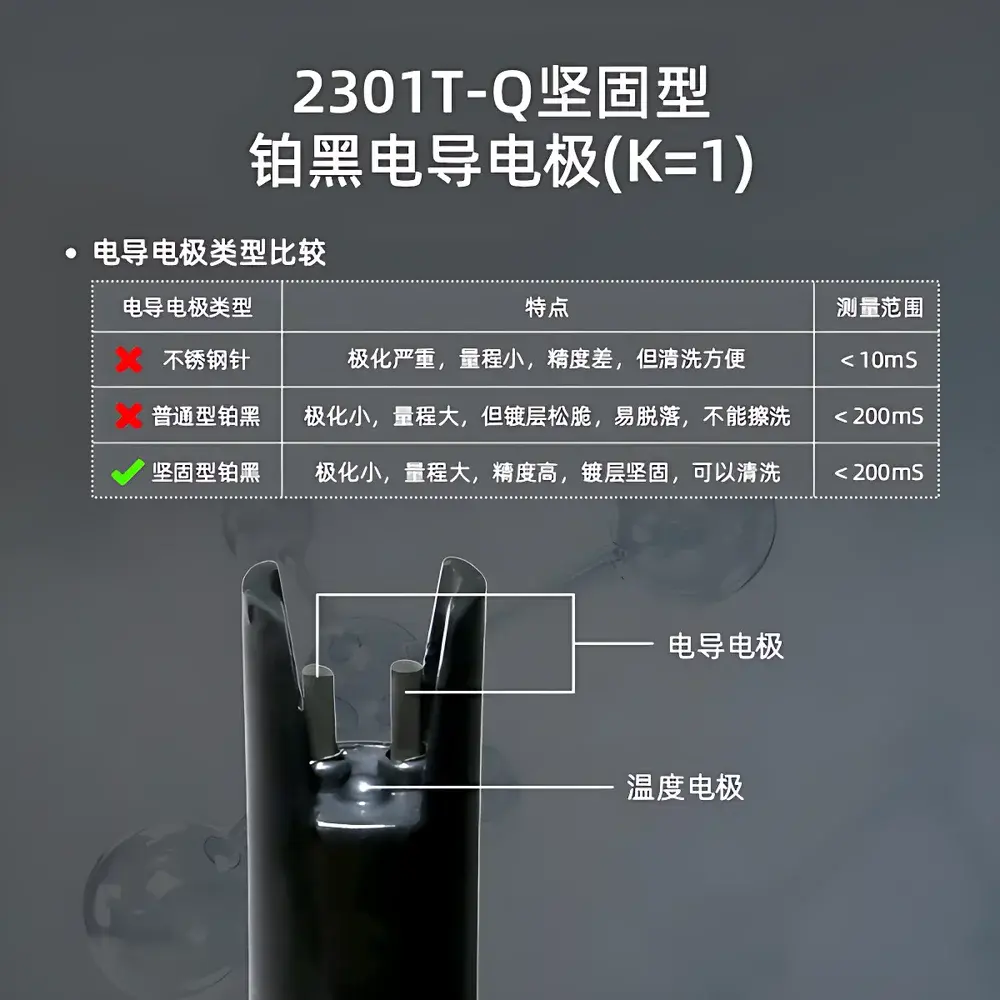
- Advanced electrode system: Factory-calibrated 201T-Q tri-combination pH electrode featuring lithium glass membrane (fast response, low drift), built-in thermistor, and ruggedized ABS housing; paired with 2301T-Q platinum black conductivity cell optimized for wide-range stability (0.00 μS/cm to 199.9 mS/cm) and non-linear temperature compensation below 10 μS/cm.
- Intelligent calibration management: Auto-recognition of 12 pH buffer standards (including custom solutions); 1–3 point pH calibration with slope and offset diagnostics; auto-identification of 8 conductivity standards across three cell constants (0.1, 1.0, 10 cm⁻¹); configurable TDS conversion factor (0.4–1.0).
- Ruggedized field design: IP57-rated enclosure certified for dust resistance and immersion up to 1 m for 30 minutes; foldable stand for hands-free operation; shock-absorbing molded carrying case (480 × 360 × 95 mm) containing all accessories including buffers, standards, USB cable, and software.
- Regulatory-ready data handling: 1000 GLP-compliant memory slots storing timestamped entries with measurement values, units, temperature, electrode ID, calibration history, and operator ID; manual and auto-timed storage modes; USB interface supporting 21 CFR Part 11–compatible audit trail export via PC-Link software.
Sample Compatibility & Compliance
The SX823 is validated for aqueous matrices ranging from ultrapure water (e.g., boiler feedwater, semiconductor rinse water) to highly conductive industrial effluents (e.g., brine, electroplating baths). Its adaptive conductivity algorithm applies non-linear temperature compensation for sub-10 μS/cm samples—critical for ASTM D5127 and IEC 60404-8-11 compliance in power generation. The pH module supports specialized operational modes: “Pure Water pH” (with low-ionic-strength correction) and “Ammoniated Pure Water pH” (for condensate monitoring in fossil-fuel plants), both referencing IAPWS thermodynamic models. All calibrations adhere to ISO/IEC 17025 documentation requirements, and stored data meet GLP/GMP record retention mandates for environmental reporting (EPA Method 120.1, APHA 4500-H⁺ B) and pharmaceutical water system qualification (USP ).
Software & Data Management
PC-Link software provides secure, encrypted USB communication for bidirectional data transfer, calibration report generation, and firmware updates. Each stored record includes immutable metadata: date/time stamp, measurement mode, electrode serial number, calibration status flags, and ambient temperature. Audit trails log all user actions—including calibration edits, parameter changes, and data deletions—with timestamps and operator identifiers. Export formats include CSV and PDF, compatible with LIMS integration and automated QA/QC dashboards. The instrument enforces data integrity through write-protected memory sectors and automatic power-fail recovery—ensuring zero loss during battery depletion or unexpected shutdown.
Applications
- Power industry: Condensate, demineralized water, and steam cycle chemistry monitoring per EPRI guidelines and IEEE Std 117.
- Pharmaceutical manufacturing: Purified water (PW) and water for injection (WFI) system verification per USP , EU Annex 1, and WHO TRS 970.
- Environmental fieldwork: Surface water, groundwater, and wastewater compliance testing aligned with ISO 5667-3 and EPA Region 9 protocols.
- Microelectronics: Ultrapure water resistivity validation for wafer cleaning processes (SEMI F57).
- Academic research: Field-based hydrological studies requiring portable, multi-parameter electrochemical profiling with traceable uncertainty budgets.
FAQ
Does the SX823 support 21 CFR Part 11 compliance?
Yes—via PC-Link software with electronic signature capability, role-based access control, and full audit trail generation.
Can the instrument perform simultaneous pH and conductivity measurements?
No—it measures parameters sequentially but allows rapid toggling between pH, mV, conductivity, TDS, salinity, and resistivity with shared temperature compensation.
What is the calibration frequency recommendation for GLP environments?
Daily calibration verification is advised before critical measurements; full 2-point pH and 1-point conductivity calibration required per shift or after electrode replacement.
Is the 201T-Q pH electrode suitable for high-temperature applications?
It is rated for continuous use up to 80 °C; intermittent exposure to 100 °C is permissible for ≤5 minutes per session.
How does the SX823 handle low-conductivity water measurements below 10 μS/cm?
It applies a proprietary non-linear temperature compensation curve based on Kohlrausch’s law and water dissociation thermodynamics, minimizing error in ultrapure water applications.







