
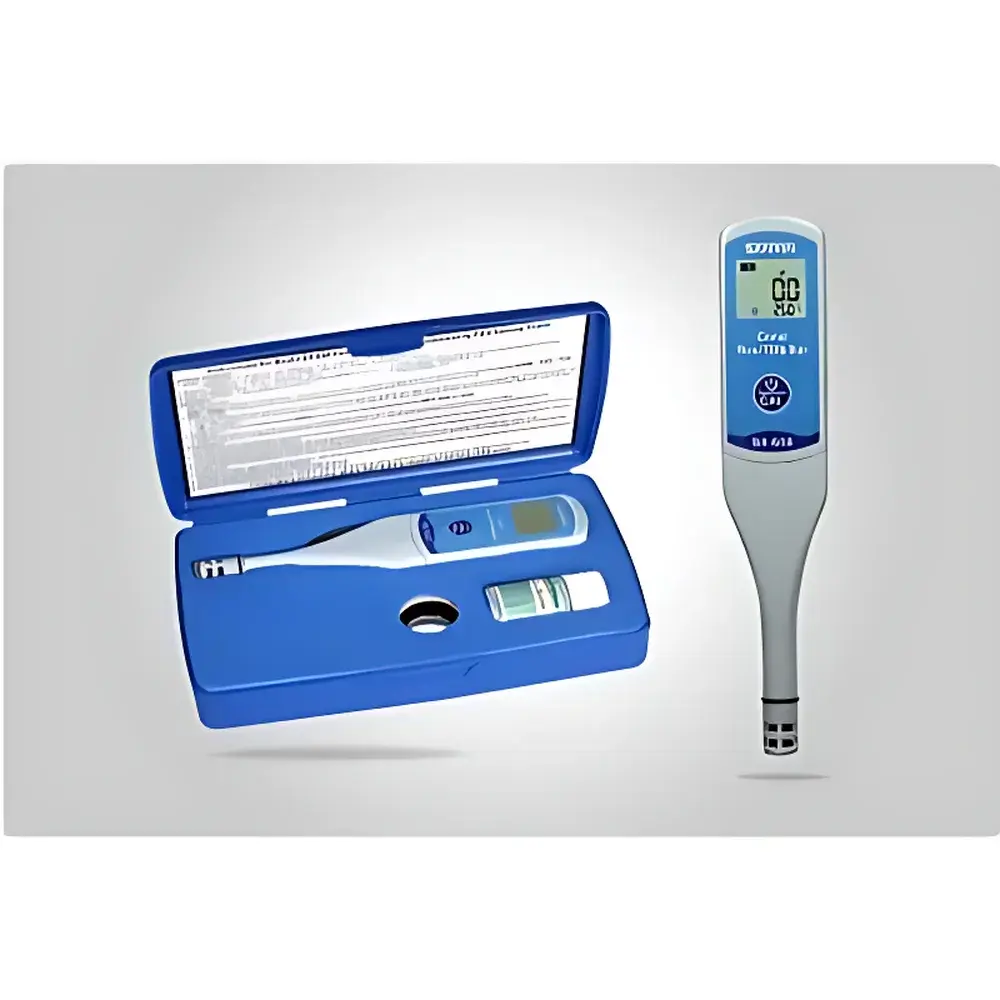
Sanxin SX650 Pocket-Sized Conductivity Meter
| Brand | Sanxin |
|---|---|
| Origin | Shanghai, China |
| Manufacturer Type | OEM/ODM Manufacturer |
| Product Category | Domestic (China-Made) |
| Model | SX650 |
| Price | USD 85 (FOB Shanghai) |
| Dimensions | 148 × 29 × 14 mm |
| Weight | 38 g |
| IP Rating | IP57 |
| Measurement Range | Conductivity: 0–50.0 mS/cm |
| Resistivity | 0–20.0 MΩ·cm (at low conductivity) & 50–500 μS/cm (mid-range) |
| TDS | 0–35.0 g/L (with 0.50–5.00 mS/cm conversion range) |
| Salinity | 0–25.0 ppt (calibrated to NaCl standard, 5.0–50.0 mS/cm equivalent) |
| Temperature | 0–50.0 °C |
| Accuracy | ±1.0% FS (conductivity), ±0.5 °C (temperature) |
| Temp. Compensation | Automatic, 0–50 °C, β = 2.0 %/°C |
| Calibration | Single-point, using 1413 μS/cm KCl standard |
| Power | Two CR2032 lithium coin cells (≥100 h continuous operation) |
| Compliance | ISO 9001:2000 certified quality management system, CE marked per EU Directive 2014/30/EU (EMC) and 2011/65/EU (RoHS) |
Overview
The Sanxin SX650 Pocket-Sized Conductivity Meter is a compact, field-deployable electrochemical instrument engineered for rapid, reliable measurement of electrical conductivity, resistivity, total dissolved solids (TDS), and salinity in aqueous solutions. Operating on the principle of two-electrode AC conductometry at a fixed frequency (typically 1 kHz), the SX650 applies a low-amplitude alternating current across a graphite or stainless-steel electrode pair immersed in sample media, measuring the resulting conductance and converting it to standardized units via factory-calibrated algorithms. Its design prioritizes operational simplicity and environmental resilience—making it suitable for routine QC checks in water treatment plants, in-line verification during food & beverage production, spot monitoring in aquaculture ponds, and preliminary screening in environmental field surveys. Unlike benchtop meters requiring external temperature probes or multi-point calibration routines, the SX650 integrates a built-in NTC thermistor for real-time automatic temperature compensation (ATC) across its full operating range (0–50.0 °C), eliminating manual correction errors and ensuring traceable consistency under variable ambient conditions.
Key Features
- Ultra-compact form factor (148 × 29 × 14 mm; 38 g), enabling one-handed operation and pocket-level portability without sacrificing readability or tactile feedback.
- Single-button interface with intuitive menu navigation—no learning curve for field technicians or non-specialist users.
- Integrated dual-line LCD display showing primary parameter (e.g., conductivity) and secondary parameter (e.g., temperature) simultaneously, with high-contrast segments optimized for outdoor visibility.
- Intelligent power management: auto-off after 10 minutes of inactivity; low-battery indicator; estimated >100 hours of continuous use per set of CR2032 cells.
- Robust mechanical architecture compliant with IP57 ingress protection—fully dust-resistant and capable of withstanding immersion in 1 m of freshwater for up to 30 minutes.
- Built-in calibration reference vial (1413 μS/cm KCl) and electrode storage solution included in the molded plastic carrying case—ensuring immediate readiness and long-term sensor hydration.
Sample Compatibility & Compliance
The SX650 is validated for use with low-to-moderate ionic strength aqueous samples, including potable water, wastewater effluent, nutrient solutions, brackish aquaculture water, and process rinse streams. It is not intended for highly viscous, suspended-solid-laden, or strongly oxidizing media (e.g., concentrated chlorine solutions or hot alkaline caustic). Electrode geometry and cell constant (k = 1.0 cm⁻¹ nominal) are optimized for the stated measurement ranges; users must verify suitability for specific matrix interferences (e.g., heavy metal ion complexation, organic fouling potential) prior to deployment. The instrument complies with ISO 9001:2000 quality system requirements and bears CE marking under the European Union’s Electromagnetic Compatibility (2014/30/EU) and Restriction of Hazardous Substances (2011/65/EU) directives. While not certified to GLP or FDA 21 CFR Part 11 standards due to its portable, non-networked architecture, its single-point calibration traceability and ATC algorithm support data integrity in non-regulated QA/QC environments.
Software & Data Management
The SX650 operates as a standalone, embedded-system device with no onboard memory, USB interface, or Bluetooth connectivity. All measurements are displayed in real time and intended for immediate visual interpretation or manual transcription. No proprietary software, drivers, or cloud synchronization is provided or required. This design minimizes failure points, eliminates firmware update dependencies, and ensures compliance with air-gapped operational protocols common in secure industrial facilities. For laboratories requiring electronic record retention, users may employ external digital loggers or mobile apps equipped with OCR-based readout capture—though such workflows fall outside the manufacturer’s validation scope.
Applications
- Drinking water safety verification at distribution points and household taps.
- Routine conductivity checks during reverse osmosis (RO) and deionization (DI) system maintenance.
- Nutrient solution monitoring in hydroponic and aquaponic cultivation systems.
- Salinity profiling in coastal estuaries, shrimp farms, and marine aquariums.
- Pre-screening of cleaning-in-place (CIP) rinse water conductivity to confirm detergent removal in food processing lines.
- Educational labs for introducing fundamental electrochemical concepts and calibration principles.
FAQ
Does the SX650 support multi-point calibration?
No. It is designed exclusively for single-point calibration using the supplied 1413 μS/cm KCl standard solution.
Can the electrode be replaced independently?
Yes—the integrated sensor module is field-replaceable; replacement electrodes (model SX-EC-1) are available separately.
Is temperature compensation adjustable by the user?
No. The temperature coefficient is fixed at 2.0 %/°C, aligned with standard NaCl-based conductivity models per ISO 7888 and ASTM D1125.
What is the recommended recalibration interval?
For routine field use, recalibration is advised before each daily measurement session or after exposure to extreme temperatures or aggressive matrices.
Does the IP57 rating permit submersion during active measurement?
IP57 certifies protection against temporary immersion—but the device must be powered off and sealed prior to submersion; live underwater operation is not supported.





