
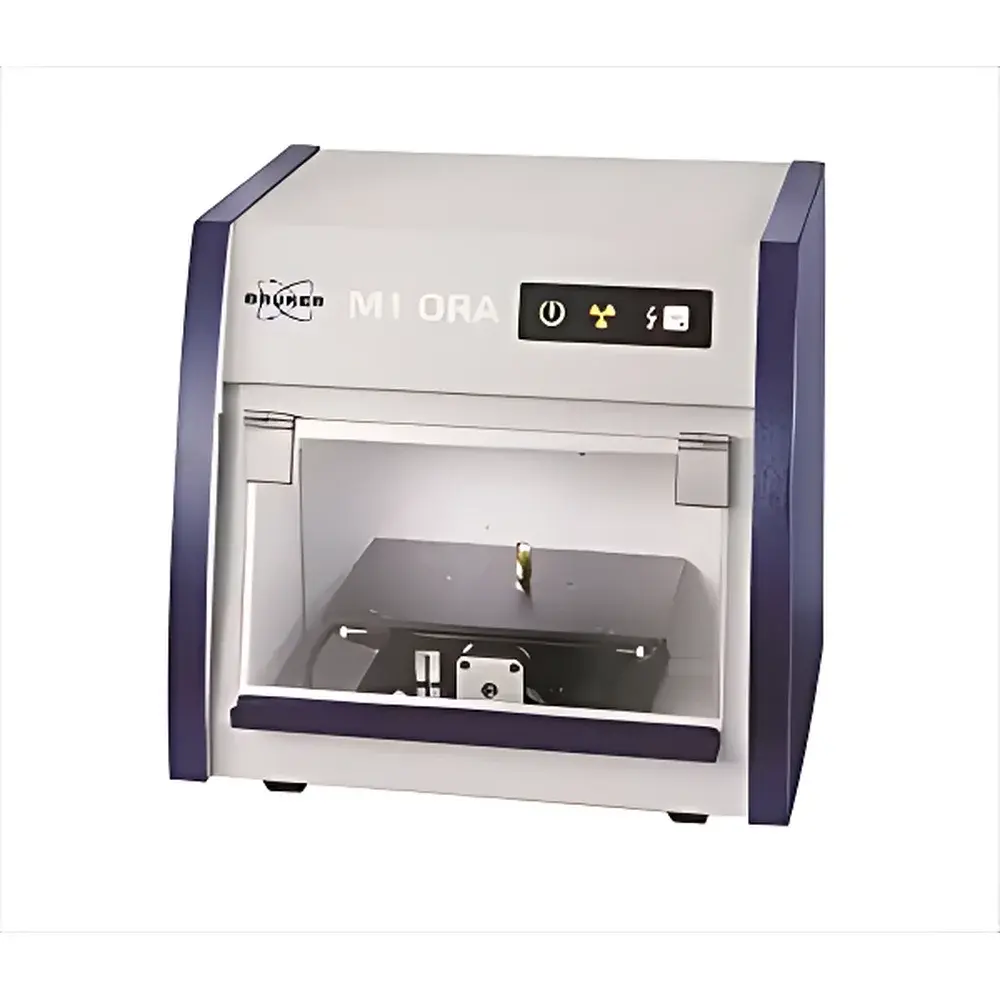
Bruker M1 ORA Micro-XRF Spectrometer
| Brand | Bruker |
|---|---|
| Origin | Germany |
| Model | M1 ORA |
| Excitation Geometry | Top-illumination |
| Minimum Beam Spot Size | 0.3 mm |
| Elemental Range | Z ≥ 22 (Ti and higher) |
| Sample Dimensions (Max) | 100 × 100 × 100 mm |
| Detection Principle | Energy-Dispersive X-ray Fluorescence (ED-XRF) |
| Detector Type | Large-Area Proportional Counter |
| Quantification Modes | Fundamental Parameters (FP) and Standard-Based Calibration |
| Detection Limit | ≥ 0.5 wt% for most elements |
| Typical Accuracy | ±0.2 wt% (relative to certified reference materials) |
| Sample Handling | Non-contact, non-destructive, no preparation required |
| Positioning System | Integrated Optical Microscope with Live Imaging |
Overview
The Bruker M1 ORA is a benchtop micro-focused X-ray fluorescence (μ-XRF) spectrometer engineered specifically for high-precision elemental analysis of precious metal alloys in jewelry manufacturing, assaying, and quality control laboratories. It operates on the principle of energy-dispersive X-ray fluorescence (ED-XRF), where a focused primary X-ray beam excites atoms in the sample, causing emission of characteristic secondary (fluorescent) X-rays. These emitted photons are collected by a large-area proportional counter detector and spectrally resolved to identify and quantify elemental composition. Unlike bulk XRF systems, the M1 ORA integrates micro-beam optics with top-illumination geometry, enabling spatially resolved analysis down to a 0.3 mm diameter spot — critical for evaluating heterogeneous alloys, layered platings, solder joints, or multi-metal settings without cross-contamination or signal averaging. Its compact footprint and integrated optical microscope allow direct visual targeting of sub-millimeter features, ensuring measurement repeatability and traceability in compliance with ISO 17025–accredited workflows.
Key Features
- Micro-beam capability with adjustable collimation down to 0.3 mm spot size for localized analysis of intricate jewelry components
- Top-illumination X-ray tube geometry optimized for flat, irregular, or elevated samples — eliminates shadowing and enhances signal-to-noise ratio
- Large-area proportional counter detector providing high photon collection efficiency and improved counting statistics for enhanced precision
- Integrated high-resolution optical microscope with live video feed and motorized stage positioning for precise region-of-interest selection
- Non-destructive, ambient-air operation requiring zero sample preparation — ideal for finished goods, heirlooms, and regulatory-compliant verification
- Quantitative analysis supported by both fundamental parameters (FP) algorithms and empirical calibration models using certified reference materials (CRMs)
- Comprehensive spectral deconvolution software capable of identifying unexpected or trace elements beyond the primary assay scope
Sample Compatibility & Compliance
The M1 ORA accommodates samples up to 100 × 100 × 100 mm in volume, including rings, pendants, clasps, ingots, and granular scrap — all analyzed directly on the motorized stage. Its non-invasive methodology meets the requirements of ISO 8655 (reference material certification), ASTM E1621 (standard guide for ED-XRF analysis of metals), and EU RoHS Directive Annex II screening protocols. For laboratory accreditation, the system supports audit-ready data logging, user access controls, and electronic signature functionality aligned with GLP and GMP documentation standards. While not FDA 21 CFR Part 11–validated out-of-the-box, its data export architecture (CSV, SPC, XML) enables integration into validated LIMS environments for regulated assay reporting.
Software & Data Management
Bruker’s proprietary ESPRIT™ software provides intuitive workflow management from acquisition to report generation. It includes automated peak identification, matrix correction routines for alloy-specific inter-element effects (e.g., Au–Ag–Cu–Pd interactions), and customizable reporting templates compliant with assay house documentation standards. All spectra and quantitative results are stored with full metadata — including acquisition time, operator ID, stage coordinates, and instrument configuration — ensuring full traceability. Raw spectral data can be exported for third-party multivariate analysis or reprocessing using open-format libraries (e.g., PyMCA). Audit trail functionality records parameter changes, calibration updates, and user actions in chronological order — essential for internal QA reviews and external accreditation audits.
Applications
- Quantitative determination of gold fineness (333–999.9 ‰) and alloying elements (Cu, Ag, Ni, Zn, Pd, Pt, Rh) in karat gold, white gold, and platinum group metal (PGM) jewelry
- Verification of hallmark compliance per national standards (e.g., UK Hallmarking Act, German Eichgesetz, US FTC Jewelry Guides)
- Plating thickness estimation via intensity ratio modeling (e.g., Rh over white gold, Pt over silver)
- Failure analysis of discoloration, porosity, or solder incompatibility through elemental mapping of cross-sections or surface zones
- Recycling stream characterization for precious metal recovery facilities requiring rapid grade sorting
- Research-grade compositional profiling of historical artifacts and museum collections under conservation-safe conditions
FAQ
Can the M1 ORA analyze titanium or stainless steel components commonly found in watch cases or earring posts?
Yes — its elemental range starts at titanium (Z = 22), enabling reliable detection and quantification of Ti, Cr, Fe, Ni, and Mo in stainless alloys, provided concentrations exceed ~0.5 wt% and matrix effects are accounted for in calibration.
Is helium purge required for light element analysis?
No — the M1 ORA is optimized for heavier elements (Z ≥ 22) typical in precious metal applications; atmospheric air path is sufficient for all target analytes without vacuum or purge gas.
How does the system handle overlapping peaks, such as Au L-lines and Pb M-lines?
ESPRIT™ employs iterative least-squares fitting with physically constrained background modeling and library-based interference correction to resolve spectral overlaps with <0.5% relative error in certified reference materials.
Can it be used for regulatory reporting in EU or U.S. markets?
Yes — when operated within documented SOPs and calibrated against NIST-traceable CRMs, results meet the technical validity criteria outlined in EN 15048 and ASTM B963 for precious metal assay reporting.



