
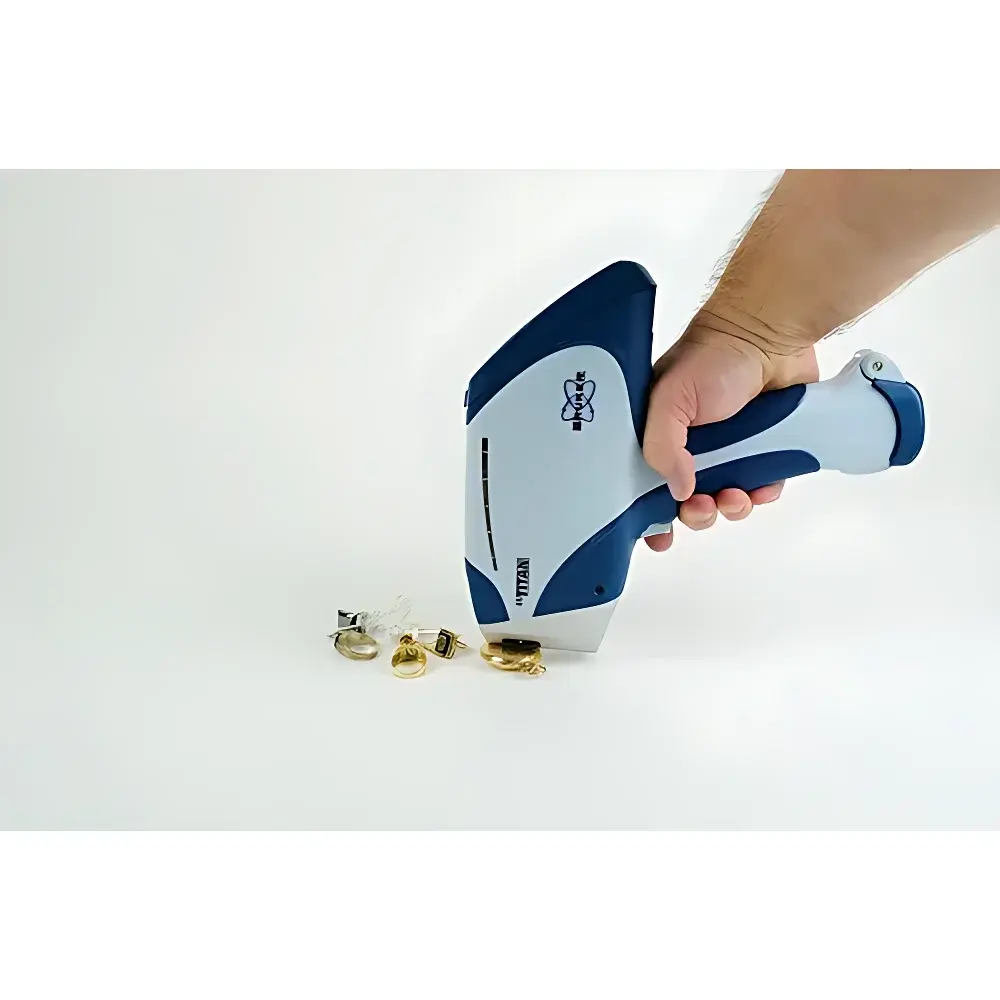
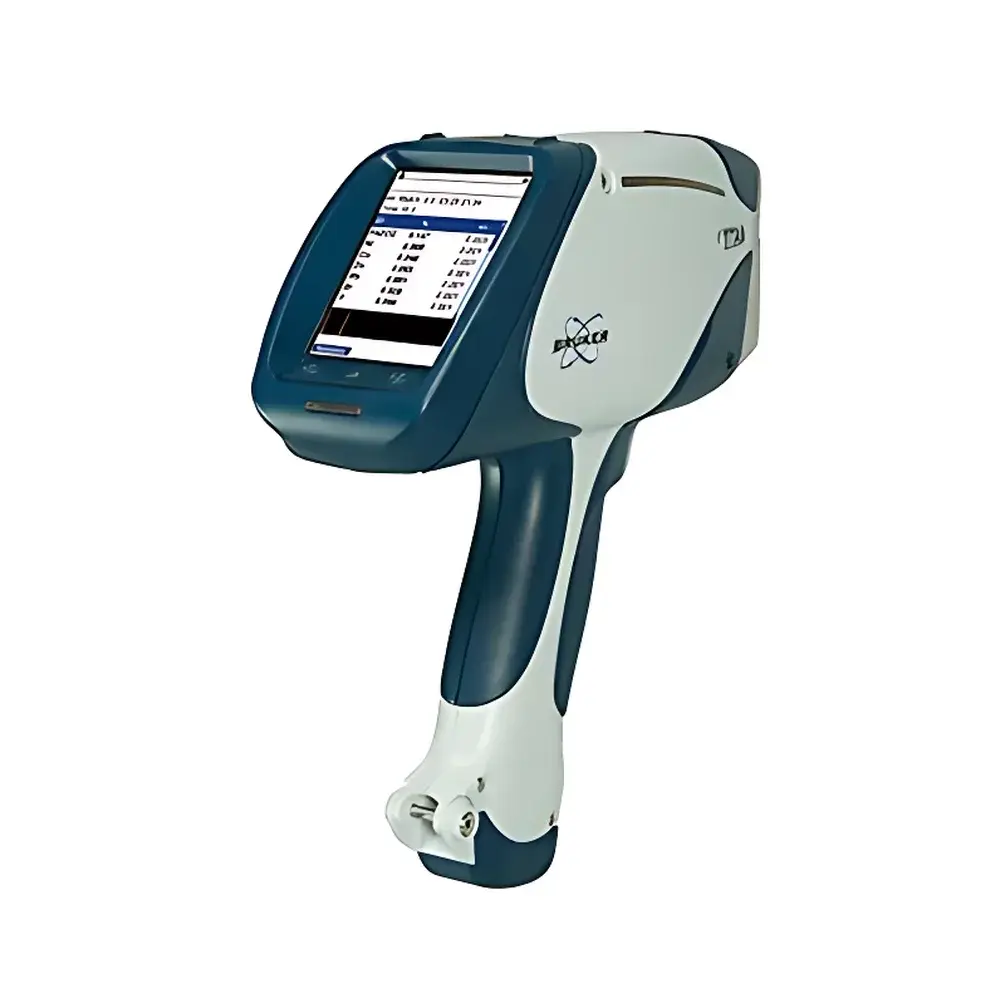
Bruker S1 TITAN Handheld XRF Precious Metals Analyzer
| Brand | Bruker |
|---|---|
| Origin | Germany |
| Model | S1 TITAN |
| Detection Principle | Energy-Dispersive X-ray Fluorescence (EDXRF) |
| Elemental Range | Ti to Bi (including Au, Ag, Pt, Pd, Rh, Ru, Ir, Ni, Cu, Fe, Zn, Sn, Pb, Cd, Cr, Co, Mn, Sb, Ti) |
| Detector | SharpBeam™ Optimized Silicon Drift Detector (SDD) with Optional Pin-Proof Shield™ |
| X-ray Tube | 50 kV Max Excitation |
| Display | High-Contrast LCD Touchscreen |
| Optional Accessories | Integrated CCD Color Camera, Micro-Spot Collimation, Desktop/Tripod Mount, Remote Control Interface |
| Compliance | Designed for GLP/GMP environments |
Overview
The Bruker S1 TITAN Handheld XRF Precious Metals Analyzer is an engineered solution for rapid, non-destructive quantification of gold, silver, platinum group metals (PGMs), and associated alloying or contaminant elements in jewelry, bullion, scrap, and manufactured precious metal products. Based on energy-dispersive X-ray fluorescence (EDXRF) spectroscopy, the instrument excites sample atoms using a high-stability 50 kV micro-focus X-ray tube and resolves emitted characteristic X-rays via a silicon drift detector (SDD) optimized with Bruker’s proprietary SharpBeam™ geometry. This configuration delivers high peak-to-background ratios and excellent spectral resolution—critical for accurate differentiation between adjacent emission lines (e.g., Au Lα at 9.71 keV and Pb Lα at 10.55 keV). The system operates without vacuum or helium purge, enabling true field portability while maintaining analytical rigor suitable for commercial valuation, quality control, and regulatory screening.
Key Features
- SharpBeam™ optical path optimization for enhanced sensitivity and reduced matrix effects in heterogeneous precious metal samples
- Pin-Proof Shield™ detector protection—engineered to withstand up to 50 N of localized mechanical stress from sharp metallic debris (e.g., swarf, wire ends), eliminating routine detector window replacement and minimizing downtime
- High-contrast capacitive touchscreen interface with intuitive icon-driven navigation and preloaded precious metal grade libraries (e.g., karat-based gold standards, ISO 8654 platinum alloys)
- Integrated 5 MP CCD color camera with crosshair-aligned micro-spot collimation (down to 3 mm diameter) for precise targeting of small, curved, or irregular geometries—including rings, chains, watch cases, and filigree
- Flexible deployment modes: handheld operation for on-site inspection; tripod- or bench-mounted configuration for stable measurement of larger items (e.g., trays, ingots, flatware)
- Karat-to-weight-% conversion engine with real-time display—automatically reports Au content in both % w/w and karat scale (e.g., 18K = 75.0% Au), with configurable alarm thresholds for out-of-specification results
Sample Compatibility & Compliance
The S1 TITAN accommodates diverse physical forms: earrings, pendants, clasps, dental restorations, electronic scrap, catalytic converter fragments, and plated substrates. Its micro-spot capability enables representative analysis of features smaller than the nominal beam size through intelligent signal averaging and geometric correction algorithms. For regulatory applications, the analyzer supports GLP-compliant data capture—including operator ID, timestamp, GPS coordinates (optional), and image-anchored result logging. When paired with Bruker’s QUANTAX software suite and validated method packages, the system meets documentation requirements aligned with ISO/IEC 17025 for field-deployable testing laboratories and satisfies evidentiary criteria under USP / for elemental impurity screening in pharmaceutical-grade precious metal catalysts.
Software & Data Management
Data acquisition, processing, and reporting are managed through Bruker’s proprietary MSA (Multi-Spectrum Analysis) firmware and optional PC-based QUANTAX software. All measurements generate encrypted, tamper-evident result files (.qdb) containing full spectra, calibration metadata, and image snapshots. Reports are exportable in PDF, CSV, or XML formats—with customizable templates that embed photographs, measurement location tags, and compliance statements. Audit trail functionality records all user actions, parameter changes, and calibration events—enabling full traceability required under FDA 21 CFR Part 11 when configured with electronic signature modules. Firmware updates are delivered via secure HTTPS channels and validated against SHA-256 checksums.
Applications
- Jewelry appraisal and pawnshop verification—real-time karat validation with pass/fail alerts for substandard gold content
- Recycling facility sorting—rapid discrimination between Au-Ag-Pt-Pd bearing streams and base metal contaminants (e.g., Pb, Cd, Sb)
- Manufacturing QC—verification of plating thickness consistency and substrate composition in electroformed components
- Customs and border control—non-invasive screening of imported artifacts for restricted heavy metals (e.g., Ni, Cr, Pb) per EU RoHS and REACH directives
- Archaeometric studies—surface-sensitive analysis of historical coins and ceremonial objects without sampling
- Bank vault inventory management—batch-level reconciliation of bullion bars using spatially resolved mapping protocols
FAQ
What elements can the S1 TITAN detect in precious metal matrices?
It quantifies Au, Ag, Pt, Pd, Rh, Ru, Ir, Cu, Ni, Zn, Fe, Sn, Pb, Cd, Cr, Co, Mn, Sb, Ti, and In—covering all major alloying, impurity, and regulatory concern elements across jewelry, electronics, and catalysis applications.
Is the instrument capable of measuring gold plating thickness?
Yes—using fundamental parameter (FP) modeling with multi-layer calibration standards, it provides semi-quantitative estimates of Au layer mass per unit area (µg/cm²) on substrates such as brass, stainless steel, or copper.
Does the S1 TITAN require external gas purging or vacuum pumping?
No—it performs air-path EDXRF analysis without consumables, making it suitable for continuous operation in ambient environments including retail floors, auction houses, and scrap yards.
How is measurement reproducibility ensured across operators and sites?
Through factory-installed, matrix-matched calibration standards and automated drift correction routines that reference internal reference peaks before each analysis sequence.
Can the device be integrated into a laboratory LIMS or ERP system?
Yes—via standardized OPC UA or RESTful API interfaces, enabling automated data ingestion into enterprise systems for batch traceability and statistical process control (SPC) dashboards.





