
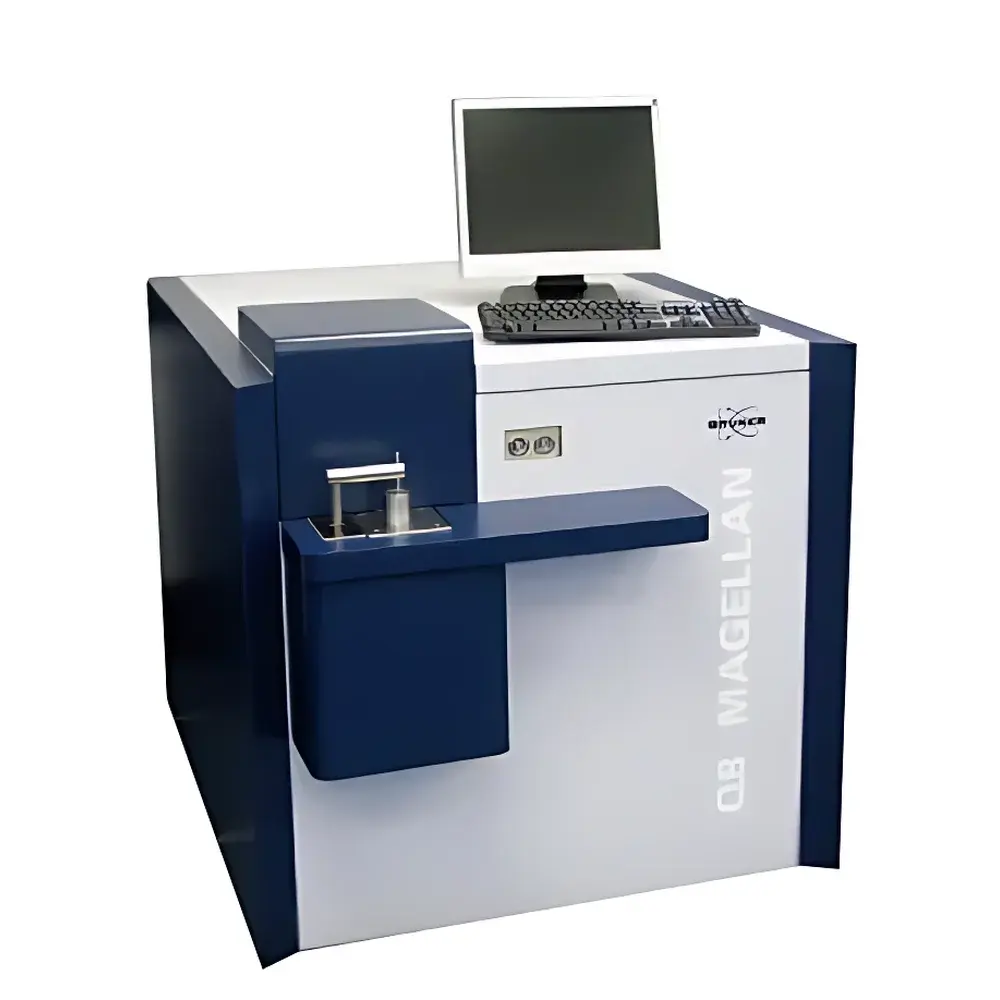
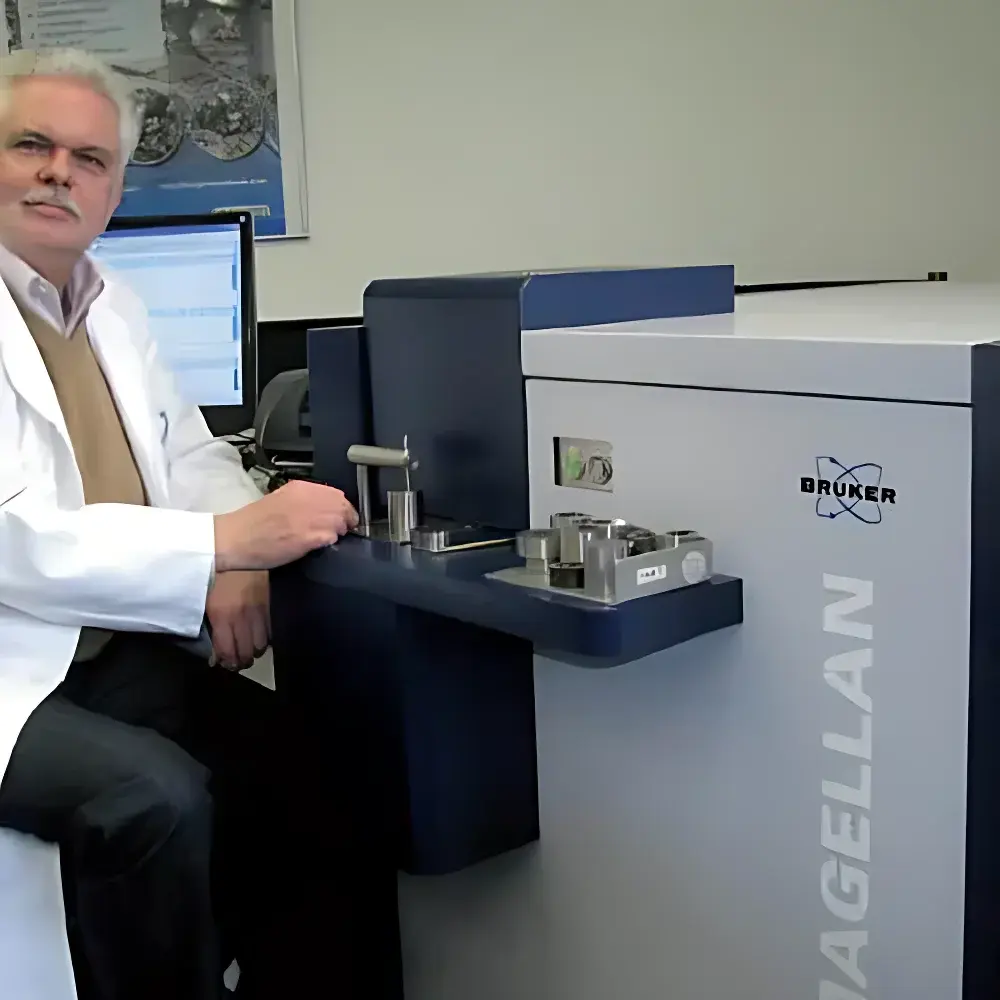
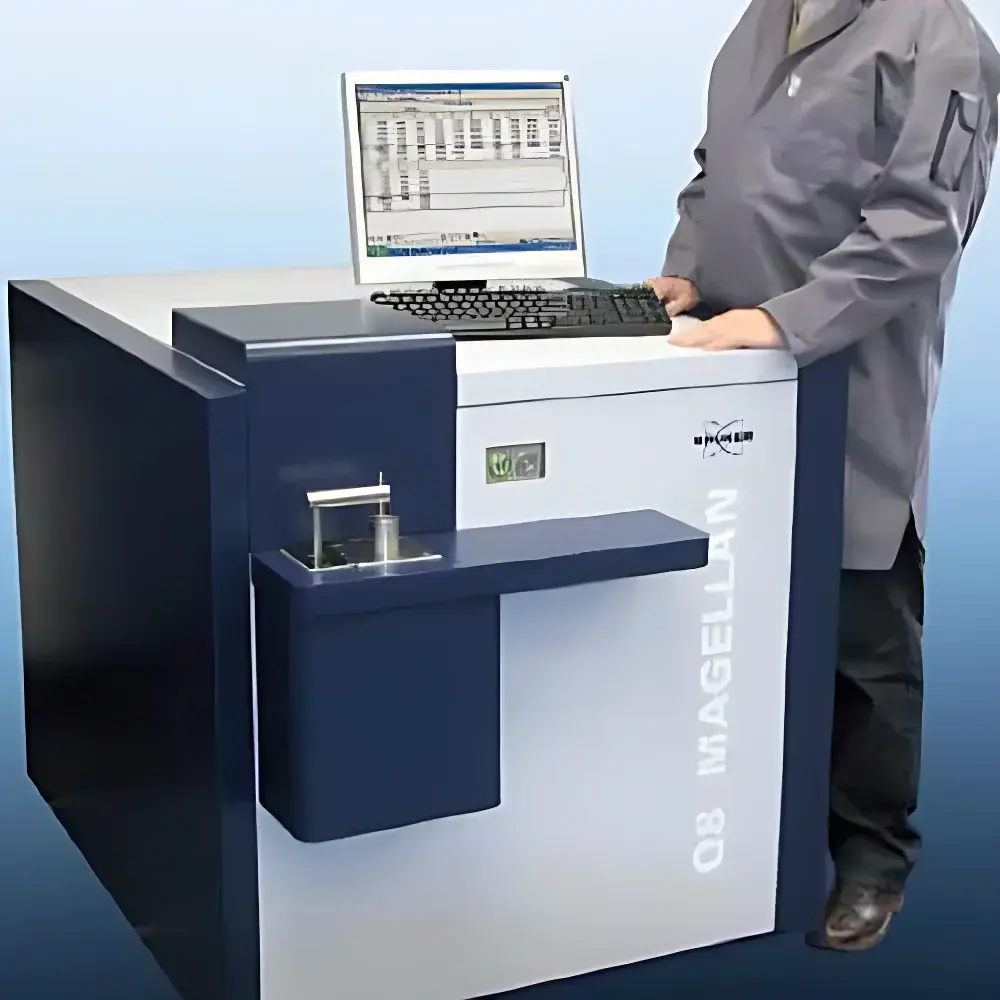
Brookfield Q8 MAGELLAN Direct-Reading Spark Optical Emission Spectrometer
| Brand | Bruker |
|---|---|
| Origin | Germany |
| Model | Q8 MAGELLAN |
| Instrument Type | Benchtop |
| Excitation Method | Spark |
| Detector Type | Photomultiplier Tube (PMT) |
| Focal Length | 1000 mm |
| Grating Groove Density | 3600 lines/mm |
| Wavelength Range | 110–800 nm |
| Number of Channels | 128 |
Overview
The Brookfield Q8 MAGELLAN is a high-performance benchtop direct-reading spark optical emission spectrometer (OES) engineered for precise, reproducible elemental analysis of metallic materials in demanding industrial and laboratory environments. Based on the fundamental principle of atomic emission spectroscopy, the instrument excites solid metal samples using a controlled high-energy spark discharge under inert argon atmosphere; emitted radiation is dispersed by a high-resolution Czerny–Turner optical system and resolved into characteristic spectral lines. Detection is performed via an array of photomultiplier tubes (PMTs), each dedicated to a pre-aligned analytical wavelength, enabling simultaneous multi-element quantification with high signal-to-noise ratio and exceptional long-term stability. The Q8 MAGELLAN integrates a vacuum-sealed, temperature-stabilized optical bench (1000 mm focal length), a solid-state digital spark generator operating at up to 1000 Hz pulse frequency, and time-resolved spectral acquisition across four independently configurable integration windows — a configuration that enhances matrix tolerance and suppresses interferences from spectral overlaps or transient plasma effects.
Key Features
- High-resolution optical system featuring a 1000 mm focal length vacuum spectrometer housing and 3600 lines/mm holographic grating, delivering spectral dispersion of 0.2 nm/mm in second-order diffraction
- Dedicated PMT detection architecture with 128 fixed channels, optimized for low dark current and superior signal-to-noise performance across the full 110–800 nm range
- Digital solid-state spark source with real-time current/voltage feedback control, ensuring consistent energy delivery and minimal electrode wear
- Time-resolved spark analysis (TRSA): acquisition of up to 1000 individual spark pulses per channel, distributed across four user-defined temporal windows to isolate early plasma continuum, peak line intensity, and late-decay background
- Robust, maintenance-free spark stand with coaxial argon flow design and integrated sample clamping mechanism for rapid, repeatable positioning of irregular or large-format specimens
- Active thermal stabilization of optical components and vacuum environment maintained by a turbomolecular pumping system — eliminating oil vapor contamination and ensuring long-term calibration integrity
Sample Compatibility & Compliance
The Q8 MAGELLAN supports analysis of conductive solid metals including ferrous alloys (carbon steels, stainless steels, cast irons), non-ferrous systems (Al, Cu, Mg, Ni, Co, Ti, Sn, Pb-based alloys), and specialty superalloys used in aerospace, energy, and automotive manufacturing. Sample forms include castings, forgings, rolled plates, machined parts, and scrap fragments conforming to ISO 11577, ASTM E415, ASTM E1086, and EN 10315 standards. The system complies with IEC 61000-6-3 (EMC) and IEC 61010-1 (safety); software operation supports audit trails, electronic signatures, and data integrity protocols aligned with FDA 21 CFR Part 11 and GLP/GMP requirements when configured with optional validation packages.
Software & Data Management
Controlled via Bruker’s proprietary SparkAnalyzer Pro software, the Q8 MAGELLAN provides intuitive workflow management from spark parameter setup and calibration curve generation to routine analysis, statistical process control (SPC), and report export. Calibration models support both univariate and multivariate regression (PLS), with built-in drift correction algorithms based on internal reference lines. All raw spectral data, spark pulse histories, and metadata are stored in a secure, timestamped relational database compliant with ISO/IEC 17025 documentation requirements. Export formats include CSV, XML, PDF, and LIMS-compatible ASTM E1382-compliant files. Remote diagnostics, firmware updates, and method synchronization across multiple instruments are supported through secure HTTPS-based network architecture.
Applications
The Q8 MAGELLAN is deployed for compositional verification and grade identification in incoming material inspection, melt shop process control, heat treatment validation, finished part certification, and scrap sorting. Its robustness enables continuous operation in foundry floor environments, while its analytical precision meets the stringent demands of aerospace-grade titanium alloy certification (e.g., ASTM B348 Grade 5), nuclear-grade stainless steel verification (ASTM A240), and high-purity aluminum conductor analysis (ASTM B209). It is routinely used in third-party testing laboratories accredited to ISO/IEC 17025, university metallurgy departments conducting phase diagram research, and R&D centers developing new alloy systems requiring trace element quantification down to sub-ppm levels.
FAQ
What vacuum level does the optical system maintain, and how is it sustained?
The spectrometer operates under high vacuum (≤1 × 10⁻⁵ mbar) maintained continuously by a dry turbomolecular pump; no oil-based roughing pumps are used, preventing hydrocarbon contamination of optical surfaces.
Can the Q8 MAGELLAN analyze coated or surface-treated samples?
Yes — with appropriate spark parameter optimization and use of pre-spark cleaning routines, it can perform depth-profiling analysis of galvanized, aluminized, or nitrided layers when combined with certified reference materials with known coating thicknesses.
Is method transfer possible between different Q8 MAGELLAN units?
Yes — calibration models, spark parameters, and spectral libraries are fully portable via encrypted USB export/import; cross-instrument reproducibility is validated per ASTM E3061 using CRMs with certified homogeneity.
Does the system support automated sample changers?
Optional motorized XYZ sample stages and robotic autosamplers (up to 120 positions) are available and fully integrated into SparkAnalyzer Pro for unattended batch analysis.
How frequently is recalibration required under routine operation?
Typical recalibration intervals exceed 2000 sparks per channel under stable environmental conditions; drift monitoring is performed automatically using internal standard lines, triggering alerts only when deviation exceeds user-defined thresholds (e.g., ±0.5% relative intensity).




