
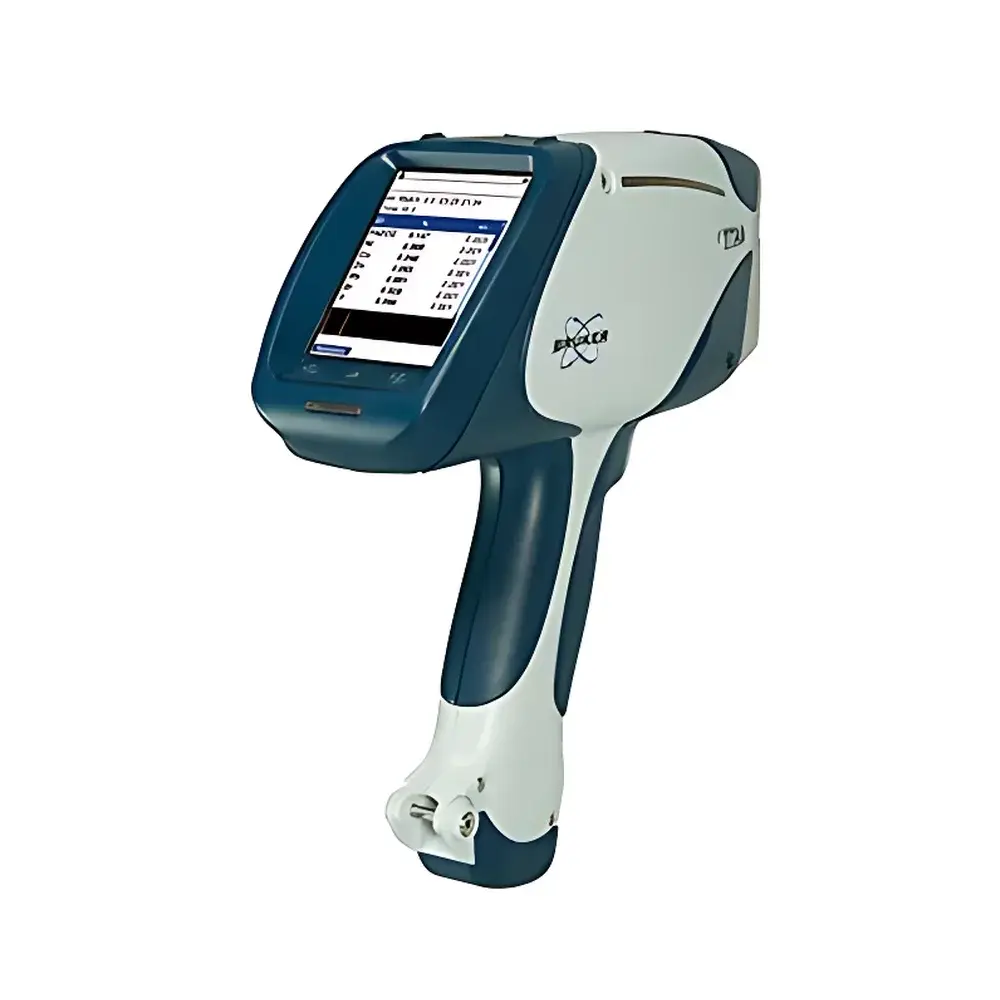
Bruker s1 TITAN Handheld Energy Dispersive X-Ray Fluorescence Spectrometer
| Brand | Bruker |
|---|---|
| Origin | Germany |
| Manufacturer Type | Authorized Distributor |
| Import Status | Imported |
| Model | s1 TITAN |
| Application | Handheld / Portable |
| Industry Use | General-Purpose |
| Elemental Range | Mg to U |
| Quantification Range | 1 ppm – 99.99% |
| Energy Resolution | <140 eV (Mn Kα) |
| Repeatability | ≤0.1% RSD |
| Detector | Silicon Drift Detector (SDD) |
Overview
The Bruker s1 TITAN is a handheld energy dispersive X-ray fluorescence (EDXRF) spectrometer engineered for rapid, non-destructive elemental analysis of lubricating oils, hydraulic fluids, and other petroleum-based matrices in situ. Operating on the fundamental principle of X-ray fluorescence—where primary X-rays excite atoms in the sample, causing emission of characteristic secondary X-rays—the instrument delivers quantitative and semi-quantitative data on elemental composition without sample digestion or laboratory preparation. Its compact, ergonomic design integrates a high-power microfocus X-ray tube and a large-area silicon drift detector (SDD), enabling high-count-rate performance and superior spectral resolution (<140 eV at Mn Kα). Designed for field-deployable operation, the s1 TITAN meets ISO 8502-12, ASTM D6595, and ASTM D7751 requirements for on-site oil condition monitoring and wear debris analysis, supporting predictive maintenance strategies across industrial, marine, and power generation sectors.
Key Features
- Real-time, non-contact elemental analysis of oils and filter media—no solvent extraction or acid digestion required
- Optimized excitation geometry and proprietary vacuum/purge-capable sample chamber for enhanced light-element sensitivity (Mg–P)
- Ruggedized IP54-rated housing with integrated shock-absorbing bumper and MIL-STD-810G compliance for field durability
- Onboard calibration libraries pre-configured for oil matrix correction, including viscosity and density compensation algorithms
- Integrated GPS, camera, and barcode scanner for full traceability of sampling location, time, and operator identity
- Battery-powered operation (>8 hours continuous use) with hot-swappable Li-ion battery system
Sample Compatibility & Compliance
The s1 TITAN accommodates direct analysis of bulk oils (in sealed vials or drip samples), used filter patches, and swab-collected residues. It supports ASTM D6595 (standard test method for determination of wear metals in used lubricating oils by rotating disc electrode atomic emission spectrometry) as a field-complementary technique and aligns with ISO 21325 (petroleum products — determination of sulfur content in middle distillates — wavelength dispersive X-ray fluorescence spectrometry) for sulfur quantification. All measurement protocols comply with GLP principles; audit trails, electronic signatures, and user-access controls satisfy FDA 21 CFR Part 11 requirements when deployed in regulated environments. Data output conforms to ASTM E1357 and ISO/IEC 17025 documentation standards.
Software & Data Management
Powered by Bruker’s proprietary S1 PXRF software, the instrument features intuitive touch-screen workflow navigation, customizable reporting templates (PDF/CSV/XLSX), and automated QA/QC flagging based on internal standard recovery and peak-to-background ratios. Spectral deconvolution employs fundamental parameter (FP) and empirical calibration models, with optional matrix-matched standardization using NIST-traceable oil reference materials (e.g., NIST SRM 2720a). Cloud-enabled synchronization via Bruker Connect allows secure, role-based data sharing across enterprise networks and integration with CMMS (Computerized Maintenance Management Systems) such as IBM Maximo or SAP PM. Full audit trail logging includes timestamped spectra, detector temperature, tube current/voltage, and user login metadata.
Applications
- Wear metal monitoring (Fe, Cu, Al, Cr, Pb, Sn) to assess mechanical component degradation in turbines, gearboxes, and engines
- Sulfur content verification in diesel, jet fuel, and marine bunker fuels per IMO 2020 and EPA Tier 3 specifications
- Additive element profiling (Ca, Zn, P, Mg, Ba) to verify formulation integrity and detect depletion or contamination
- Contaminant identification (Na, Si, B, Cl) indicating coolant ingress, dust ingestion, or cross-fluid mixing
- Filter patch analysis for particle morphology correlation and root-cause failure investigation
- Field validation of lab results from ICP-OES/ICP-MS, reducing turnaround time and analytical cost per sample
FAQ
Can the s1 TITAN quantify sulfur in ultra-low-sulfur diesel (ULSD) to 10 ppm accuracy?
Yes—when operated under helium purge mode and calibrated with certified ULSD reference standards, it achieves typical precision of ±2 ppm at 10 ppm level (k=2, n=6).
Is spectral interference correction applied for overlapping lines (e.g., V Kβ and Ti Kα)?
Yes—advanced peak deconvolution uses iterative least-squares fitting with physical detector response modeling and inter-element correction matrices.
Does the instrument support regulatory reporting for ISO 55000 asset management frameworks?
Yes—its built-in data governance tools, electronic signature capability, and configurable report templates meet ISO 55001 evidence requirements for condition-based maintenance records.
What is the minimum droplet volume required for reliable analysis?
A stable 0.5 mL sample in a low-background polypropylene vial yields reproducible results; smaller volumes may be analyzed using capillary film holders with appropriate normalization.
How often does the instrument require factory recalibration?
Annual verification against Bruker-certified check standards is recommended; daily field checks using built-in Cu/Ni/Fe reference foil are mandatory per ISO/IEC 17025 clause 7.7.
Related Products



